Fashion on Television · Screen Style Topics
Succession: Quiet Luxury, Tailored to Intimidate
A drama about the richest family on television dressed its cast in clothes that refuse to announce themselves: unbranded caps, logo-free knitwear, suits whose cost is legible only in the cut. Within a few seasons, that refusal had a name — quiet luxury — a search spike of 1,230 percent, and resale numbers most fashion campaigns would envy. This guide tells the design story behind Succession's wardrobe: how Michelle Matland built a complete semiotics of stealth wealth across four seasons, garment by garment, and how the audience learned to read it.
At a Glance
- Series
- Succession (HBO, 2018–2023), created by Jesse Armstrong
- Setting
- The boardrooms, jets and estates of the Roy family, owners of the Waystar Royco media empire — New York and wherever power travels
- Costume designers
- Michelle Matland (all four seasons)
- Signature look
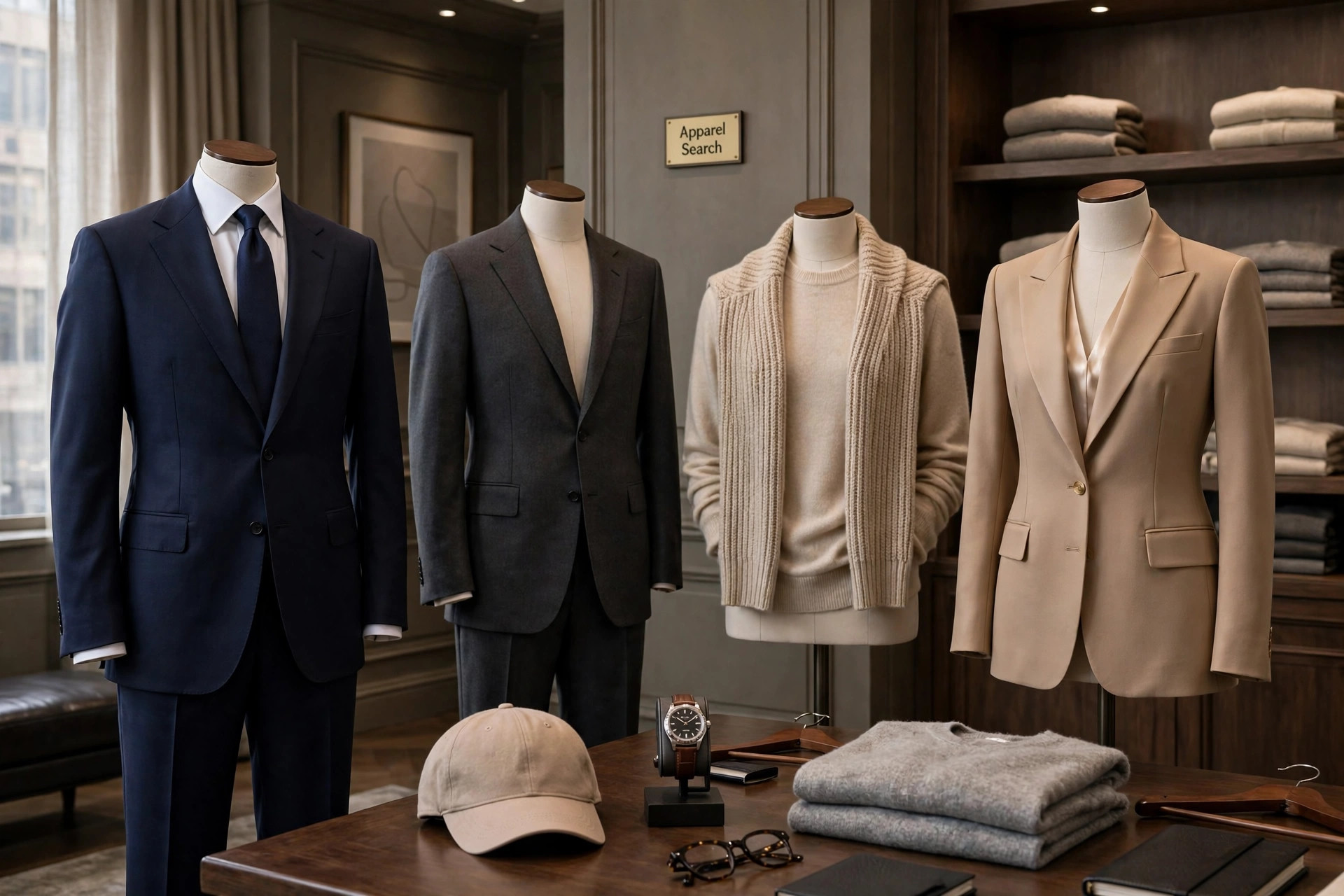
- Stealth wealth: flawless tailoring, cashmere and fine wool in navy, grey and camel, and almost no visible logos — wealth that whispers
- The fashion effect
- "Quiet luxury" searches up 1,230 percent in April 2023 with the show as named driver; eBay recorded Loro Piana sales up about 50 percent after the season four debut
The Design Brief
Dressing Money That Never Has to Mention Itself
Every costume brief contains a theory of its characters, and Michelle Matland's theory of the Roys was an inversion of television habit. Rich characters are usually dressed to be read instantly — labels forward, jewellery lit, expense made visible for the back row. The Roys, Matland understood, belong to the stratum for whom that visibility is vulgar. Their money is not new, not insecure and not for sale, so their clothes perform the opposite trick: maximum quality, minimum signal. A suit is perfect and says nothing. A knit is cashmere and could be anything. The wardrobe's drama is in what it withholds.
That withholding is a craft discipline, not an absence of one. Dressing down wealth convincingly means the fit must be flawless, the fabrics genuinely fine, the palette controlled to a narrow register of navy, charcoal, camel and cream — because the audience for this show includes people who can tell. Matland dressed the family from the real vocabulary of stealth wealth: Italian tailoring and knitwear houses whose names are known to their wearers and invisible on the garments themselves. The result reads, to most viewers, as simply "expensive-looking" — and to the initiated, as a precise map of rank.
The system also had to carry the show's central cruelty: nobody in this family is safe. Costume tracks the power balance episode by episode — who is dressed for the room they want, who for the room they have lost, whose tailoring is armor and whose has begun to slip. Across four seasons Matland kept one hand on that dial, and the fashion world, watching a masterclass in the aesthetic it would soon name quiet luxury, took notes. First, the wardrobe itself.
The Wardrobe
The Stealth-Wealth Wardrobe, Piece by Piece
The suit. The foundation garment is the tailored suit — Logan's dark, patriarchal armour; the sons' variations on it as they circle the throne. Nothing about these suits shouts: no fashion cuts, no novelty, no branding. Their statement is proportion and cloth, the boardroom equivalent of a level voice. When a Roy is winning, the tailoring is exact; the rare moments of sartorial overreach — a too-fashionable sneaker, a try-hard accessory — are the wardrobe marking a character as reaching beyond his rank.
The baseball cap. The show's most famous single item is a plain baseball cap in fine cashmere, worn by Logan and Kendall, with every trace of branding removed. It became a cultural shorthand on sight: an object that looks like the cheapest thing in the room and is among the most expensive, detectable only by those who already know. If quiet luxury needed a logo, it chose an anti-logo — the cap is the movement's perfect emblem precisely because it refuses to be one.
Knitwear and the soft layer. Between the suits, the Roys live in cashmere crewnecks, fine-gauge knits, unstructured jackets and plain shirts in the family's muted palette. This soft layer does the weekend-and-estate work of the series: wealth at leisure, still refusing display. It is also the layer the audience could actually buy into, which is one reason the show's fashion effect, detailed below, concentrated in exactly these categories.
Shiv's tailoring. Siobhan Roy's wardrobe is the show's essay on a woman dressing inside a male dynasty: high-waisted tailored trousers, turtlenecks, sharp blazers and, as her power bids sharpen, increasingly structured silhouettes. Her clothes negotiate the family's code rather than rebelling against it — the same quiet palette, cut to claim space in rooms designed to exclude her. Her Cartier Panthère watch, noted in the fashion-effect numbers below, is the exception that proves the rule: one precise, recognisable luxury object, worn like punctuation.
The outsiders' tells. Matland's system needs its contrasts, and it gets them at the family's edges: Tom's slightly too-eager polish, Greg's ill-fitting arrival in the world of tailoring, the occasional guest whose visible logos or fashion-forward choices mark them, instantly, as not from this altitude. The show's single most quoted costume judgment — a guest's conspicuously capacious designer handbag dismissed as "ludicrously capacious" — lands because the wardrobe has spent seasons teaching the audience the code it violates.
Character in Clothes
A Family Dressed in Rank Order
Succession's costume design does its storytelling as hierarchy. Read any boardroom scene by its clothes and you can reconstruct the week's power table: the patriarch in the darkest tailoring, the heir of the moment dressed closest to him, the exiled in softer, sadder registers, the climbers betrayed by a half-degree of visible effort.
In the Roy wardrobe, effort is the only true fashion crime — the clothes must look like they cost nothing at all, least of all thought.
Logan dresses as institution: dark suits, plain shirts, the cap as crown. His wardrobe never changes because, in his own account, neither does his position. Kendall is the wardrobe's tragic barometer — immaculate when ascendant, his style periodically destabilised by streetwear inflections and statement sneakers that read, inside the family code, as a man performing a self he has not secured. Roman dresses down the hierarchy on purpose: slimmer, looser, less armored, the silhouette of a son who wants to look unbothered by the contest he is losing. Shiv, as above, tailors her way toward the chair. And Tom and Greg, the in-marrying climbers, wear the show's most instructive clothes — correct in every detail and somehow still visibly trying, which in this world is the one unforgivable tell.
The discipline is that none of this is ever announced. There are no makeover scenes, no shopping montages, no character remarking on an outfit unless it fails. The wardrobe simply behaves like real wealth behaves, and trusts the audience to learn — which, season by season, it demonstrably did.
The Deep Read
Why Quiet Is the Hardest Thing to Dress
It is worth pausing on the difficulty of what Matland's department achieved, because understatement is the most expensive effect in costume design. A ballgown announces its own budget; a perfect plain suit hides its budget in fit, cloth and restraint, and any error — a cheap-looking fabric, a fashion-cut lapel, a visible label — collapses the illusion for exactly the viewers the show most needed to convince. The Roys' world also spans boardrooms, private jets, yachts, weddings, funerals and a hunting lodge, each with its own unwritten dress code that the wardrobe had to observe as faithfully as the family itself would.
The consistency across four seasons is the other half of the achievement. One designer, one family, one code, held without drift while the characters' fortunes swung wildly inside it. The palette never wandered into fashion; the logos never crept in; the cap stayed plain. That steadiness is what allowed the audience's literacy to compound — by the final season, viewers were reading half-second shots of knitwear the way earlier audiences read ballgowns, and posting their readings to an audience of millions. The costume department had, in effect, taught a mass audience a new fashion language, fluently enough that the fashion industry could adopt the phrase for it: quiet luxury was a retail category waiting for a name, and a costume designer supplied the curriculum.
The Fashion Effect
Quiet Luxury: A Trend With Receipts
Television fashion effects are usually asserted. Succession's was measured, and the measurements describe a trend the show did not so much follow as focus. In April 2023, as the fourth and final season aired, British Vogue — citing the fashion-data account Data But Make It Fashion — reported that searches for "quiet luxury" had spiked 1,230 percent, with Succession as the named driver. A costume aesthetic with no logos to search for had become the most searched idea in fashion: the paradox is the point, and it belongs to Matland's department.
The retail receipts followed on eBay, in data reported from the platform: after the season four debut, sales of Loro Piana — the Italian house whose unbranded knitwear and caps define the real stealth-wealth wardrobe — surged about 50 percent globally, month-on-month. Kendall's Gucci Run sneakers rose 40 percent, and Shiv's Cartier Panthère watches 30 percent. Note what the audience bought: not costumes, not replicas, but the genuine articles at genuine prices — the show had not merchandised a look so much as certified a taste.
The mechanism matters, and our Fashion on Television overview names it: literacy and longing. A film costume gets two hours; the Roys' wardrobe got four seasons to teach its code, in rooms the audience was invited to covet and condemn at once. Quiet luxury was the proof that a television wardrobe could move the top of the fashion market — the hardest, richest, most logo-averse end of it — as surely as a high-school drama moves the high street.
The Legacy
What Succession Changed
Succession ended in 2023, but its wardrobe's afterlife is still running. Quiet luxury outlived the series as a durable retail and editorial category — the default language of a certain kind of wealth dressing, taught to the mainstream by a costume department. Every subsequent drama about money now works in its shadow: dress the rich too loudly and the audience, trained by Matland, reads it as a mistake rather than a choice.
The craft legacy is equally specific. Succession demonstrated that costume design could carry theme at the highest level of prestige television without a single period gown or fantasy build — that restraint, fit and fabric could be a series' signature as surely as spectacle. Michelle Matland's four seasons stand as the contemporary-set counterpart to the great period wardrobes elsewhere in our Fashion on Television series: proof that the most eloquent thing a costume can do, in the right story, is refuse to speak above a whisper — and be heard everywhere.
Common Questions
Questions & Answers
Who designed Succession's costumes?
Michelle Matland designed all four seasons of Succession (2018–2023). Her brief was the wardrobe of a media dynasty whose wealth is old enough to be quiet: impeccable tailoring, the finest natural fibres and almost no visible logos, so that the clothes signal power only to viewers who know how to read them.
Why is there a plain baseball cap in a billionaire's wardrobe?
The unbranded cashmere baseball cap worn by Logan Roy and Kendall became the show's most discussed single garment precisely because it looks like nothing: a luxury object with the branding removed, priced far beyond an ordinary cap yet indistinguishable from one at a glance. It is quiet luxury reduced to one item — status that only the initiated can detect.
Did Succession really move fashion sales?
Yes, and the effect was measured. British Vogue, citing Data But Make It Fashion, put the April 2023 spike in 'quiet luxury' searches at 1,230 percent with the show as the named driver, and eBay reported that after the season four debut, Loro Piana sales surged about 50 percent globally month-on-month, with Kendall's Gucci Run sneakers up 40 percent and Shiv's Cartier Panthère watches up 30 percent.
In This Series
The Fashion on Television hub this guide belongs to, the parent film section, and two companion guides — television's great mid-century wardrobe, and resort dressing with a body count.
Search Apparel Search