Fashion on Television · Screen Style Topics
The White Lotus: Resort Dressing as Social Satire
Every season, a new set of rich guests checks into a beautiful resort and lets its wardrobe confess for it. This guide follows the one constant across Hawaii, Sicily and Thailand: costume designer Alex Bovaird — Emmy-nominated for the first two seasons — and the resort dressing she built, from kaftans and prints to the tote that surged 800 percent in searches, the licensed capsule collections, and the on-set showroom that around 100 brands sent clothes to join.
At a Glance
- Series
- The White Lotus (HBO, 2021– ), created by Mike White
- Setting
- A luxury resort per season — Hawaii (season 1), Sicily (season 2), Thailand (season 3)
- Costume designers
- Alex Bovaird (all three seasons; Emmy nominations for seasons 1–2)
- Signature look
- Luxury resort dressing as status language — printed kaftans, tropical and Mediterranean prints, linen, and the recognisable designer tote
- The fashion effect
- Licensed capsule collections from H&M and Banana Republic in season 3; Goyard tote searches up 800%+; around 100 brands sent pieces to the on-set showroom
The Design Story
One Designer, Three Resorts: Alex Bovaird's Brief
The White Lotus is an anthology with a wardrobe problem built into its premise: every season, a new cast of wealthy guests arrives at a new luxury resort — Hawaii in season one, Sicily in season two, Thailand in season three — and nearly everything the audience learns about them must be read from what they wear, because people this rich rarely say what they mean. Across all three seasons, one costume designer has carried that brief: Alex Bovaird, whose work on the first two seasons brought her two Emmy nominations and whose third season extended the show's fashion life further off screen than any wardrobe in recent television. Continuity of designer is the series' hidden structure. The guests change, the continent changes; the eye reading wealth through clothes does not.
Bovaird's task differs from most prestige television. Her characters are not dressing for work, war or history — they are dressing for leisure, which is where rich people perform hardest. A resort wardrobe is a pure status language: swimwear, kaftans, linen, evening dresses for dinners nobody enjoys, and luggage-grade accessories that announce their price across a pool deck. Bovaird speaks that language fluently enough to satirise it from inside. Her guests look genuinely enviable and faintly ridiculous at the same time, often in the same outfit, and that doubleness is the show's whole thesis worn on the body.
The setting discipline is the other half of the design. Each season's wardrobe is rebuilt from its place: the tropical colour and floral ease of Hawaii; the Mediterranean sophistication of Sicily, where the prints took their cue from the island itself; the craft textures and jungle tones of Thailand. A guest's clothes must look chosen for that resort — packed, not costumed — while still telling the audience, within one scene, who has taste, who has only money, and who is coming apart. That Bovaird sustained the trick across three wardrobes with almost no repeated cast is why her name, alone among the show's departments, anchors every season.
The Wardrobe
The Resort Wardrobe, Piece by Piece
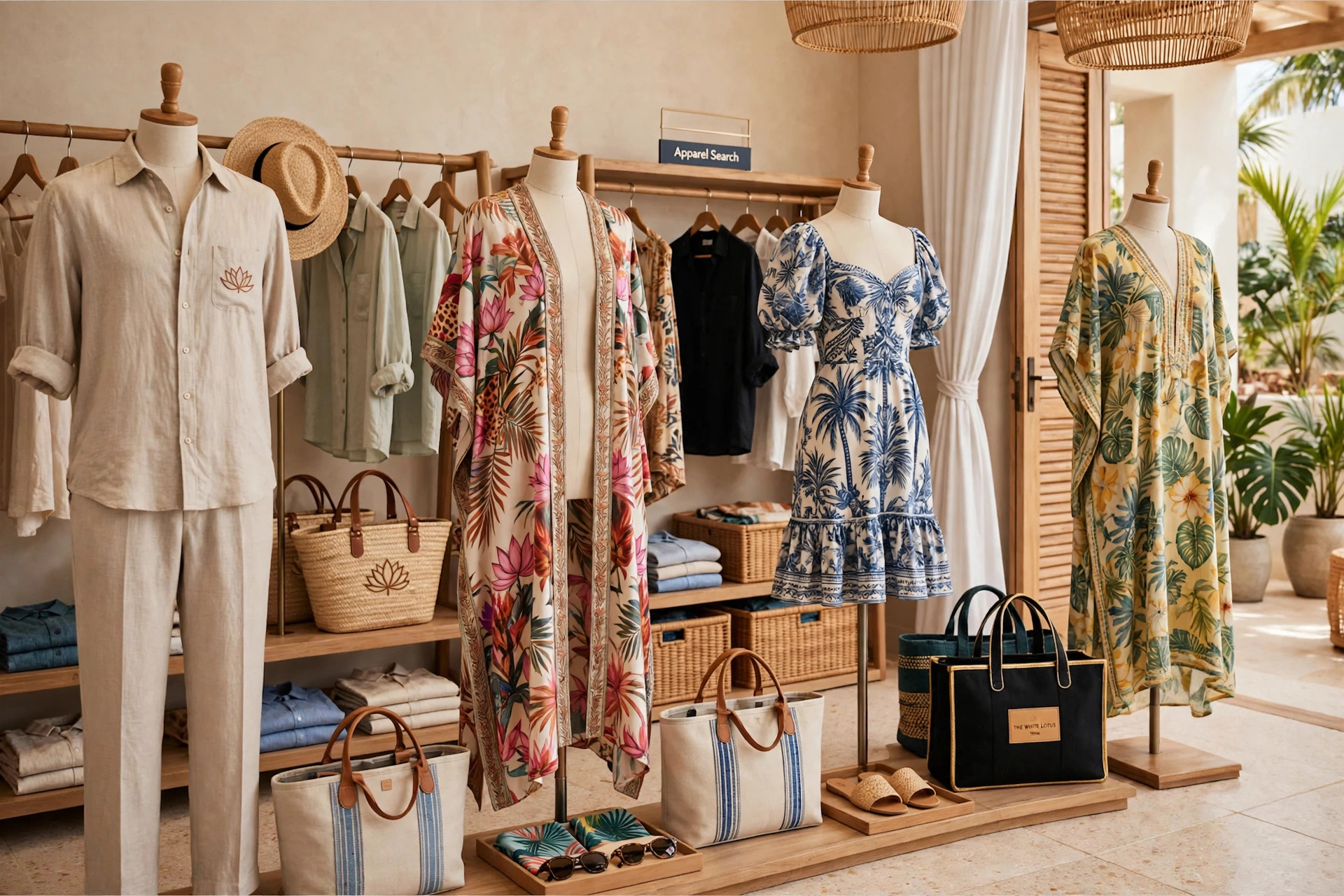
The kaftan. The series' emblematic garment: long, loose, printed, expensive-looking ease. The kaftan is what wealth wears when it is officially doing nothing, and The White Lotus made it the uniform of a certain kind of resort matriarch — glamour as camouflage for chaos. When the show's fashion effect produced licensed collections, the kaftan led them; of every piece Bovaird put on screen, it was the one viewers most wanted to pack.
Prints as personality. Tropical florals in Hawaii, Mediterranean prints in Sicily, motifs drawn from Thailand in season three: Bovaird uses print the way other designers use tailoring, as the character signal. The loud print on the insecure guest, the tasteful one on the dangerous one, the clashing set on the family that cannot agree about anything — the pool deck becomes a chart of alliances readable from the balcony, before a single line of the episode's dialogue.
The tote and the accessories. Resort dressing runs on accessories — sunglasses, sandals, jewellery worn to the beach, and above all the bag. The show understands that a recognisable luxury tote, carried to breakfast, is a complete character statement, and the audience proved it with their searches: as the effect section records, eBay searches for one guest's Goyard Saint Louis tote surged more than 800 percent in a single year-on-year comparison. No garment in the series was measured more precisely than a handbag.
Men's resort wear. The husbands and sons get the satire's sharpest tailoring: linen shirts, resort shirts with prints a size too confident, swim shorts as social armour. Bovaird dresses the men as men who dressed for the holiday they wanted to be seen on — a subtle but devastating distinction — and the gap between their self-image and their situation widens, in clothes, all week.
Staff and setting. Against the guests' performed leisure, the resort itself is dressed with place-specific discipline: each season's world has its own palette, drawn from its landscape and crafts, so the guests' imported wardrobes clash against it exactly as their behaviour does. The design lesson is structural: satire needs a norm, and Bovaird builds the norm out of the location, then lets the guests violate it in designer prints.
Character in Clothes
Wealth, Read at the Pool Deck
Every White Lotus season is a mystery with two questions — who will die, and what is wrong with these people — and the wardrobe answers the second one continuously. Bovaird's guests arrive dressed as the people they believe themselves to be, and the week undresses those beliefs: the prints get louder as the control slips, the perfect resort polish wilts in the heat, the couple that matched on arrival stops matching. It is character development conducted entirely in clothing changes, in a genre — the luxury-holiday satire — that barely existed on television before this series defined it.
A resort wardrobe is a pure status language — and Bovaird speaks it fluently enough to satirise it from inside.
The design's sophistication is that it never tips into caricature. These are, by the standards of real luxury retail, plausible clothes — the same labels and silhouettes the show's own audience buys, which is precisely why the satire stings and why the fashion industry, rather than taking offence, queued up to participate. A lesser wardrobe would have mocked the rich from outside, in costumes. Bovaird indicts them from inside their own closets, and the closets turned out to be the most effective fashion platform of the decade.
That inside position explains the Emmy recognition for the first two seasons and the industry's behaviour in the third. When a costume designer is trusted by the very brands her work satirises — trusted to hold their pieces, to place them, to understand why a guest would carry that tote to that breakfast — the line between costume design and fashion styling dissolves. The White Lotus is where that dissolution completed, and the next section documents what it produced.
The Showroom
One Hundred Brands Sent Clothes
By the third season, the relationship between this wardrobe and the fashion industry had inverted. TheWrap's reporting on the Thailand season records the scale of it: around 100 brands sent pieces to Bovaird's on-set showroom, hoping for placement in her guests' wardrobes, and the house of Jacquemus sought her out to collaborate. Read that again: not the production begging labels for loans — the arrangement Patricia Field pioneered a generation earlier — but labels petitioning the production, and a major designer house approaching the costume designer. The resort had become a runway that brands competed to dress.
A showroom of that size changes the designer's job. Bovaird in Thailand was part costume designer, part editor-in-chief of a floating fashion closet, curating hundreds of offered pieces into wardrobes that still had to serve character and satire rather than the brands' hopes. That the season's clothes remained character-true under that commercial weather is the professional achievement inside the headline number — and it set a new template for how prestige productions and fashion houses now negotiate, with the costume department holding the stronger hand.
The Fashion Effect
From Pool Deck to Capsule Collection
The White Lotus effect operates at three documented levels. The first is search behaviour: eBay data recorded searches for Rachel's Goyard Saint Louis tote surging more than 800 percent (September 2023 against September 2022) — a season-one accessory still compounding two years later — while searches for Loewe rose by triple digits. The audience was not just watching the wardrobe; it was pricing it, piece by piece, on the resale market.
The second level is licensed product. Season three extended off screen into licensed capsule collections from H&M and Banana Republic — high-street and premium chains selling the resort wardrobe, with Bovaird herself collaborating on the H&M collection, whose 25 pieces translated her characters' looks, kaftans first, for the audience's own holidays. Costume-to-retail pipelines existed before, but they usually followed a series' success at a distance; here the designer of the satire co-designed the merchandise of it, while the season aired.
The third level is the industry's own verdict: the roughly 100 brands in the showroom queue and Jacquemus seeking collaboration, both documented in TheWrap's season-three reporting. Put the levels together and the pattern in our Fashion on Television overview completes itself: Field's era made designers lend to television; Bovaird's era made television the placement designers compete for. The fashion effect is no longer a side effect of this series. It is one of its production departments, measured in search percentages, capsule collections and a showroom brands fly clothes to Thailand to join.
Legacy
What The White Lotus Changed
The series' first legacy is a genre: the luxury-resort wardrobe as a television language. Before The White Lotus, holiday clothes were what characters wore between plots; Bovaird made them the plot's evidence — wealth, taste, delusion and decline, all readable at the pool deck. Every glossy ensemble drama since has had to decide what its characters' leisure clothes say, because this series proved the audience reads them, searches them and buys them.
Its second legacy is commercial, and it is structural. The documented facts — capsule collections from H&M and Banana Republic built with the costume designer's participation, around 100 brands supplying an on-set showroom, a designer house seeking the collaboration, an 800-percent search surge for a single tote — describe a new equilibrium between fashion and television. The costume department is no longer a supplicant for loans; it is a gatekeeper of the most valuable placement in fashion media, an audience watching clothes for hours, in character, in paradise.
And its third legacy is the designer herself as the constant. Anthology television resets everything — cast, country, story — and The White Lotus kept one authorial hand in the wardrobe across Hawaii, Sicily and Thailand, collecting Emmy nominations for the first two seasons and the industry's pilgrimage in the third. In the longer history gathered in our Fashion on Television hub, that is the pattern of every era-defining television wardrobe: a single designer, trusted for years, until the clothes become the show's signature. Bovaird's resort satire is this decade's entry in that line — and the kaftans in a million holiday suitcases are its evidence.
Common Questions
Questions & Answers
Who designed The White Lotus's costumes?
Alex Bovaird has designed the costumes for all three seasons of The White Lotus — Hawaii, Sicily and Thailand. She received Emmy nominations for her work on the first two seasons, and remained the series' designer for the third season in Thailand, where around 100 brands sent pieces to her on-set showroom.
What is the signature White Lotus wardrobe piece?
The printed kaftan — long, loose, luxurious ease — is the emblematic garment, leading the licensed collections the show inspired. The most measured piece, though, is an accessory: eBay data recorded searches for Rachel's Goyard Saint Louis tote surging more than 800 percent in September 2023 compared with September 2022, with Loewe searches up by triple digits.
How did The White Lotus change the fashion industry's relationship with TV?
By season three the relationship had inverted: instead of a production borrowing clothes, around 100 brands sent pieces to Alex Bovaird's on-set showroom hoping for placement, Jacquemus sought her out to collaborate, and the season extended into licensed capsule collections from H&M and Banana Republic, with Bovaird collaborating on the H&M collection. The costume department had become a gatekeeper brands compete to reach.
In This Series
The Fashion on Television hub this guide belongs to, the parent film section, and two sister guides — the other great wealth-in-clothes satire of the era and the maximalist Paris wardrobe.
Search Apparel Search