Fashion on Television · Screen Style Topics
Yellowstone: The Wardrobe That Put the Modern West Back to Work
Most television westerns are set in the past. Yellowstone dressed the present — a Montana ranching family in denim, boots and hats that had to work for a living — and turned that working wardrobe into one of the most commercially powerful looks on modern television. This guide tells its design story honestly: the founding season by Ruth E. Carter, the long stewardship of Johnetta Boone from Season 2 onward, Beth Dutton's power dressing, and a fashion effect that ran, deliberately, through licensing as much as through the street.
At a Glance
- Series
- Yellowstone (Paramount Network, 2018–2024), created by Taylor Sheridan and John Linson
- Setting
- Contemporary Montana — the Yellowstone Dutton Ranch and the country around it
- Costume designers
- Ruth E. Carter (season 1 only), Johnetta Boone (Season 2 onward)
- Signature look
- A working modern western wardrobe: denim, cowboy hats, boots and weathered outerwear, sharpened by Beth Dutton's power dressing
- The fashion effect
- License Global: the show “reinvigorated interest in everything from denim to cowboy hats”; Boone co-launched an exclusive Ariat collection — an effect substantially licensing-driven through Paramount's consumer-products programme
The Design Brief
A Working West, Not a Costume-Party West
Yellowstone arrived on Paramount Network in 2018 as a contemporary drama, not a period piece, and that distinction shaped everything its costume designers did. The series, created by Taylor Sheridan and John Linson, follows the Dutton family and the conflicts around the Yellowstone Dutton Ranch in Montana — the ranch, the neighbouring Broken Rock Indian Reservation, Yellowstone National Park and the land developers pressing in from every side. The clothes therefore had to do a job that a nineteenth-century western wardrobe never has to do: they had to look completely at home in the present day, on people who work outdoors for a living, while still carrying the unmistakable silhouette of the American West. Denim, boots, hats and heavy outerwear are not decoration here. They are the uniform of a place and a profession, worn by characters who would notice — and judge — anyone dressed as if they were playing at being a cowboy.
That brief explains the wardrobe's restraint. The Yellowstone look is built from garments that already existed in real ranch life long before the cameras arrived: jeans that can take a day's work, shirts that can be layered against changing mountain weather, jackets that protect against wind and brush, and hats that shade eyes as much as they signal identity. The design achievement was not inventing a new western style from nothing. It was selecting, fitting, weathering and repeating the right real garments so consistently, season after season, that an audience could read a character's standing, loyalties and mood from across a corral — and could then go and buy a version of the same working wardrobe for themselves.
The designer credit itself tells the first part of that story, and it is a credit this guide states carefully because it is so often shortened. Ruth E. Carter designed the first season only. She joined the production in August 2017 and departed at the end of that first season. Johnetta Boone then joined for the second season and designed the series from Season 2 onward, through to its conclusion in 2024. Any account that credits Boone with the whole run, or Carter with more than its opening chapter, misstates the record. Carter established the world; Boone inhabited it, developed it and ultimately carried its look off the screen and into retail, as the fashion-effect section below describes.
That handover matters for more than accuracy. A long-running series lives or dies on visual continuity, and a change of designer after a single season is a genuine risk: the audience has already learned what these people wear. Boone's task was therefore double — preserve what Carter had established so the world did not visibly lurch, and deepen it as the family's story darkened, fortunes shifted and characters moved between the bunkhouse, the boardroom and the governor's world. The wardrobe's later strength — especially the sharpening contrast between ranch workwear and power dressing — is the evidence that the handover worked.
The Wardrobe
The Yellowstone Wardrobe, Piece by Piece
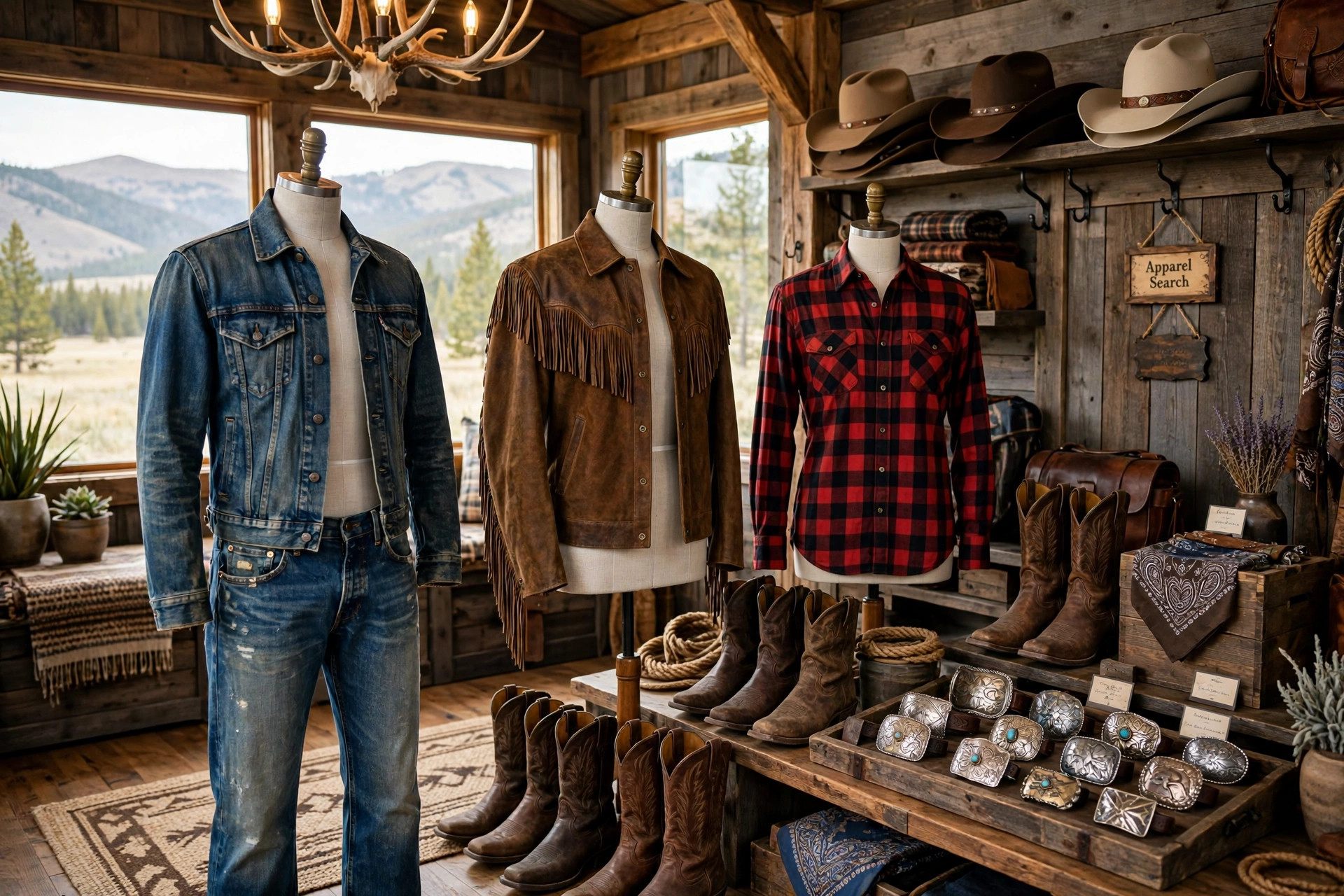
Denim first. Everything in this wardrobe stands on denim, and the trade coverage of the show's effect names it first for a reason. Jeans are the ranch's true foundation garment: practical, durable, democratic within the world of the show, and endlessly variable in wash, fit and wear. On screen, denim does quiet character work. Fresh, dark denim reads as intention and presentation; faded, repaired and dust-worn denim reads as labour. Because the audience sees these garments in close-up and in wide landscape shots alike, the difference between a pair worn for work and a pair worn for town has to be legible without a line of dialogue to explain it.
The cowboy hat. If denim is the foundation, the hat is the signature. License Global, reporting on the show's wider influence, summarised that Yellowstone "reinvigorated interest in everything from denim to cowboy hats" — pairing the most ordinary garment in the wardrobe with its most symbolic one. A cowboy hat on this series is never a prop added at the end of a fitting. Its shape, condition and colour belong to the character wearing it, and removing it changes the silhouette completely. That is why the hat became one of the easiest pieces of the look for viewers to adopt: it is a single, recognisable purchase that carries the whole world with it.
Boots, belts and buckles. Western boots complete the working silhouette from the ground up, and they matter to the retail story in particular because Boone's later Ariat collection — discussed below — covered boots as well as apparel. Belts and buckles operate at a smaller scale but with the same logic: functional objects, worn every day, that become personal insignia through repetition. In a wardrobe built on restraint, those small, repeated details are where individuality is allowed to live.
Outerwear for real weather. Montana in the series is not a postcard backdrop; it is a working environment with cold, wind and long distances in it. Heavy jackets, layered shirts and weatherproof coats therefore recur throughout the run, chosen to look as if they have kept their wearers warm through more than one season. Good contemporary costume design of this kind depends on ageing and breaking-in as much as on selection — a brand-new-looking work jacket would break the illusion faster than any anachronism could.
Shirts: work, town and ceremony. The plaid and work shirts of the bunkhouse, the cleaner shirts worn into town, and the sharper dressing reserved for formal or political occasions form a ladder the audience learns to climb with the characters. The same man does not dress identically to mend a fence and to face a hearing, and the wardrobe respects that difference every time. It is a realistic system, and its realism is precisely what made it exportable: viewers were not being sold a fantasy costume, they were being shown a coherent way of dressing that already existed and that they could enter piece by piece.
Character in Clothes
Power Dressing, Dutton Style
The clearest proof that this wardrobe thinks in character, not just in genre, is Beth Dutton. Boone herself has described how Beth's look developed across the seasons she designed: from Seasons 2 to 3, Beth wore a man's shirt and a pencil skirt, which Boone identified as her version of power dressing. As the family's circumstances shifted, the department began putting Beth in suits as well. That progression is a complete character argument in three garments. The borrowed-from-menswear shirt claims authority on male ground without surrendering femininity; the pencil skirt keeps the silhouette deliberate and controlled; and the later suits mark a woman moving into rooms where power is exercised in tailoring, and meeting those rooms on their own terms.
Boone drew an equally telling contrast in Beth's private life. Around Rip Wheeler — her husband, and in Boone's description the love of Beth's life — Beth wears dresses, a choice the designer noted works to soften the character. Yet Boone was quick to add the complication that keeps the observation honest: Beth can be just as aggressive in a dress as she is in a suit. The clothes modulate the character; they do not rewrite her. That distinction is the difference between costume as storytelling and costume as labelling, and Yellowstone, at its best, stays firmly on the storytelling side of the line.
Boone also described the working method behind those choices: long fittings with the actor, going through the script scene by scene and sentence by sentence so that the clothes presented Beth as the writing intended. It is an unglamorous account of the craft — no sudden inspiration, just close reading translated into cloth — and it explains why the wardrobe holds up across a long run. Each look was argued from the text before it was admired on the screen.
From a man's shirt and a pencil skirt to full suits: Beth Dutton's wardrobe is power dressing translated into the language of a Montana ranch.
The men of the series are dressed with the same discipline, in the opposite register. Where Beth's wardrobe is allowed to evolve visibly, the ranch's senior men are defined by consistency — the same kinds of hats, jackets and work clothes, repeated until they become inseparable from the men themselves. In television, repetition is meaning. A character who dresses the same way in grief, in violence and in negotiation is telling the audience that his identity is not negotiable either. The Dutton world is built on that claim, and the wardrobe makes it before a word is spoken.
The Handover
Carter Built It, Boone Carried It
Two designers, one world — and the division of labour could hardly be cleaner. Ruth E. Carter, who joined in August 2017, designed the first season and departed at its end. Johnetta Boone, who has described Carter as her mentor, took over from Season 2 and remained the show's costume designer for the rest of its run to 2024. Boone had not designed a western before, though she brought her own grounding in horse country: she rode horses in high school and grew up in Washington, D.C., surrounded by the equine communities of northern Virginia and southern Maryland. The unfamiliar genre and the familiar landscape make a fitting combination for this particular job — respect for the world, without a museum's fear of touching it.
Succession of this kind is one of television costume design's least visible skills. The incoming designer inherits not just racks of clothes but a set of promises the programme has already made to its audience: this is what a Dutton looks like, this is what the bunkhouse wears, this is how wealth and labour read against each other in this valley. Breaking those promises would cost the show its coherence; simply freezing them would cost it its life. Boone's seasons thread that needle — the world stays recognisably itself while individual wardrobes, Beth's above all, are allowed to grow. When the series ended in December 2024, the look that retailers were selling was substantially the look Boone had stewarded for the great majority of the run, which is why her name, correctly, is the one attached to the collection that followed.
The Fashion Effect
Denim, Hats and a Licensing Engine: The Effect, Honestly Told
Yellowstone's fashion effect is real, documented — and different in kind from most of the effects traced in this series of guides, a difference this page states plainly rather than smoothing over. License Global, the licensing trade's own publication, reported that the show "reinvigorated interest in everything from denim to cowboy hats." That is a trade verdict on a broad revival of western dressing with the series at its centre, and it is supported by the most concrete fact in the show's fashion record: Johnetta Boone herself co-launched an exclusive Ariat western apparel and boots collection inspired by the show's looks, sold through Amazon and Ariat. When a programme's own costume designer is curating the retail version of her own wardrobe, the line between screen style and shop floor has not just been crossed — it has been professionally staffed.
But honesty about mechanism matters, and our Fashion on Television overview makes the same distinction across the whole field. Yellowstone's impact is substantially licensing-driven: it flows through Paramount's consumer-products programme, which set out deliberately to convert the show's popularity into product, with the Ariat collection as its flagship fashion example. That does not make the effect fake. The interest in denim, hats and boots still had to exist for the licences to sell into, and a designer-led collection is a far more credible translation of a wardrobe than a logo printed on a generic garment. It does, however, mean Yellowstone should not be described as a purely organic street-style uprising that retail merely noticed afterwards. The demand and the supply were built together, by the same corporate hand, and the result is better understood — and more interesting — as a case study in how modern television fashion effects are manufactured as well as discovered.
Seen that way, the show's lesson for the fashion industry is almost the opposite of the usual one. The wardrobe did not need to be fantastical to be commercial; it needed to be coherent, repeatable and rooted in garments people could actually wear to work, to town and to dinner. A viewer could enter the Yellowstone look at any price of commitment — a hat, a pair of boots, a better denim jacket — and each single piece still read as part of the whole. Licensing programmes dream of wardrobes like that, and very few contemporary dramas provide one. Yellowstone did, because its designers dressed a real way of life first and a brand second.
Legacy
What Yellowstone Leaves Behind
The series concluded in 2024 after its 2018–2024 run, but its wardrobe's afterlife was already organised before the final episodes aired — that, in itself, is the legacy. Yellowstone leaves behind a template for the modern western as a commercial fashion force: not the embroidered, rhinestoned caricature the West periodically becomes in fashion's imagination, but a restrained working wardrobe of denim, hats, boots and weathered outerwear, given glamour by fit, repetition and landscape rather than by ornament. Fashion returns to the West in cycles; Yellowstone's contribution was to remind the industry that the cycle can be driven by a television drama about the present day, and that authenticity of use is itself a selling point.
It also leaves a model worth naming for how designer credit should work in the streaming era. Carter's single founding season and Boone's long stewardship are both essential to the story, and the retail chapter belongs to Boone because she was there to build it. Programmes that run for years will increasingly have wardrobes with more than one author; the honest habit — credit each designer for the seasons they actually designed, in order — is the one this guide has followed, and the one the wider Fashion on Television section follows throughout. Yellowstone, a show about inheritance and who has the right to claim a legacy, turns out to offer a tidy lesson in costume credit as well: a legacy is strongest when everyone who built it is named for the part they built.
Finally, there is the audience's part. Western dress never disappeared from the places Yellowstone depicts; what the series changed was its visibility and its fashion standing everywhere else. A hat shape or a boot that read as regional workwear in 2017 could read, a few seasons later, as a deliberate style choice in a city that had never seen a cattle gate. That translation — from working clothes to chosen clothes, without stripping out the work — is the Yellowstone effect at its simplest, and it is likely to outlast the licensing programme that amplified it.
Common Questions
Questions & Answers
Who designed Yellowstone's costumes?
Ruth E. Carter designed the first season only, joining the production in August 2017 and departing at the end of Season 1. Johnetta Boone, who has described Carter as her mentor, took over from Season 2 and designed the series from Season 2 onward through its conclusion in 2024.
What defines the Yellowstone look?
A working modern western wardrobe built on denim, cowboy hats, boots, belts and weathered outerwear — real ranch garments, fitted and repeated until they read as character. Its sharpest expression is Beth Dutton's power dressing: a man's shirt and a pencil skirt in Seasons 2 to 3, suits as her circumstances shifted, and dresses around her husband Rip Wheeler.
Did Yellowstone really change how people dress?
License Global reported that the show reinvigorated interest in everything from denim to cowboy hats, and Johnetta Boone co-launched an exclusive Ariat western apparel and boots collection inspired by the show's looks, sold via Amazon and Ariat. The effect is substantially licensing-driven through Paramount's consumer-products programme, rather than purely organic street demand.
In This Series
The Fashion on Television hub this guide belongs to, the parent film section, and two neighbouring western and resort wardrobes in the same series.
Search Apparel Search