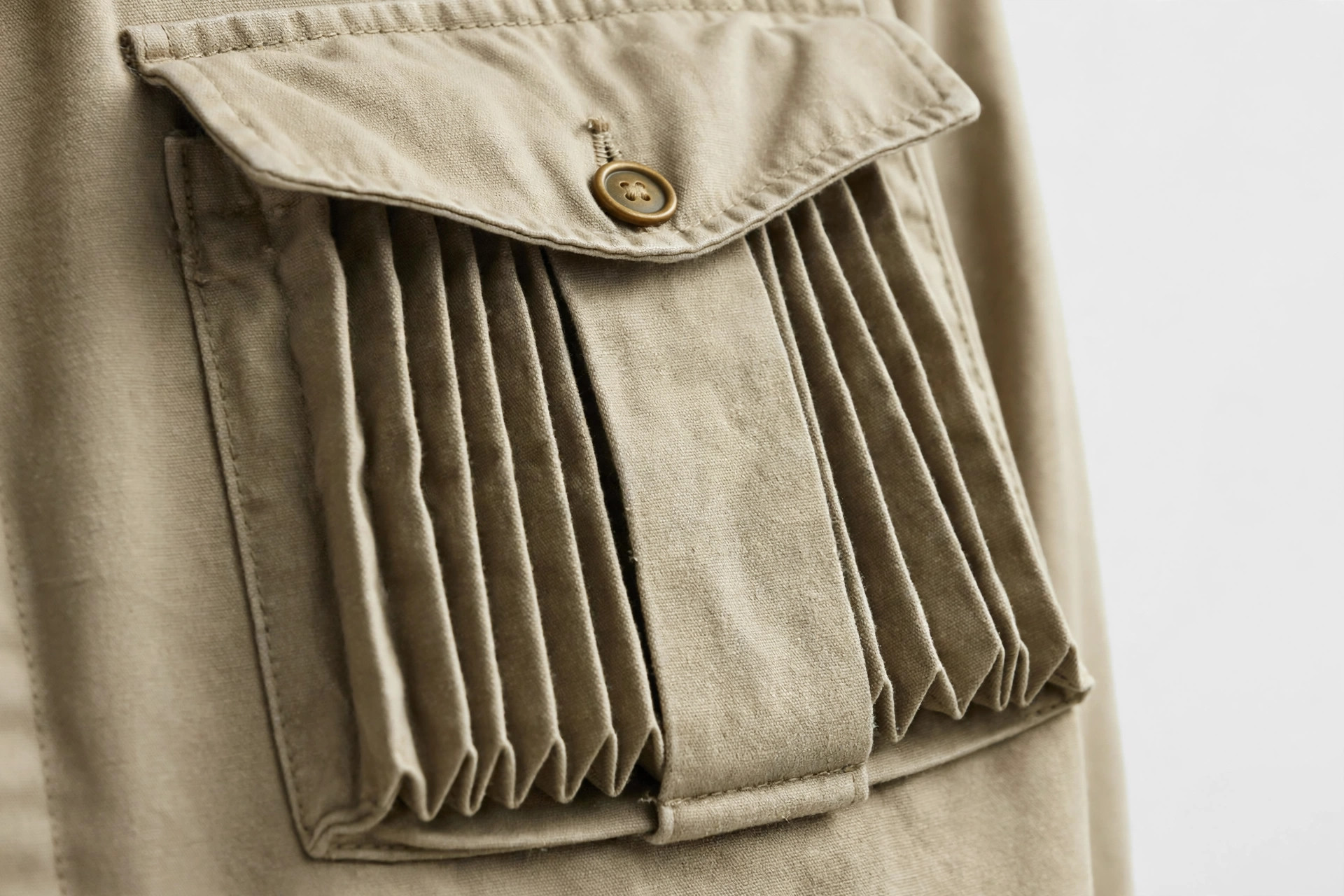
A bellows pocket is a patch pocket built with an expandable fold — a pleat or gusset — around its sides and sometimes its bottom. Lying flat and neat when empty, it billows outward as it fills, which is where the name comes from: it works like the bellows of a forge or accordion. It is the classic pocket of safari jackets, field jackets, and photographers' vests.
How the Bellows Works
Instead of sewing the pocket flat to the garment on all sides, the maker forms a strip of fabric into a box pleat around the pocket's edges. The hidden fold is extra material in reserve: slide in a notebook, gloves, or a map and the pleat opens out, giving the pocket real three-dimensional volume without straining the stitching.
Bellows pockets are almost always topped with a flap, frequently buttoned, to keep the expanded load secure.
Where Bellows Pockets Are Used
- Safari and bush jackets — the four-pocket classic, with bellows at chest and hip.
- Military field jackets — room for dressings, rations, and kit.
- Cargo trousers and shorts — the thigh pocket is usually a bellows design.
- Fishing and photography vests — multiple expanding pockets for small gear.
FAQs
- What is the difference between a bellows pocket and a patch pocket?
- A patch pocket is sewn flat and holds flat things. A bellows pocket has pleated, expandable sides, so it can hold bulky three-dimensional objects.
- Why is it called a bellows pocket?
- Because it expands and contracts like a bellows — the device of folded leather sides used to blow air into a fire.
- Are bellows pockets the same as cargo pockets?
- Cargo pockets are usually bellows pockets — the terms overlap. 'Cargo' describes the placement and purpose (carrying loads, typically on the thigh); 'bellows' describes the expanding construction.
Detailed Guides: see Bellows Pocket in the glossary A–Z listing of the Apparel Search fashion glossary for related terms.