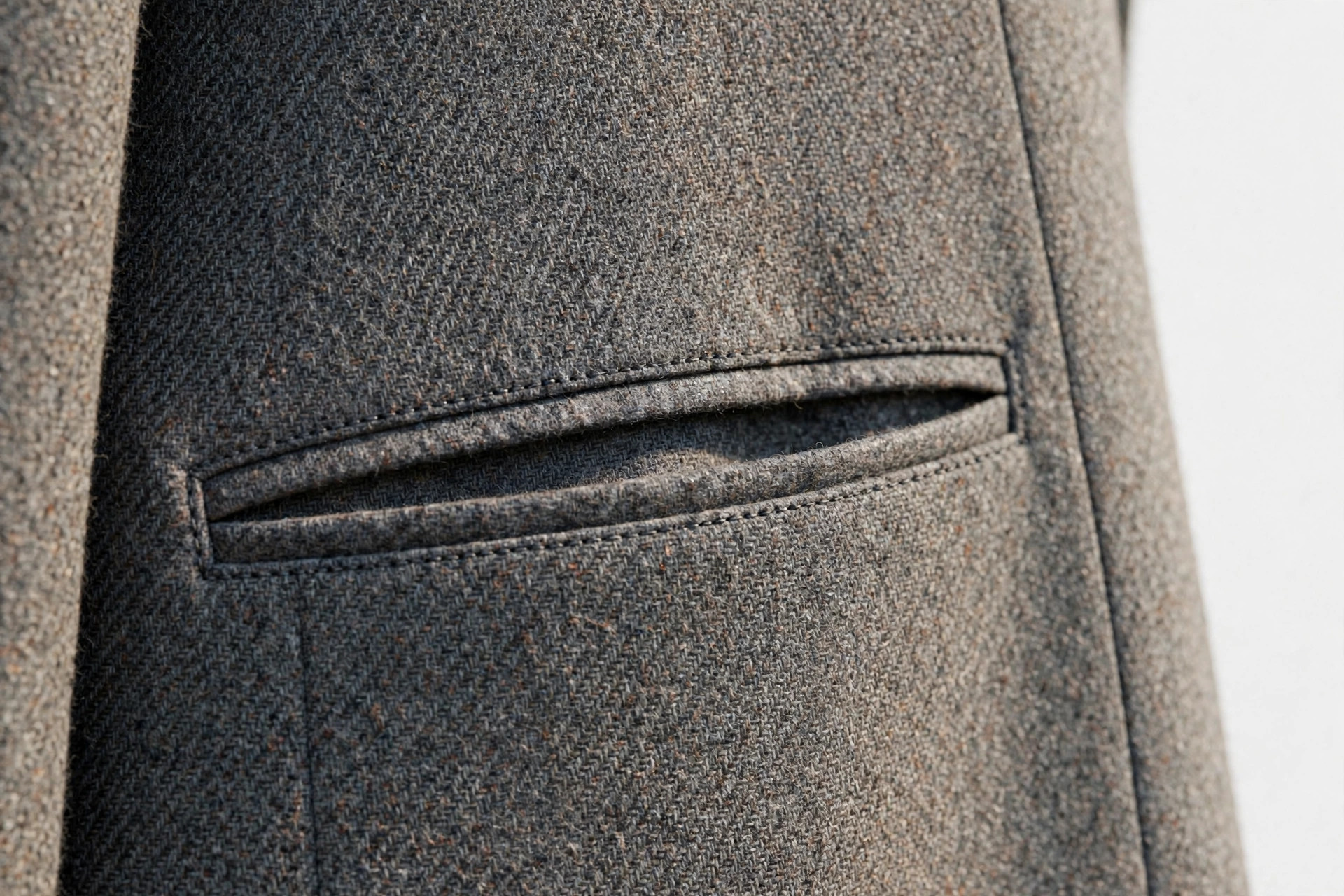
A welt pocket is an inset (set-in) pocket whose opening is finished with one or two narrow, raised strips of fabric called welts. The pocket bag hangs hidden inside the garment, so from the outside you see only a neat horizontal or slightly angled slit edged with fabric. It is the classic pocket of tailored jackets, trousers, and waistcoats.
Where You Will Find Welt Pockets
Welt pockets are the signature pocket of tailoring. Look for them at the hip of a suit jacket (often with a flap tucked in or out), as the breast pocket that holds a pocket square, and at the back of dress trousers, where a single-welt or double-welt opening keeps the line smooth under a jacket.
- Single welt — one lip of fabric, usually below the opening; common on trouser back pockets.
- Double welt (besom) — lips above and below the opening; the most formal jacket finish.
- Welt with flap — a flap is set into the opening and can be worn out or tucked in.
How a Welt Pocket Is Made
The opening is cut into the garment, the welt strips are stitched around the slit, and the work is turned through to the inside, where the pocket bag is attached. Precision matters: the welts must be even, the corners square, and the lips must meet without gaping. Because the construction is visible on tailored cloth, a badly made welt pocket is one of the easiest faults to spot on a jacket.
On quality garments the welt is cut from the same fabric as the garment and matched so any pattern continues across the opening.
FAQs
- What is the difference between a welt pocket and a flap pocket?
- A welt pocket shows only narrow fabric lips at the opening. A flap pocket adds a hanging flap that covers the opening — though many tailored jackets combine the two, with a flap set into a welt opening.
- Are welt pockets functional?
- Yes. Jacket and trouser welt pockets hold small flat items such as cards, a handkerchief, or a pocket square, though heavy or bulky items will distort the tailored line.
- What is a besom pocket?
- Besom is another name for a double-welt pocket — an inset pocket finished with a welt above and below the slit, with no flap.
Detailed Guides: see Welt Pocket in the glossary A–Z listing of the Apparel Search fashion glossary for related terms.