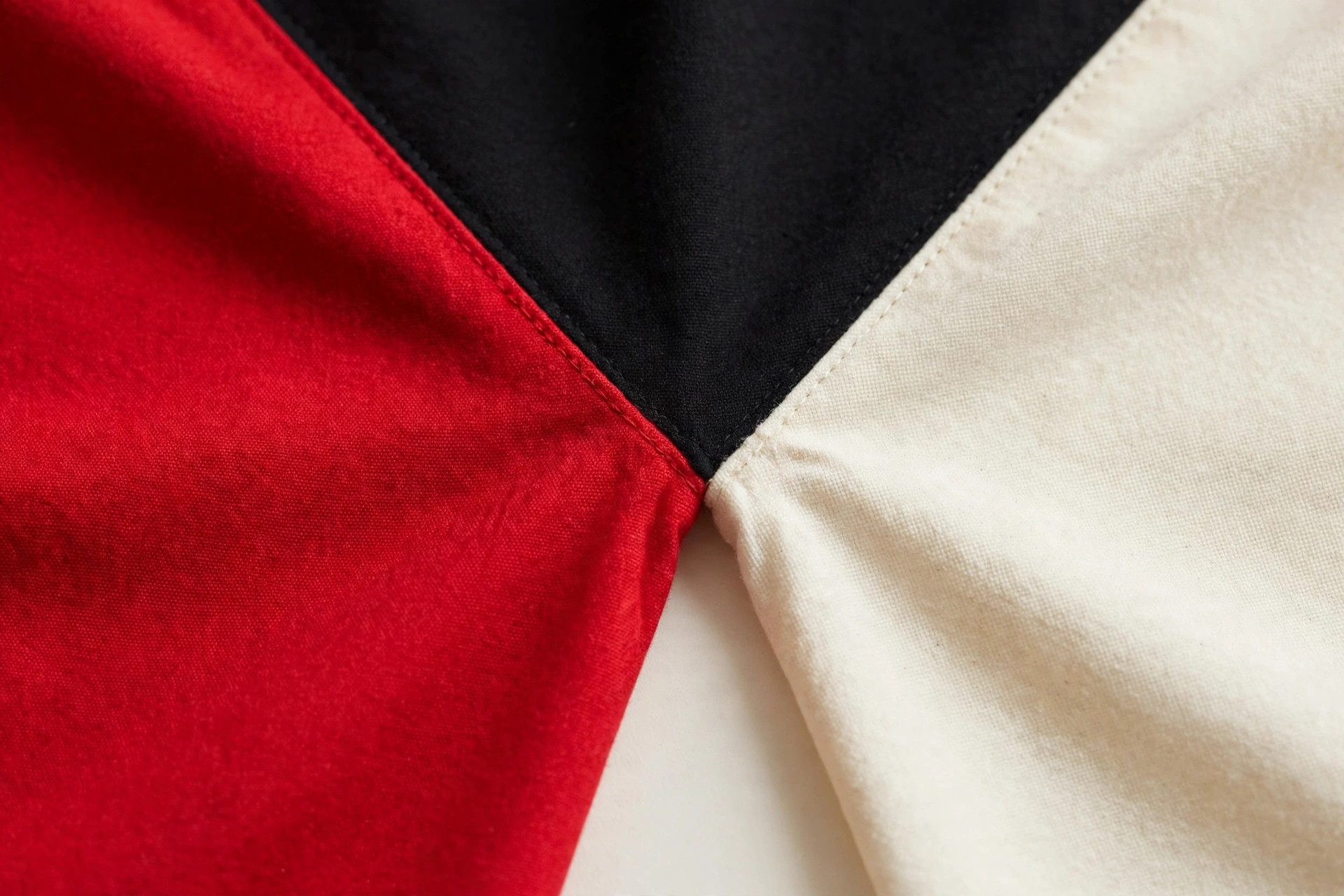
Color blocking (also written colour blocking) is the design technique of building a garment from distinct panels of solid, contrasting colour — a red bodice with black sleeves and a cream band, rather than a print. A color-block garment is usually constructed, not decorated: each block is a separate piece of fabric cut and sewn at the seams, or knitted intarsia-style, so the colour changes are structural. The effect is graphic, modern, and deliberately bold.
How Color Blocking Is Made
In cut-and-sew construction, the pattern is split at chosen lines — across the bust, at the waist, down a sleeve — and each piece is cut from a different solid fabric of matched weight and behaviour, then joined with careful seam matching so the boundaries sit exactly where designed. In knitwear, intarsia knitting works separate yarn supplies for each block, giving clean edges with no floats behind.
The design rules are about proportion and placement: dark blocks recede, bright blocks advance, and a block boundary can be used to sculpt — narrowing a waist, lengthening a leg, or spotlighting a shoulder. Colour theory drives the pairings, from complementary contrasts to tonal families of one hue.
A Short History of Color Blocking
Piet Mondrian's grid paintings inspired Yves Saint Laurent's 1965 Mondrian dresses — flat panels of white, red, blue, and yellow divided by black bands — which fixed color blocking in fashion history. The technique returned in 1980s sportswear, in 1990s streetwear, and in the bold 2010s revival, and it remains a standard tool whenever designers want impact without print.
- Classic pairings — black/white/red; navy/cream/tan; jewel tones against black.
- Sport color blocking — team-colour panels on jackets, sneakers, and athletic wear.
- Tonal blocking — shades of one colour for a subtler, elongated effect.
FAQs
- Is color blocking a print?
- No — true color blocking is constructed from separate pieces of solid fabric (or intarsia knitting). Printed imitations exist, but the real technique has seams at the colour boundaries.
- Does color blocking flatter the figure?
- Used deliberately, yes: dark side panels slim, a bright block draws the eye where placed, and horizontal boundaries can lengthen or shorten proportions.
- What colours work together in color blocking?
- Complementary pairs (blue/orange), triads, or one bright against neutrals like black, white, and grey are the reliable formulas; tonal shades of one hue are the safe modern option.
Detailed Guides: see Color-Block / Color Blocking in the glossary A–Z listing of the Apparel Search fashion glossary for related terms.