Apparel Search · Secondhand Skills
How to Date Vintage Clothing
Old garments carry their own paperwork. Labels, union tags, registration numbers, zippers and seam finishes each narrow down when a piece was made — here is how collectors read that evidence, and how much weight each clue deserves.
Dating is the skill that turns a nice old dress into a 1958 dress — and the difference matters, for value, for care, and for the simple pleasure of knowing what you are holding. This guide, part of the Thrifting & Secondhand Fashion cluster, walks through the evidence in the order collectors check it. One warning before we start: every cue below is approximate. Labels were used until stock ran out, old zippers were sewn into newer garments, and home sewers mixed eras freely. Dating means triangulating — gathering several clues and trusting the period where they agree.
Start With the Labels
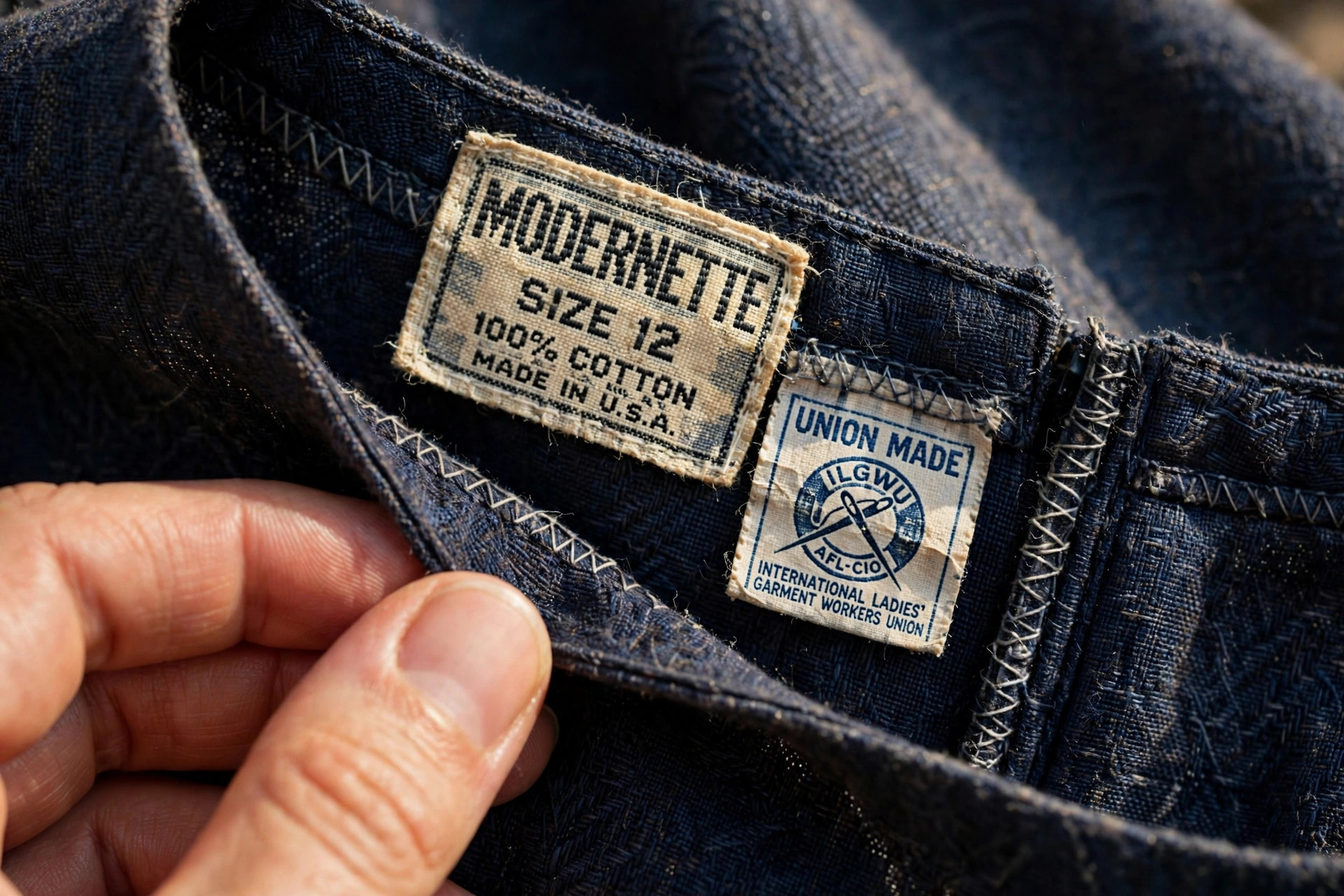
A garment's labels are its documents. Brand labels tell you who made or sold it, and label designs changed over the decades, so a maker's label style itself is evidence. Beyond the brand label, look for three more: a union label, a size label, and any label carrying an RN or WPL number. Photograph them all before you buy — they are the first thing a knowledgeable seller or appraiser will ask about.
Union Labels: The ILGWU Paper Trail
The International Ladies' Garment Workers' Union — the ILGWU — sewed its label into garments made in its union shops, and because the label's design changed over time, it is one of the most useful dating tools in American vintage clothing. The broad strokes every collector learns: union labels appear from the early 1900s onward in various designs; labels carrying the words “AFL-CIO” cannot predate the 1955 merger of the two labor federations; the familiar red, white and blue union label was introduced in 1974 and is the design most often found on 1970s and 1980s garments; and after the ILGWU merged into a new union in 1995, the classic union label disappears from new clothing. A union label therefore brackets a garment's era — and because imports never carried one, it also supports American manufacture. Treat the exact design dates as guides, not gospel: factories used up old label stock, so a label can lag a design change by a year or two.
RN Numbers and the Label Laws
American label law left a paper trail of its own. From 1941, the FTC issued WPL numbers to textile firms; in 1952 it switched to the RN (Registered Identification Number) system still in use today. An RN number identifies the company, and because numbers were issued roughly sequentially, a low number suggests an early registration — a useful supporting clue, though never a garment date in itself, since a firm registered in 1955 could sew that same number into a dress in 1985. Two later laws bracket garments from the other side: fiber-content labeling arrived with the Textile Fiber Products Identification Act of 1960, and mandatory permanent care labels took effect in 1972. So a garment with fiber content but no care label plausibly falls between those dates — while remembering that care labels are the first thing many wearers cut out.
Construction Clues
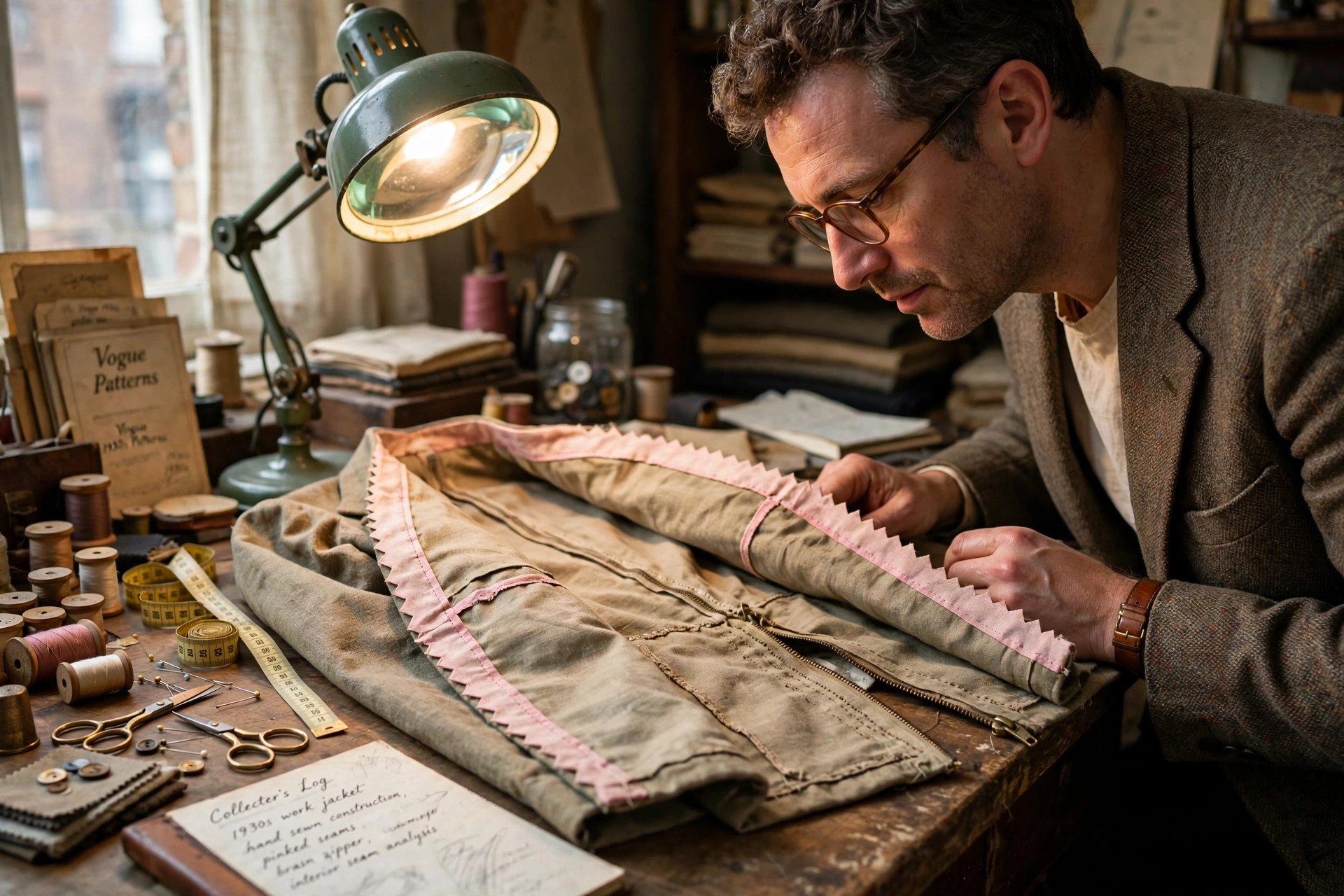
How a garment is put together changes with the machinery of its era. Zippers are the classic clue: metal zippers are typical of garments made before the mid-1960s, while nylon coil zippers spread through the late 1960s and 1970s — and on dresses, a side zipper placement is common in the 1940s and 1950s, with center-back zippers becoming standard later. Seam finishes speak too: pinked (zigzag-cut) seam allowances and hand-finished details point to earlier or home production, while serged, overlocked edges became widespread as that machinery spread through factories and home sewing rooms in the later twentieth century. Bound buttonholes, hand-sewn hems with generous turn-ups, and hook-and-eye closures all lean earlier; fused interfacings and uniform machine finishing lean later. These same construction details double as quality evidence — the quality and fakes guide reads them from the other direction.
Fabric, Silhouette and Size
Materials carry dates as well. Rayon is the signature fiber of the 1930s and 1940s; nylon arrives after the Second World War; polyester peaks in the 1960s and 1970s; and the fiber-content label's own wording and order follow the rules of its decade. Silhouette is the clue everyone sees first — the wasp waist of the 1950s, the shift of the 1960s, the shoulder pads that belong to both the 1940s and the 1980s (construction and labels separate those two). Labeled sizes, finally, are evidence of drift rather than date: a size 12 from the 1950s measures far smaller than a modern 12, which is why experienced buyers of era clothing — like the women's vintage clothing guide — shop by measurement, never by tag.
Putting It Together
Watch the method work on two imaginary finds. The first dress has a metal side zipper, pinked seams, no care label and no RN number: each clue leans early, and together they suggest the 1950s or before. The second has a red, white and blue union label, a care label, serged seams and a nylon back zipper: the union design says 1974 or later, the care label agrees, and the construction concurs — a late 1970s or 1980s piece. Neither conclusion is certain, and honest sellers say “circa” for a reason. But a garment whose clues all agree within a few years is dated as well as vintage clothing ever is — and priced, cared for and appreciated accordingly.
Common Questions
What is the single most reliable way to date a vintage garment?
There isn't one — reliable dating always combines several clues. A union label suggests a range of years, the zipper type narrows it further, and the presence or absence of a care label and RN number brackets it from the other side. When three or four independent clues point to the same decade, you can date a garment with reasonable confidence. Any single clue used alone will eventually fool you.
What does an RN number on a label tell you?
An RN number identifies the company that registered with the U.S. Federal Trade Commission — the system began in 1952, replacing the earlier WPL numbers issued from 1941. Because numbers were issued roughly in sequence, a very low RN suggests a company that registered early. But companies keep their numbers for decades, so an RN dates the firm's registration, not the garment. Use it as supporting evidence, never as the date itself.
When did care labels become mandatory in clothing?
In the United States, permanent care labels became a legal requirement in the early 1970s, when the FTC's Care Labeling Rule took effect in 1972. A garment with no care label at all may well predate the rule — though labels are also cut out by wearers, so absence is a hint rather than proof. Fiber-content labeling is older: the Textile Fiber Products Identification Act dates to 1960.
If a garment has no union label, does that mean it was not made in America?
No. Union labels appear only on garments made in union shops — chiefly those of the ILGWU, the garment workers' union. Plenty of American clothing was made in non-union factories, at home, or by dressmakers, and imported garments never carried one. A union label is strong positive evidence of era and origin; its absence proves nothing either way.
Back to the Thrifting & Secondhand Fashion Guide
The Thrifting & Secondhand Fashion hub covers the whole practice — hunting, dating, judging quality, selling, and the shops themselves — with a map of every guide in this cluster.