Fashion Law & IP — The Guide Hub
Fashion Law & Intellectual Property Guide
The four legal tools that protect a fashion brand — what each one covers, what it misses, and where to go deeper.
Fashion runs on originality, yet the law does not protect “fashion” as a single thing. Instead, four separate legal tools each protect a different part of what makes a garment or a brand valuable: the name on the label, the artwork on the fabric, the overall look of the product, and the shape of the design. A single handbag can involve all four at once. This guide compares the four tools side by side, explains which problem each one solves, and links to a full Apparel Search guide on each — together with the founding fashion law pages this site has published for years.
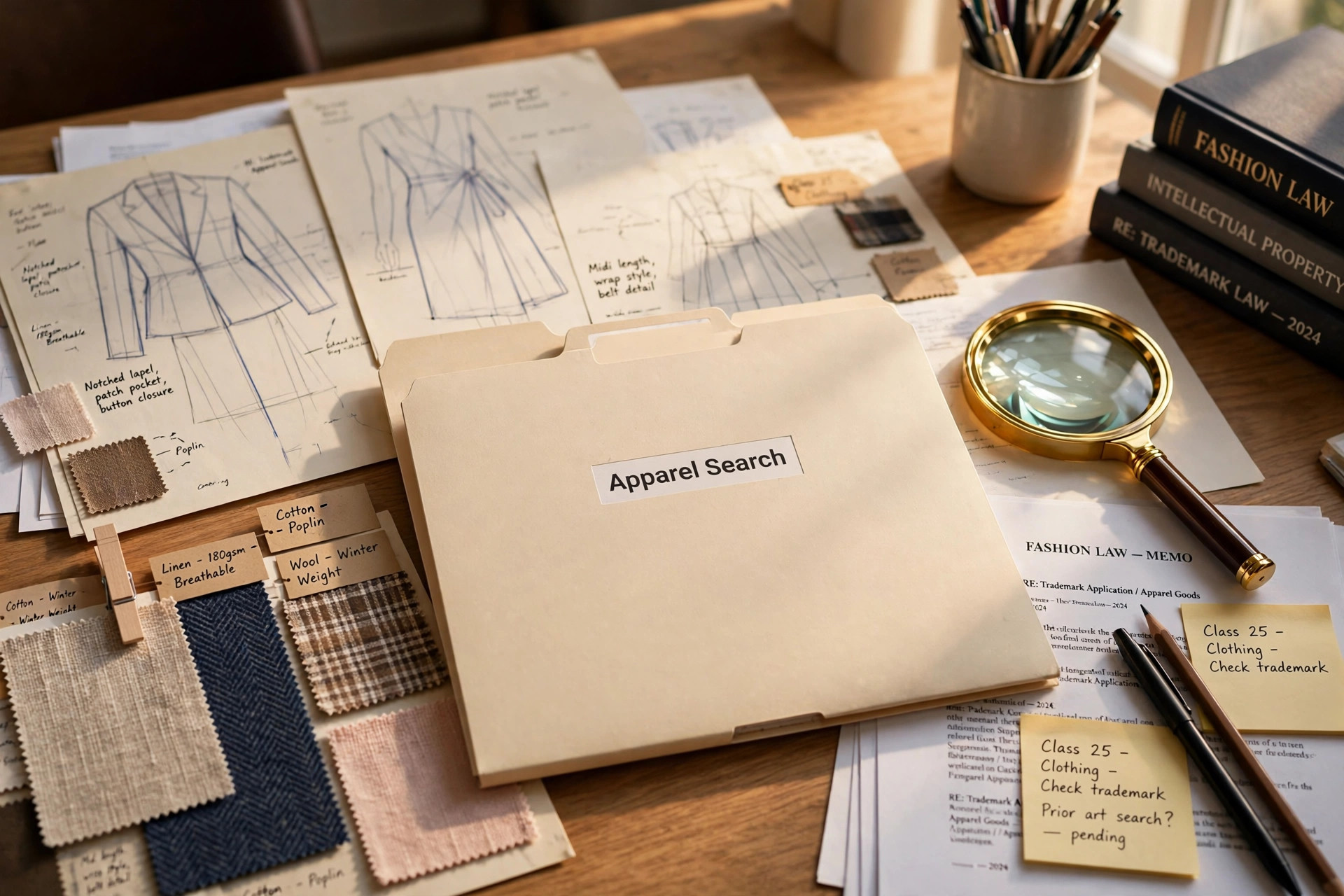
The Four Protection Tools, Compared
Every design-protection question in fashion is really a question about which of these four tools fits the thing being copied. They differ in what they cover, how a brand gets them, and how long they last, and they work best in combination rather than alone.
Trademark
Protects the signs that identify a brand: names, logos, slogans and other source identifiers.
- Protects
- Brand identity, not the product design itself
- How you get it
- Rights grow from use; registration with the U.S. Patent and Trademark Office strengthens them
- Lasts
- Potentially indefinitely, while the mark stays in use
Copyright
Protects original creative expression: fabric prints, graphics, photographs, artwork and text.
- Protects
- Creative works fixed in a tangible form
- How you get it
- Automatically at creation; registration adds enforcement advantages
- Lasts
- Generally the author’s life plus 70 years
Trade Dress
Protects a product’s total look and image when consumers have learned to read that look as a brand signature.
- Protects
- The overall appearance of a product or its packaging
- How you get it
- By building distinctiveness, usually proven through sales, advertising and recognition
- Lasts
- While the look stays distinctive and in use
Design Patent
Protects the ornamental design of a functional item: its shape, configuration and surface decoration.
- Protects
- How a product looks, never how it works
- How you get it
- By application and examination at the U.S. Patent and Trademark Office
- Lasts
- 15 years from grant, with no renewal
Which Tool Fits the Problem?
Start from what was taken. If another company is using your name or logo, or one confusingly close to it, that is a trademark problem. If a competitor lifted your print, graphic or photograph, that is copyright territory, because two-dimensional artwork is the part of a garment the law protects most clearly. If a rival product copies the overall look your customers recognize — the silhouette, the color combination, the signature details — you are in trade dress territory, provided the look is not functional and buyers connect it with you. And if the copied item is a new shape or ornamental design you have just launched, a design patent is the tool designed for exactly that moment, because it does not require years of sales history first.
Real disputes usually combine several of these. A copied handbag might infringe a trademark in its logo hardware, a copyright in its printed lining, a design patent in its shape and trade dress in its overall presentation all at the same time. That is why experienced fashion brands build their protection in layers from the launch of a product, not after a copy appears.

When Protection Fails: Counterfeits, Knockoffs and Dupes
Not every lookalike is illegal, and the differences matter. A counterfeit carries a fake trademark and is made to pass as the genuine article; it is the clearest form of infringement and the target of customs seizures at the border. A knockoff copies a design or style without using a fake mark. A dupe is a budget alternative openly sold as an inspired-by option. Our Counterfeit Fashion Guide separates the three, explains how enforcement works, and shows how buyers and brands can spot fakes; the site’s long-standing glossary pages on counterfeit goods and knockoffs cover the basic definitions.
Licensing: Putting Rights to Work
Protection is only half the story. The same rights that keep copiers out can be rented, carefully and profitably, through licensing: a designer name on eyewear, fragrance or home goods made by a specialist manufacturer, under a contract that sets royalties and quality standards. Our Fashion Licensing Legal Guide explains how those agreements are built, and the site’s Licensing & Legal Practices pages connect readers with the legal side of the licensing business.
Founding Pages and Further Reading
Apparel Search has covered fashion law for years. These pages remain the
foundation this guide builds on:
Fashion Law Summary
— the field, its four pillars, and fashion law in everyday business.
Fashion Copyrights
— our glossary entry on copyright in fashion, expanded by the new guide above.
Counterfeit Goods and Counterfeit Fashion
— the glossary definition of counterfeiting.
Knockoffs — what the
term means and how knockoffs differ from counterfeits.
Fashion Law Institute
— the field’s best-known training and research organization.
Related Guides
Fashion Photography & Media Production Guide
Photo shoots run on the same rights this guide covers: image usage licenses, model releases and who owns the pictures.
Textile Printing Methods Guide
Prints are fashion’s most clearly copyrighted element; this companion guide covers how they are made, from screen printing to digital.
Not sure where a copying problem belongs? Find what was taken — a name, a print, a look, or a shape — in the comparison above, then read the guide that matches. Each one explains the rules, the limits and the practical next steps in plain language.
Common Questions
What is fashion law?
Fashion law is the area of law covering the life of a garment and a fashion brand, from design and manufacturing through branding, retail and licensing. Intellectual property is its best-known part: trademarks for brand names and logos, copyright for prints and artwork, trade dress for a product's recognized look, and design patents for ornamental shapes.
What is the difference between a trademark and a copyright in fashion?
A trademark identifies the source of goods, so it protects brand names, logos and slogans for as long as they are used. A copyright protects original creative expression, such as a fabric print or a photograph, for a fixed term. A single product can carry both: the logo on a shirt is trademark territory, while the artwork printed on it is copyright territory.
Can a clothing design itself be protected?
Partly, and it depends on the tool. United States copyright law generally does not protect the cut or shape of a garment, because clothing is a useful article. The design can still be protected in layers: a design patent can cover a new ornamental shape, trade dress can protect a look consumers recognize as yours, and copyright covers separable artwork such as prints.
The Fashion Law & IP Guides
This page is general educational information about how intellectual property law applies to the fashion industry. It is not legal advice and does not create an attorney-client relationship. For advice about a specific situation, consult a qualified attorney.