Apparel Search Consumer Guides
How to Measure Your Feet
The trace-and-measure method for both feet, what the numbers mean, and what the measuring gauge in a shoe shop reads that paper cannot.
Every shoe purchase starts from a number, and for most people that number is a size they settled on years ago in a shop they no longer remember. Measuring your own feet replaces the guess with something better: a length and a width, in centimetres, that stay true whatever brand you are shopping. The method takes ten minutes, a sheet of paper and a pencil, and it is the foundation the rest of our shoe fit guide stands on — toe room, width letters and heel checks are all easier to judge once you know what your feet actually measure.
What You Need
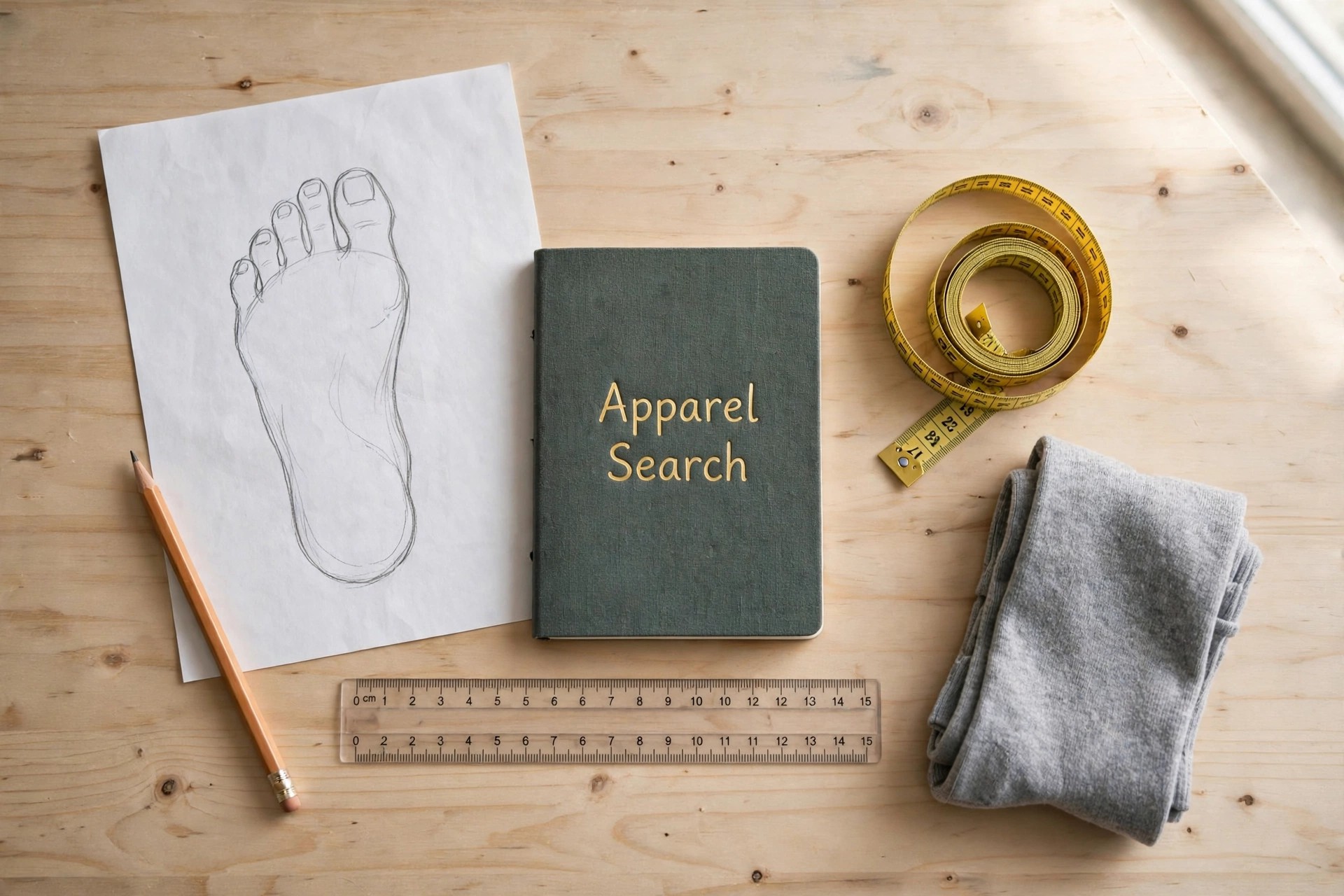
- Paper larger than your foot — two sheets, one per foot, or a single large sheet of card.
- A pencil or fine pen, held upright as you trace.
- A ruler or tape measure that reads centimetres as well as inches.
- A hard floor and a wall with a straight skirting board to set your heel against.
- The socks you mean to wear with the shoes you are measuring for.
- A helper, if one is handy — tracing your own foot works, but a second person's outline, drawn while you simply stand, is usually truer.
The Trace-and-Measure Method
- Set up late in the day. Tape the paper to a hard floor with one short edge tight against the wall. Put on the socks you will wear with the shoes, and measure in the afternoon or evening, when your feet are at their full size.
- Stand on the paper. Heel resting lightly against the wall, foot straight, your full weight on it. A foot measured sitting down, or dangling, is a smaller foot than the one that walks in your shoes.
- Trace the outline. Run the pencil around the whole foot, holding it vertical and close against the skin all the way — leaning the pencil in or out adds or steals millimetres. Keep your weight still and even while the outline is drawn.
- Measure the length. Step off, then rule a straight line across the back of the heel and another across the tip of the longest toe — which may be the second toe, not the big toe. The distance between the lines is your foot length. Write it down in centimetres as well as inches; centimetres are the number worth keeping.
- Measure the width. Rule across the widest part of the outline, usually the ball of the foot from the joint of the big toe to the joint of the little toe, and measure straight across. This is the number that tells you whether standard fittings suit you or whether to look at wide and narrow ranges.
- Repeat for the other foot. Trace and measure the second foot exactly the same way. Two sets of numbers, side by side, are the whole point of the exercise — most people find a difference, and it is the larger foot that shoes must fit.
Reading Your Numbers
Length does most of the work: it is the measurement every size chart is built from, and our shoe size conversion chart turns it into US, UK and European sizes. If your length falls between two chart sizes, the common practice for closed shoes is to start with the larger and manage any extra room with socks or an insole — room can be taken up, but length cannot be added. Width works differently. There is no exact home formula that converts a width measurement into a width letter, because makers grade their letters themselves; what your width number tells you is comparative — set it against the sizing information a maker publishes, and read it alongside the evidence of your current shoes. If the sides of your feet bulge over the soles of the shoes you own, your width measurement is telling you to shop wide ranges first.
One shoe category reads numbers like these more literally than most: the extra-depth shoes sold for the diabetic ranges are lasted for volume as much as for length, and their removable insoles assume the wearer’s own measurements — and feet — change through the day. Our diabetic-friendly shoes guide shows how that category is built and fitted.
In the Store: The Brannock Device
The metal measuring gauge you see in shoe shops — the Brannock device, a fixture of shoe stores for close to a century — measures three things, and the third is the one paper cannot give you. It reads heel-to-toe length, like your tracing. It reads width, from a sliding bar set against the side of the foot. And it reads arch length: the distance from your heel to the ball joint of your foot, taken by a pointer that slides to the joint. Arch length matters because a shoe must bend where your foot bends. If your arch length reads longer than your toe length — the ball of your foot sits further forward than your overall size suggests — a good fitter fits you to the arch length and lets the toes have the extra room, rather than leaving the shoe's flex point behind your own.
A fitter will measure you seated first and then standing, because a foot lengthens and spreads under weight, and will measure both feet for the same reason you traced both at home. If a shop offers to measure, accept: the device in practised hands is the most complete quick picture of your feet you can get, and the numbers are yours to keep.
Why Sizes Differ Between Brands
With your centimetres in hand, brand differences become easier to forgive. A shoe is built on a last — a foot-shaped form — and each maker grades lengths and widths around their own last, so a size is an index into one brand's system, not a unit. The steps themselves differ between scales: US, UK and European numbers do not convert with perfect consistency, which is why conversion charts disagree with each other at the edges. The exception that proves the rule is mondopoint, the system used for ski boots and some work footwear, where the size simply is the foot length in millimetres — the most honest labelling in the shoe world, and a hint of how the rest of it might behave. Until it does, your measurement is the constant. Carry it in centimetres, note the sizes that genuinely fit you in the brands you buy, and let the box number be the last thing you trust.
Keep Your Numbers
Write down the date, both feet, length and width in centimetres, and the sock you measured in. Feet change slowly across adult life — many people find their feet a little longer and wider than they were a decade earlier — so refresh the numbers every year or two, and sooner if a size that always fitted you stops feeling right.
Common Questions
When is the best time of day to measure my feet?
Late in the day. Feet swell through the day and with heat and activity, so a foot measured first thing in the morning is the smallest version of itself. Measuring in the afternoon or evening, after you have been on your feet, gives the measurement that all-day shoes have to fit.
Which foot should I size for?
The larger one — usually the longer foot, but judge both dimensions, because on some people the shorter foot is the wider. Most people have a small difference between their feet. A shoe can be padded for the smaller foot with a sock or an insole; nothing can pad a shoe bigger for the larger foot.
How do I turn my measurement into a shoe size?
Take your length in centimetres or inches to a size conversion chart and read across to the US, UK or European size — then take that number as a starting point, not an answer. Brands grade their sizes on their own lasts, so the same chart size fits differently across makers. For width, a measurement across the ball of the foot tells you whether to look at standard fittings or at a maker's wide or narrow ranges.
Is one foot really bigger than the other?
For most people, yes — usually by a few millimetres, sometimes by half a size or more. It is the normal state of affairs, which is why fitters measure both feet rather than doubling one measurement. Which foot is larger does not follow handedness reliably enough to guess, so measure and see.
Back to the Shoe Fit Guide
Length, width, heel hold and toe box shape — the full fit check this measurement feeds into.