Apparel Search Consumer Guides
Kids' Shoe Fitting Guide
Measuring growing feet, how often to check the fit, the right amount of growing room, and the checks that tell you a pair truly fits.
Fitting children's shoes is the one branch of shoe fitting where the wearer cannot tell you the shoe is wrong. A toddler cannot report that a toe is pressed; an older child will pronounce two different sizes equally "fine" and choose by colour. So children's fitting is a measurement job, done on a schedule, and this guide sets it out: how fast feet grow, how often to check, the tracing method adapted for small feet, how much growing room is right, and the honest position on hand-me-downs. It is the children's branch of our shoe fit guide, and it deepens the fitting coverage in the Clothes Guide's children's shoes guide, which covers the shoe types themselves.
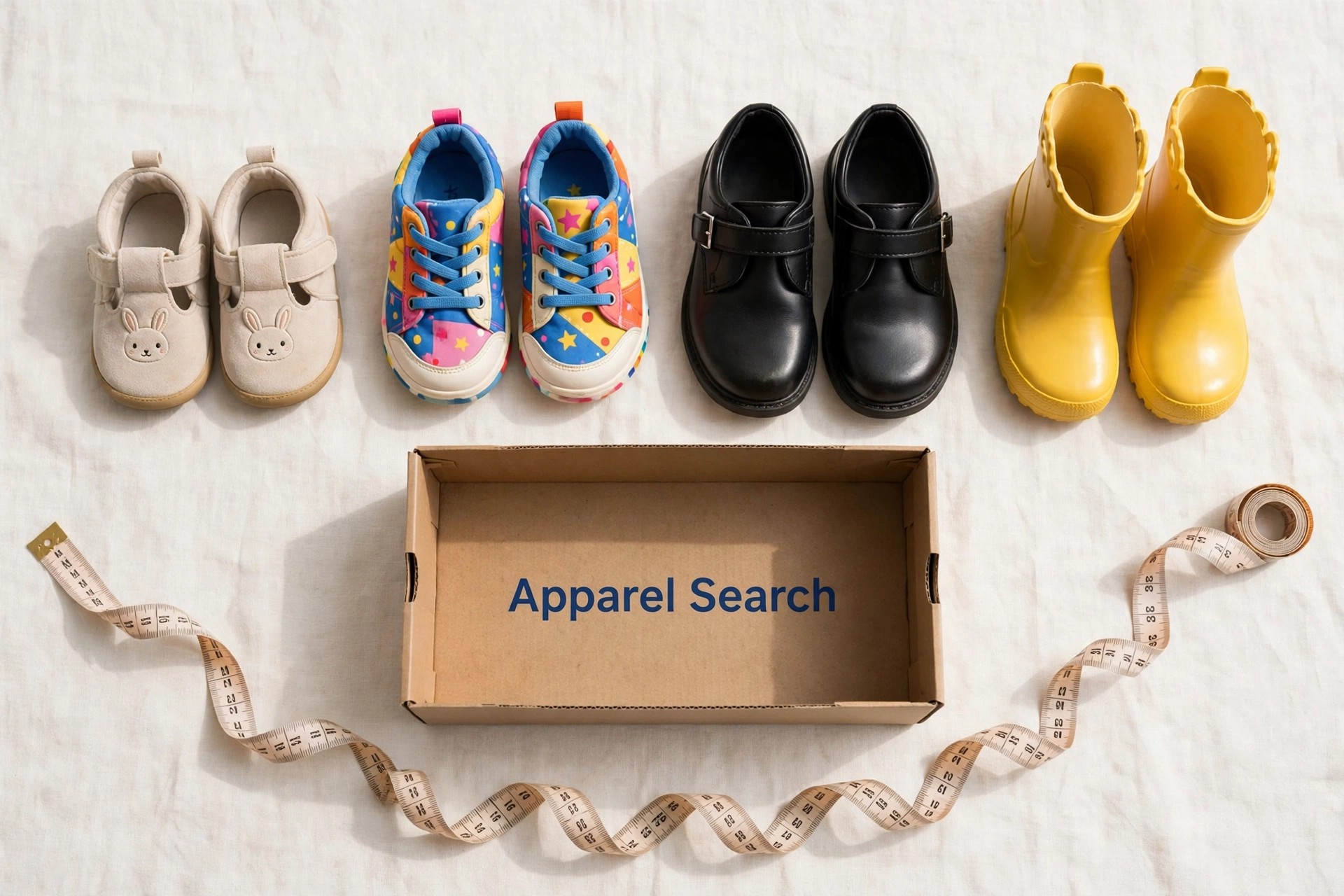
Growing Feet: The Pattern
Children's feet grow in spurts rather than steadily, and the pace is fastest exactly when the wearer is least able to comment. In the first years a pair of shoes may fit for only a few months; through the school years growth slows but continues, and feet keep growing into the teenage years. Children's shoe fitters commonly suggest checking fit every two to three months for babies and toddlers, every three to four months for preschoolers, and every four to six months for school-age children — not because a shoe expires on schedule, but because a child will rarely announce that it has stopped fitting. Between checks, learn the informal signals: a child who starts pulling shoes off, toes that reach the end of a removable insole when the child stands on it, or marks left on the feet when shoes come off.
Measuring a Child's Feet
The paper method from our guide to measuring your feet adapts directly. Tape the paper to a hard floor against a wall, and have the child stand on it in socks, weight evenly on both feet — a tracing taken with the child seated and legs dangling measures a smaller foot than the one that runs around. Draw around the foot with the pencil vertical (making a game of the outline helps cooperation more than any instruction), then measure from heel to the longest toe, and repeat for the other foot. Size for the larger foot. Shops that fit children's shoes use a junior version of the same measuring gauge adults use, and a good fitter measures both feet every time, whatever the last visit recorded.
The Wiggle-Room Question
The standing allowance is about a thumb's width — roughly a centimetre — beyond the longest toe. That space does two jobs: it is room to grow into, and it is the room toes need while walking. It tempts every parent to add a little more, and the generous version of the idea — buying a full size up "to grow into" — is where fitting goes wrong. A shoe that is too big lifts off the heel at every step, lets the foot slide forward so the toes jam the end anyway, bends at a point ahead of the ball of the foot, and asks the toes to claw to hold it on. Check the allowance with the child standing, pressing gently over the end of the shoe to feel where the longest toe ends — and accept the answer. The right pair fits today, with a centimetre in hand.
Five Fit Checks Before You Pay
- The thumb check. Child standing, press your thumb across the end of the shoe: about a thumb's width of empty shoe should sit beyond the longest toe, and the toe should not be pressing up against the top of the shoe.
- The heel check. The heel should sit snugly in the shoe's heel cup with only slight movement as the child walks — no lifting out, and no gap you can slide a finger into behind the heel.
- The width check. The sides of the foot should not bulge over the edges of the sole, and the upper should not gape loose either. Watch the little-toe side especially; it shows crowding first.
- The walk and run test. Watch the child walk, then run if the shop allows: no tripping over the toes of the shoe, no shuffling to keep it on, no change in how the child moves compared with bare feet.
- The afterwards check. At home after the first wears, look at the feet when the shoes come off. Sock marks are normal; deep red pressure marks across the toes or the top of the foot mean the shoe is pressing, whatever the shop check said.
Hand-Me-Downs: A Careful Word
Shoes are among the most handed-down of all children's clothes, and mostly it is a sensible economy — with one honest caveat. A worn shoe is not a neutral object: its footbed has moulded to another child's foot, its tread has worn at that child's angle, and its heel counter has softened in another shape. For an everyday shoe, worn for hours daily, fitters generally advise a pair fitted to the child who will wear it. Lightly worn occasion shoes — the pair worn twice for weddings — are a different case entirely. Judge any passed-down pair the way you would judge a new one, and be willing to retire it: the heel counter should still be firm, the tread even and unworn on one side, the lining smooth, and the full fit check above should pass on your child's feet, not on the memory of the last wearer's.
Fitting by Category
- First walkers: thin, flexible soles the child can feel the ground through, a toe box shaped like a foot rather than a point, and a fastening that holds the shoe on. Indoors, bare feet or grip socks are the common recommendation at this stage; the shoes are for outdoors.
- School shoes: the highest-hours shoes a child owns, so construction and fit both matter most here. Fastenings the child can manage alone — hook-and-loop straps before reliable lace-tying — are a fitting feature, not a shortcut.
- Sports shoes: as children's sport becomes organised and repetitive, the sport's own shoe earns its place, fitted like a runner's: full toe room, heel held, with the socks training is done in.
- Boots and wellingtons: fit them with the thick socks they will be worn with, and check the heel hold — tall boots forgive length errors poorly and punish them with slipping.
- Sandals: the foot should sit inside the footbed's edges front and back, with a heel strap adjusted to hold the foot rather than toes gripping to keep the sandal on.
There Is No Separate "School Shoe Size"
Children's sizes differ between brands exactly as adults' do, and a child who is one size in one maker's school shoes may be another in the next shop. Keep the centimetre measurements from each fitting, and let them — not last term's number — start every shopping trip.
School shoes sit inside a wider fitting job: the uniform itself. Our school uniform sizing, growth and fit page covers measuring for the clothes, the growth-room features to look for, and how the shoe checks in this guide fit into the whole September fitting.
Shop Kids' Shoes on Amazon
Ready to shop? Product links are kept in one place on the Apparel Search shopping guide:
Shop Clothing on AmazonThis link opens the Apparel Search shopping guide for Amazon, where the product links are kept in one place.
Common Questions
How often should I check my child's shoe fit?
Children's shoe fitters commonly suggest this rhythm: every two to three months for babies and toddlers, every three to four months through the preschool years, and every four to six months for school-age children. Add an unscheduled check whenever a child mentions sore toes, you see pressure marks at the front of a shoe, or a growth spurt has clearly happened since the last pair was bought.
How much growing room should kids' shoes have?
About a thumb's width — roughly a centimetre — beyond the longest toe, checked with the child standing. That allowance covers both growing room and the room toes need in motion. More than that is not extra value: it is the next size, and a shoe a full size too big lifts at the heel, lets the foot slide, and bends in the wrong place.
Should children wear hand-me-down shoes?
For everyday shoes, fitters generally advise fitting the child who will wear them. A shoe takes the shape and wear pattern of its first wearer — a moulded footbed, a tread worn at an angle, a heel counter softened to another foot. Lightly worn occasion shoes are a different case. Any passed-down pair deserves the same checks as a new one: firm heel counter, even tread, smooth lining, and the full fit check on the child's own feet.
Do toddlers need shoes indoors?
The common guidance from children's shoe fitters is that new walkers do best feeling the floor — bare feet or grip socks indoors — with shoes serving as protection outdoors and on rough or cold ground. Children who are not yet walking do not need structured shoes at all; soft coverings for warmth are enough, and the fitting question arrives with the first outdoor steps.
Back to the Shoe Fit Guide
Length, width, heel hold and toe box shape for adult feet — plus the measuring method this guide adapts for children.