Children's Shoes Guide
Children's shoes are the whole footwear system in one guide: school shoes, everyday shoes, boots, and the specialist members — sandals, sneakers and slippers — that have their own pages in this letter. Two facts govern the whole category: kids' shoes get dirty, and they grow out of them rather quickly. Everything in this guide follows from those two facts: fit is temporary, so it must be checked often; wear is hard, so construction matters more than decoration.
Shop Children's Shoes Now
Shop Children's Shoes on Amazon Shop Children's Shoes on eBayThe Amazon and eBay links on this page are affiliate links. If you make a purchase through them, Apparel Search may earn a commission.
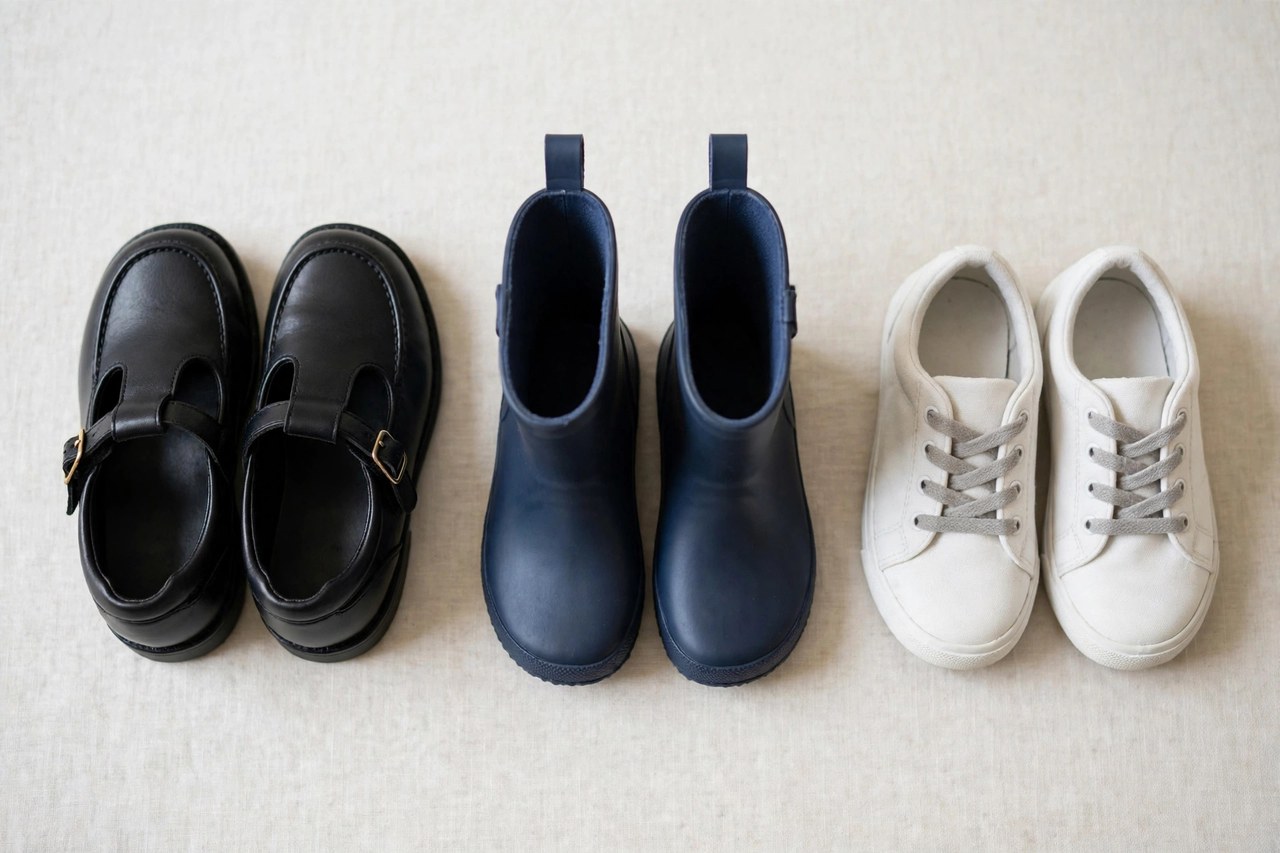
Children's shoes are the whole footwear system in one guide: school shoes, everyday shoes, boots, and the specialist members — sandals, sneakers and slippers — that have their own pages in this letter. Two facts govern the whole category: kids' shoes get dirty, and they grow out of them rather quickly. Everything in this guide follows from those two facts: fit is temporary, so it must be checked often; wear is hard, so construction matters more than decoration.
This page is the map of the system. It covers how children's feet grow, how to measure and fit any shoe, and how the footwear family divides its jobs. Then each specialist guide takes its own member in depth: sandals for summer, sneakers for sport and play, slippers for indoors, and boots in the B letter. Start here for fit, then read the specialist page for the pair you are buying.
Growing Feet and How Often Fit Changes
Young children's feet grow startlingly fast — as much as two sizes a year in the toddler years, settling to roughly a size a year through primary school, with spurts at unpredictable moments. Shoes are outgrown before they are outworn for most of childhood, which is why expensive fashion shoes are poor value and well-made everyday shoes are good value: the shoe will be retired for size with its life half used, ready to hand down if it was sound to begin with.
Check fit every six to eight weeks for under-fives and every three to four months for older children, and always after a growth spurt in height. The signs of an outgrown shoe are toes pressing the front when standing, red marks at the toes or sides, a heel that has started to slip because the foot is wedging forward, and a child who starts taking shoes off at every chance. None of these wait for a scheduled check: look whenever shoes go on in the morning, which takes five seconds.
Measuring and Fitting Any Children's Shoe
Measure both feet, standing, late in the day, in the socks the shoes will be worn with. The longer foot rules the size. A fitted shoe leaves about a centimetre — a thumb's width — of space beyond the longest toe, holds the heel without lifting out when walking, and is wide enough that the sides do not bulge over the sole. The sole should flex where the foot flexes, at the ball, and young children's shoes should never need breaking in: if it is not comfortable in the shop, it is the wrong shoe.
Fastenings scale with the child: hook-and-loop straps for the youngest and for speed at school, double straps or elastic laces as a bridge, and tied laces once a child can tie them securely and quickly — a lace that trails is a trip hazard, not a milestone. Insoles that remove for checking are a gift: stand the child on the insole and the fit is visible at a glance. Buy the pair that fits the longer foot today, never a size up to grow into, because a sloppy shoe trips, rubs and wears unevenly.
The fitting routine in full — the tracing method adapted for children, the growth-room allowance, seated and standing fit checks and a careful word on handed-down shoes — is set out step by step in our kids' shoe fitting guide, part of our shoe fit guide.
School shoes are bought as part of a uniform, and the uniform has its own fitting logic — measuring, growth room and the checks to run before term starts — set out in school uniform sizing, growth and fit.
The Family's Jobs, Care and Handing Down
Divide the jobs honestly. School shoes take the most hours and deserve the best construction in the budget: leather or good synthetic uppers, a defined heel cup, real tread. Everyday and play shoes take the mud; sneakers take sport; sandals take summer; slippers take the house; boots take winter and rain. One pair asked to do every job does none of them well and wears out doing the first. Most children need fewer pairs than shops suggest, but each pair must genuinely fit its job.
Care keeps shoes alive to hand down: brush mud off when dry, air shoes between wears — alternating two pairs where possible doubles sole life — stuff damp shoes with newspaper and dry them away from radiators, and wash only what the maker says can be washed. Check handed-down shoes as strictly as new ones: a sole worn into another child's gait, a crushed heel counter or a smooth tread means the shoe is done, however clean it looks. Whatever your kids are wearing is in fashion; fitting, sound and suited to the job is the standard that matters.
Common Questions
How often should children's shoe fit be checked?
Every six to eight weeks for under-fives and every three to four months for older children, plus whenever toes press the front, red marks appear, or a child starts removing shoes at every chance. Young feet can grow two sizes a year, so shoes are usually outgrown before they are outworn.
How much space should be at the toe of a child's shoe?
About a centimetre — a thumb's width — beyond the longest toe, measured standing on both feet late in the day in wearing socks. The heel should hold without lifting when walking, and the shoe must be comfortable immediately: children's shoes should never need breaking in.
Should you buy children's shoes a size up to grow into?
No. A sloppy shoe trips, rubs and wears unevenly, and can distort how a child walks. Buy the size that fits the longer foot today with a centimetre of room, check fit often, and hand sound outgrown pairs down rather than stretching one pair across two sizes.
More in Children's Clothes Guide S
The S letter hub and related S guides:
More to Explore on Apparel Search
Looking for Children's Clothing Stores?
This guide helps you choose children's shoes. To browse where to buy, visit our children's clothing store directory, where you can find retailers that carry them.