Apparel Search Consumer Guides
School Uniform Sizing, Growth and Fit
Children’s sizes are a moving target. Measure first, buy the growth room built into the garment, and check the fit the way a fitter would.
Children’s clothing sizes promise an age and deliver a range: one maker’s age 8 is another’s age 9, and neither was measured on your child. Uniform buying makes the problem sharper, because the same pieces are worn daily — a fit that is nearly right in September is wrong two hundred times by June. This page covers the parent’s side of fit: how to measure, where growth room genuinely lives in a garment, and the checks you can run at the kitchen table before the labels come off. It sits alongside the buying guide and the checklist in this section.
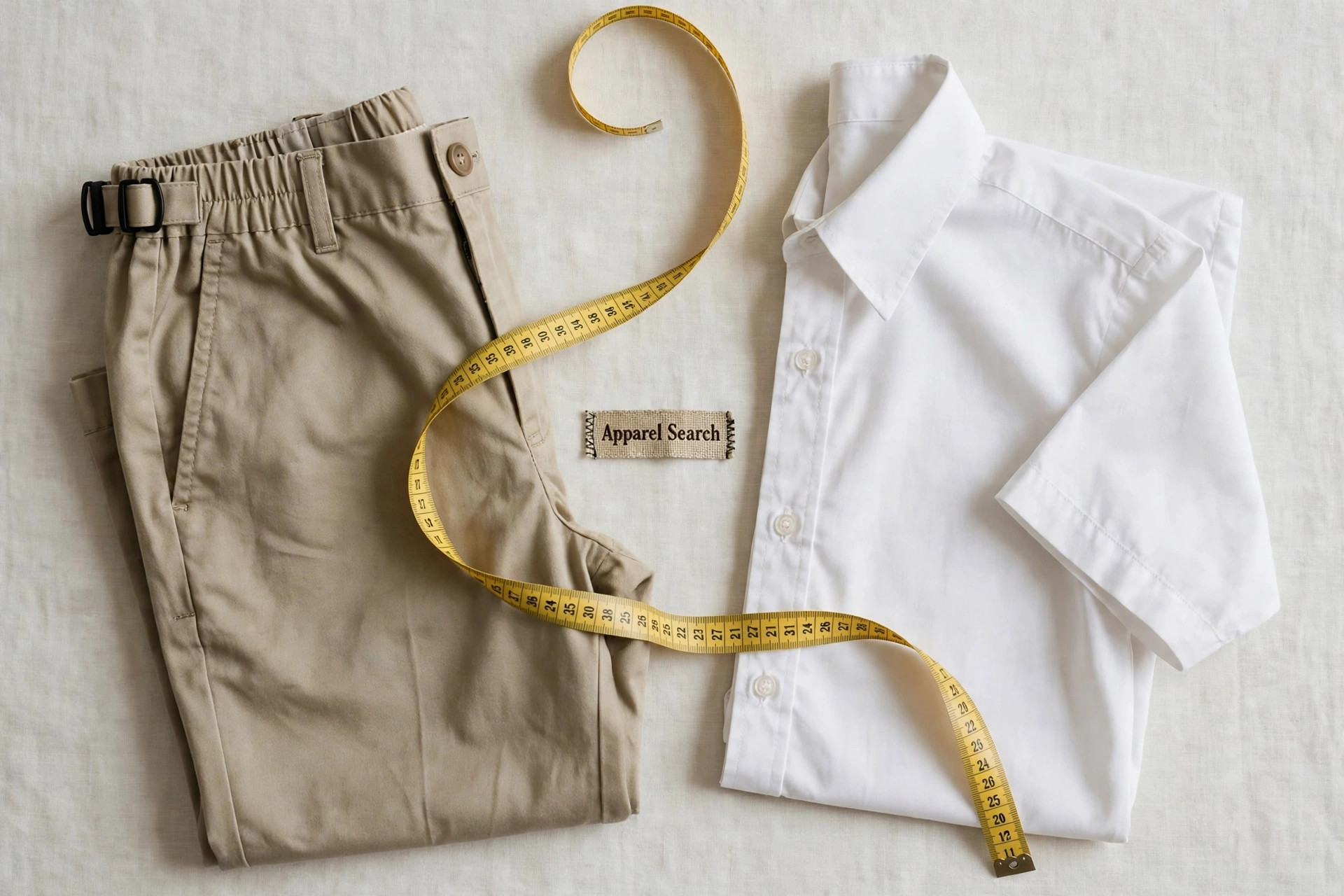
Measure First: Four Numbers
- Height. Bare feet, back against a wall, book flat on the head. Height is the anchor measurement for most children’s uniform size charts.
- Chest. Tape around the fullest part of the chest, under the arms, over a thin T-shirt — the number that sizes shirts, polos, jumpers and blazers.
- Waist. The natural waist, where the trousers will actually sit — for school trousers this is usually at or just below the navel on younger children.
- Inside leg. From the top of the inner thigh down to the ankle bone, with the child standing straight — the number that decides whether a hem needs letting down or taking up.
Keep the numbers with the school paperwork. They turn every later purchase — the mid-year replacement, the next sibling’s first set — into a chart comparison instead of a guess, and the same habit serves for shoes: our guide to measuring feet covers the tracing method fitters use.
Order for thirty children at once and measuring becomes a system rather than a kitchen-table job. Our team sizing kits and reorders guide covers the team organizer’s version — sizing kits, collecting a whole roster’s sizes, size-run ratios and spares — for the school and club kits that sit beside the classroom uniform.
Growth Room That Actually Works
Adjustable waists. The single most useful growth feature in school clothing: an elastic-and-button adjuster inside the waistband takes trousers and skirts in for September and lets them out, notch by notch, as the year goes on. A pair with a working adjuster fits for a full size of growing.
Deep hems. Trousers and skirts are often made with a generous hem allowance precisely so it can be let down. Check before you buy: a hem that can drop an inch or more is a second size hidden in the garment. Our hemming and hand sewing guide covers letting a hem down at home — it is one of the simplest sewing jobs there is.
Length in the layer. Jumpers and blazers tolerate — and hide — growth better than anything else in the wardrobe: a slightly long sleeve and body in September is simply correct fit by spring. If any piece earns a cautious size up, it is the blazer, provided the shoulders sit close to right.
The honest limit. Growth room adjusts length and waist. It does not fix shoulders, chest or shoe size, which is why the size-up-everything strategy fails: the pieces that cannot adjust are the ones that decide the size.
Age Labels Are a Starting Point, Not a Size
An age on a label is the maker’s average child, not a measurement. Two children of the same age routinely stand a full size apart, and makers cut to different averages. Measure, compare against the maker’s own chart for that garment, and where a child falls between sizes, choose by the garment: tops take the larger, adjustable bottoms take the smaller and let out.
Shoes: The Other Fit
Uniform fit checks usually stop at the clothes, but the highest-hours fit in the wardrobe is on the feet. School shoes are worn all day, every day, on feet that are still growing — school-age feet commonly need a fit check every four to six months. Our kids’ shoe fitting guide works through the wiggle-room question and the five checks to run before you pay; the short version is that a thumb’s width of growing room is right, a size and a half of it is a trip hazard in the corridor.
Between Sizes, Mid-Year, Next Sibling
Three recurring situations, three short answers. Between sizes: decide by garment, as the definition box above sets out — and prefer the size whose adjustable features have travel left in them. Mid-year: re-measure before replacing; children often grow in one dimension at a time, and the fix may be a let-down hem rather than a new pair. Handing a uniform down: the next child gets the measurements taken fresh — a sibling’s old size is a hint, never a chart. Cross-check any imported or hand-me-down sizing against the clothing size conversion chart when labels come from another system.
Shop School Uniforms on Amazon
Ready to shop? Product links are kept in one place on the Apparel Search shopping guide:
Shop Clothing on AmazonThis link opens the Apparel Search shopping guide for Amazon, where the product links are kept in one place.
Common Questions
Should I buy school uniforms a size bigger for growth?
Partly, and piece by piece. Tops tolerate a size up — a slightly long polo settles within weeks. Trousers bought a full size up bunch at the waist and pool at the shoe, and still wear out at the knee first. The growth room that works is built into the garment: an adjustable waist, a hem with length to let down, a blazer with sleeve length in reserve. Buy the current size with those features before buying the next size without them.
How do I measure my child for a uniform?
Four measurements cover most uniform charts: height, standing straight against a wall; chest, around the fullest part with the tape under the arms; the natural waist, where trousers will sit; and the inside leg, from the top of the inner thigh to the ankle bone. Write the numbers down in centimetres and inches, and shop from the measurements — age labels on children’s sizes vary too much between makers to trust alone.
What fit checks can I do at home?
Four quick ones. The shoulder seam should sit at the edge of the shoulder, not down the arm. The waistband should admit two fingers and no more once adjusted. The trouser hem should just touch the shoe, not puddle on it. And the child should be able to raise both arms, sit down and bend to the floor — the desk, the corridor and the playground in three movements — without pulling or riding up anywhere.
How often should I re-check the fit?
Twice a year is the workable rhythm: once when you buy, and once at the winter break, when the summer and autumn growth shows. Check hems against the shoe, waistbands at their last adjustment hole, and shoe fit — feet grow on their own schedule, and our kids’ shoe fitting guide suggests checking school-age feet every four to six months.
Back to the School Uniform Buying Guide
Measuring, growth room and fit checks — one part of the full school uniform buying section for parents.