Apparel Search Consumer Guides
Making School Uniforms Last
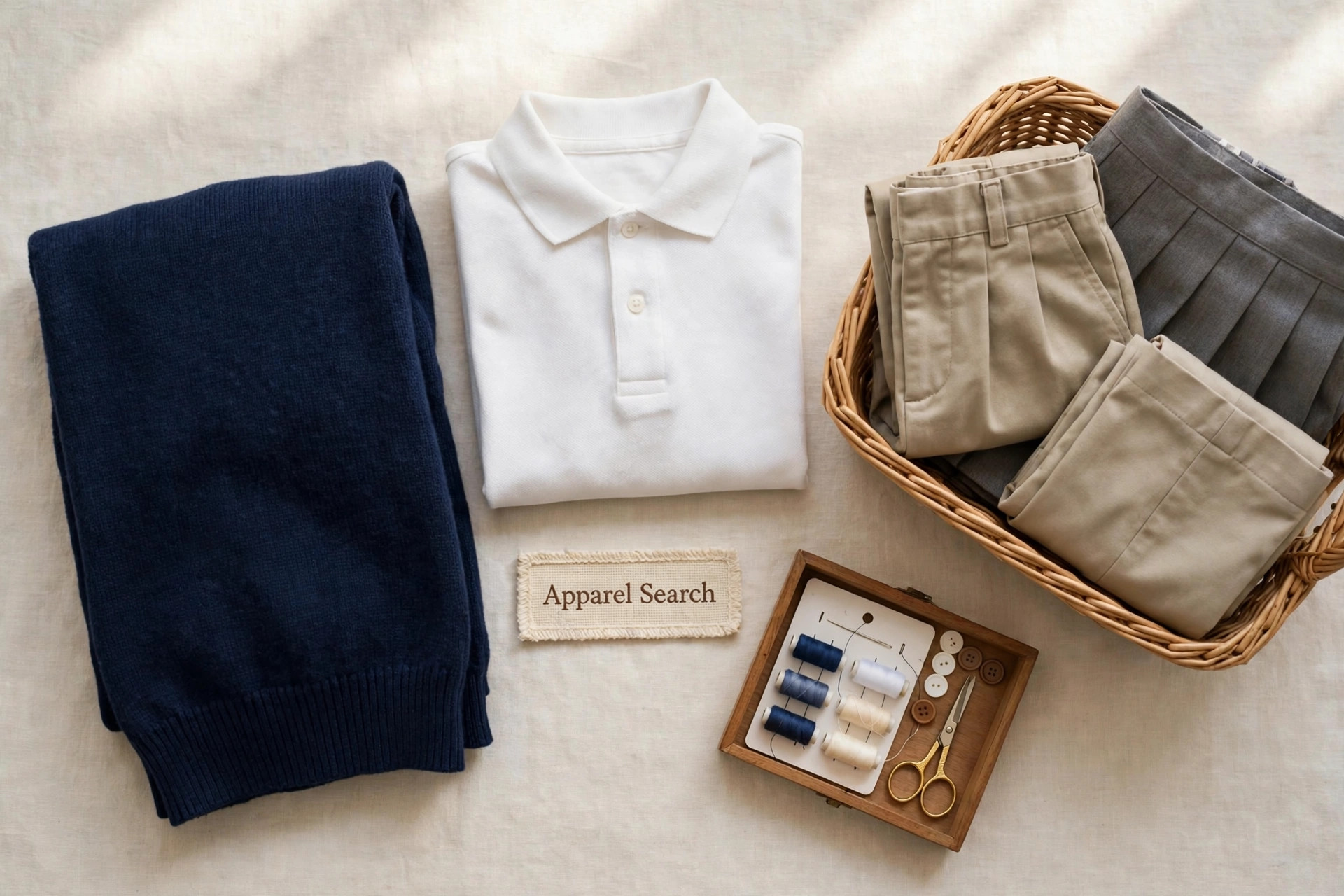
No wardrobe works harder: the same pieces, worn daily and washed weekly, all school year. Durability, rotation and small repairs are what get them through it.
No wardrobe in a child’s life works like a school uniform: the same few pieces, worn every day, washed every week, sat on floors and dragged through playgrounds, for a whole school year — and often handed down to do it again. Longevity is not luck. It is decided by what you buy (construction), how you rotate it (never the same piece two days running), how you wash it, and whether small damage gets ten minutes of attention while it is still small. This page takes those four in turn; it is the care companion to the buying guide and the quantities checklist, whose numbers assume exactly this routine.
Buy for the Wash Cycle
Uniform fabrics are chosen for the wash they will actually get. Polycotton shirts and polos hold their colour and shape through weekly washing where pure cotton fades and twists; that is why the school-uniform version of a garment is so often a blend even when the ordinary version is not. The construction details that predict survival are checkable in the shop: reinforced knees on trousers, double-stitched seams at the stress points, a collar that holds its fold, buttons sewn through rather than glued, and a zip with a metal or heavy-duty plastic slider. The children’s uniforms guide covers fabric and construction from the garment side; our wider making clothes last longer guide sets out the same principles for the whole family wardrobe.
Rotation Is the Whole Secret
Fabric and elastic recover between wearings; a garment worn two days running gets neither the rest nor the airing, and comes back to the body with yesterday’s strain still in it. The rotation built into the checklist — tops changed daily, bottoms alternating — is therefore a durability system, not just a laundry one. Practical points: hang the day’s uniform up to air when it comes off, rather than into the wash basket by default — many pieces need airing, not washing; keep one full set as the untouched spare, so rotation never collapses when a piece is drying; and let shoes rest a day between wearings where a second pair exists, since damp leather and foam break down fastest when never allowed to dry.
Stain Realities
The uniform stain list is short and predictable: grass at the knee, ink at the cuff and pocket, food down the front, paint and glue in the early years, mud everywhere in the wet terms. The rule that governs all of them is time — a stain treated the same evening is a laundry problem, and a stain treated after a hot wash and dry is a permanent one. Keep the routine simple: rinse or soak the piece when it comes home, treat the stain before the wash rather than after, and never tumble-dry a piece whose stain survived the wash, because the heat sets it. The stain removal guide works through the common stains by type, and the sorting and washing guide covers the load decisions — whites as their own load chief among them — that keep school shirts white.
Repairs: Small and Early
The uniform repair list is as predictable as the stain list: a loose button, a hem coming down, a knee thinning, a small seam opening at the pocket. Every one is a ten-minute job at the small stage and a replacement at the large one. The basic clothing mending guide covers buttons, seams and patching step by step; letting down a hem for the growth spurt is in the hemming and hand sewing guide. Keep the kit where the uniforms live — needle, thread in the uniform colours, spare buttons saved from every garment’s spare-button bag — and do the repair the week it appears, ideally the evening it is noticed.
The Second-Hand Round
A uniform that is outgrown in good condition is the most reusable garment in children’s clothing: the specification never changes, so the next wearer’s school is guaranteed to want exactly it. School second-hand sales, uniform exchanges and younger siblings are the natural routes. Before a piece changes hands, wash it, do the small repairs, and remove or cover the name label — the piece starts its second round in the condition you would want to receive it.
The Annual Audit
Once a year — at the summer buy — spread the surviving set out and judge it piece by piece against the fit and fabric tests in the sizing guide: what still fits stays in the rotation, what is outgrown in good condition goes to the second-hand round, and what is worn out becomes the spare and practice set before it leaves the house. The audit is what turns uniform buying from an annual emergency into a top-up — and it is the practical heart of the garment care approach this site takes to every wardrobe.
Shop School Uniforms on Amazon
Ready to shop? Product links are kept in one place on the Apparel Search shopping guide:
Shop Clothing on AmazonThis link opens the Apparel Search shopping guide for Amazon, where the product links are kept in one place.
Common Questions
How do I stop uniform trousers wearing out at the knee?
Three habits, in order of effect. Rotate at least two pairs so no single pair takes every day’s playground. Choose reinforced-knee styles when you replace — the extra layer is sewn where the wear is. And patch early from the inside: an iron-on patch applied when the fabric first thins, before it holes, doubles the remaining life of that knee. Once a hole is through, the pair becomes the spare set.
Why do white uniform shirts turn grey or yellow?
Usually the wash, not the shirt. Overloaded machines leave soil in the water to resettle on the load; mixed loads transfer dye from dark pieces; and too little detergent for a genuinely dirty load leaves the grime nowhere to go. Wash whites as their own load, dose for the soil level, and keep the machine’s drum and seal clean. Our laundry guide covers the dosing and sorting decisions in full.
Are more expensive uniforms worth it?
Judge them the way the wardrobe experiences them: cost divided by wears. A uniform piece is worn one to three times a week for a school year, so a trouser that costs half as much again but survives two school years — and a sibling — is the cheaper trouser. The features that predict survival are construction details, not brand names: polycotton that holds colour, reinforced knees and seats, double-stitched seams, zips and buttons that can be replaced.
When is a uniform beyond saving?
When the fit is gone — hem fully let down and still short, waist at its last notch — or when the fabric has thinned at the stress points (knees, seat, elbows, collar folds) so that a repair has nothing sound to hold to. A piece that fails on stains or buttons alone is not finished: it becomes the spare set, the art-apron cover, or the muddy-day rotation, and only leaves the wardrobe when fit or fabric gives out.
Back to the School Uniform Buying Guide
Durability, rotation, stains and repairs — one part of the full school uniform buying section for parents.