Apparel Search Consumer Guides
School Uniform Checklist and Quantities
How many of each piece a child actually needs — counted against the rhythm of your household’s wash day, not a retailer’s bundle.
Every uniform retailer sells a bundle; every bundle is a guess. The quantities that actually work are set by three facts about your household, not by a package: how many school days pass between laundry days, how young the child is (and therefore how often a top survives the day), and how the school’s week is built — PE days, formal days, muddy seasons. This page gives the common retailer guidance ranges category by category, then shows how to adjust them to your own rhythm. It assumes the wardrobe itself is settled by the dress code; the buying guide covers that order of work.
Start With the Laundry Rhythm
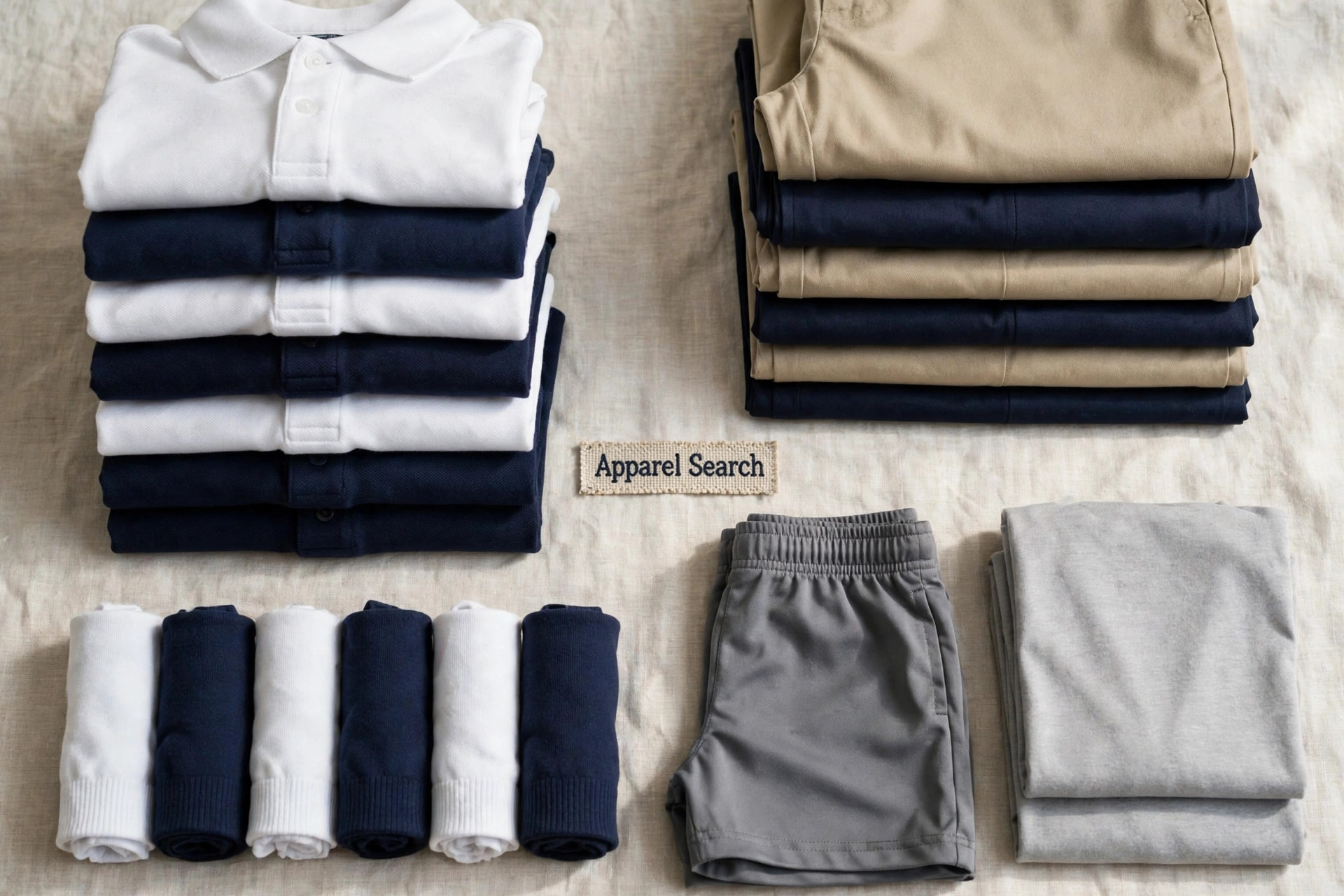
Count the school days between your laundry days; that number, plus one, is the floor for anything worn daily. A once-a-week wash means five school days to cover, so five tops minimum and a spare for the day a top comes home painted. A twice-a-week wash cuts the same wardrobe to three or four tops. Bottoms, which are not usually washed after every wear, divide differently — two or three pairs cover either rhythm. Everything else on this page hangs off that first count.
The Checklist, Category by Category
Everyday tops — 5 (range 3–7)
- Polo shirts or buttoned shirts in the code colours: five is the one-per-day standard.
- Younger children and messy eaters: lean to six or seven — tops fail by stain before they fail by wear.
- Long-sleeve versions where the code allows a seasonal swap: two or three alongside the short sleeves.
Bottoms — 2 to 3 pairs (range 2–4)
- Trousers, shorts, skirts or skorts in the code colours.
- Two pairs rotate comfortably; three covers the pair in the wash and the pair on the child.
- Summer and winter weights count separately in schools with a seasonal code.
Layers — 1 to 2
- Jumper, cardigan or sweatshirt in the code colour: one worn, one spare or in the wash.
- Blazer, where required: one — it is worn daily but cleaned rarely, and it is the piece most often bought with growth room.
- Tights for winter, where skirts are worn: three to five pairs — tights ladder, and they are bought in rotation.
PE kit — 1 set minimum, 2 comfortable
- Shorts or skort and a plain T-shirt or polo in the specified colour.
- Trainers reserved for PE, plus a named kit bag.
- A second set if PE falls on consecutive days or the kit comes home wet in winter.
Socks and underwear — a week, plus spares
- Uniform socks in the code colour: seven to ten pairs, all identical, so losses never orphan a single.
- Underwear follows the same count as for any school week; the uniform-specific point is colour — pale underwear under white shirts, and nothing that shows through.
- The children’s socks guide covers sock types and sizing in detail.
Shoes — 1 school pair, 1 PE pair
- School shoes in the code’s colour and style: one pair, fitted — see the children’s shoes guide for the category and our sizing page for the fit checks.
- Trainers for PE, counted with the kit above.
- Wellington boots where the school asks for them: one pair, kept at school in wet terms.
Build the Rotation
- Mark the wash days. Write down the days laundry actually happens in your house — not the plan, the habit.
- Count school days between washes. That count plus one spare is your tops number; half of it, rounded up, is close to your bottoms number.
- Add the failure spare. One extra full set — top and bottom — exists for the spill, the torn knee and the morning nothing is clean. It is the cheapest insurance in the wardrobe.
- Label as you unpack. Quantities only work if the pieces come back: name labels in every garment, including socks and the PE kit, before the first school day.
The Mid-Year Top-Up Is Normal
These quantities buy a September wardrobe, not a promise. Plan one small mid-year purchase — the growth spurt, the worn-through knees, the lost blazer — and the arithmetic in this page stays honest. The guide to making uniforms last covers the repairs and rotation habits that keep the top-up small.
Shop School Uniforms on Amazon
Ready to shop? Product links are kept in one place on the Apparel Search shopping guide:
Shop Clothing on AmazonThis link opens the Apparel Search shopping guide for Amazon, where the product links are kept in one place.
Common Questions
How many school uniform tops should I buy?
Five is the common starting point — one clean top for each school day — and retailer guidance generally runs from three to seven depending on laundry. A household that washes once a week needs the full five plus a spare; a household that washes twice a week can run the year on three or four. When in doubt, buy five: the spare top is the one that saves a school morning.
How many pairs of trousers, shorts or skirts?
Fewer than tops, because bottoms rewear better and wash less often. Two or three pairs rotating is the common pattern; retailer guidance for younger children runs to three or four, since playground falls and paint reach bottoms first. Adjustable waists matter more here than the count — one pair that fits all year beats two that stop fitting in February.
What belongs in the PE kit?
Whatever the code specifies, usually plain shorts or a skort, a plain T-shirt or polo in the house or school colour, trainers that stay at school or travel in the kit bag, and socks. One full kit is the minimum; a second set is the comfortable standard, because PE days rarely move for laundry. Add a named kit bag — PE kit is the most-lost clothing in any school.
How many pairs of uniform socks should we own?
A pair for every school day plus spares: seven to ten pairs covers a week, a lost one and a wet-weather change. Socks are the cheapest piece in the wardrobe and the one most often missing at 7 a.m., so this is the category to overbuy slightly. Buy them all the same colour and style, so any two make a pair.
Back to the School Uniform Buying Guide
Quantities, the dress code, sizing and budget — the full school uniform buying section for parents.