Apparel Search Consumer Guides
How to Sort and Wash Clothes
The separations that earn their keep, water temperature by fabric, cycle choice, and detergent measured rather than guessed.
Of all the stages in our laundry guide, the wash is where clothes take the most wear — agitation, water and chemistry working together are exactly what a garment experiences nowhere else. It is also the stage most surrounded by folklore. Sorting, in particular, is usually taught as a long list of rigid categories, when in fact it is three different decisions wearing one name. This page separates them: what each kind of sorting protects against, the temperatures and cycles that follow from the fabric in the drum, and how to dose detergent so it cleans instead of coating.
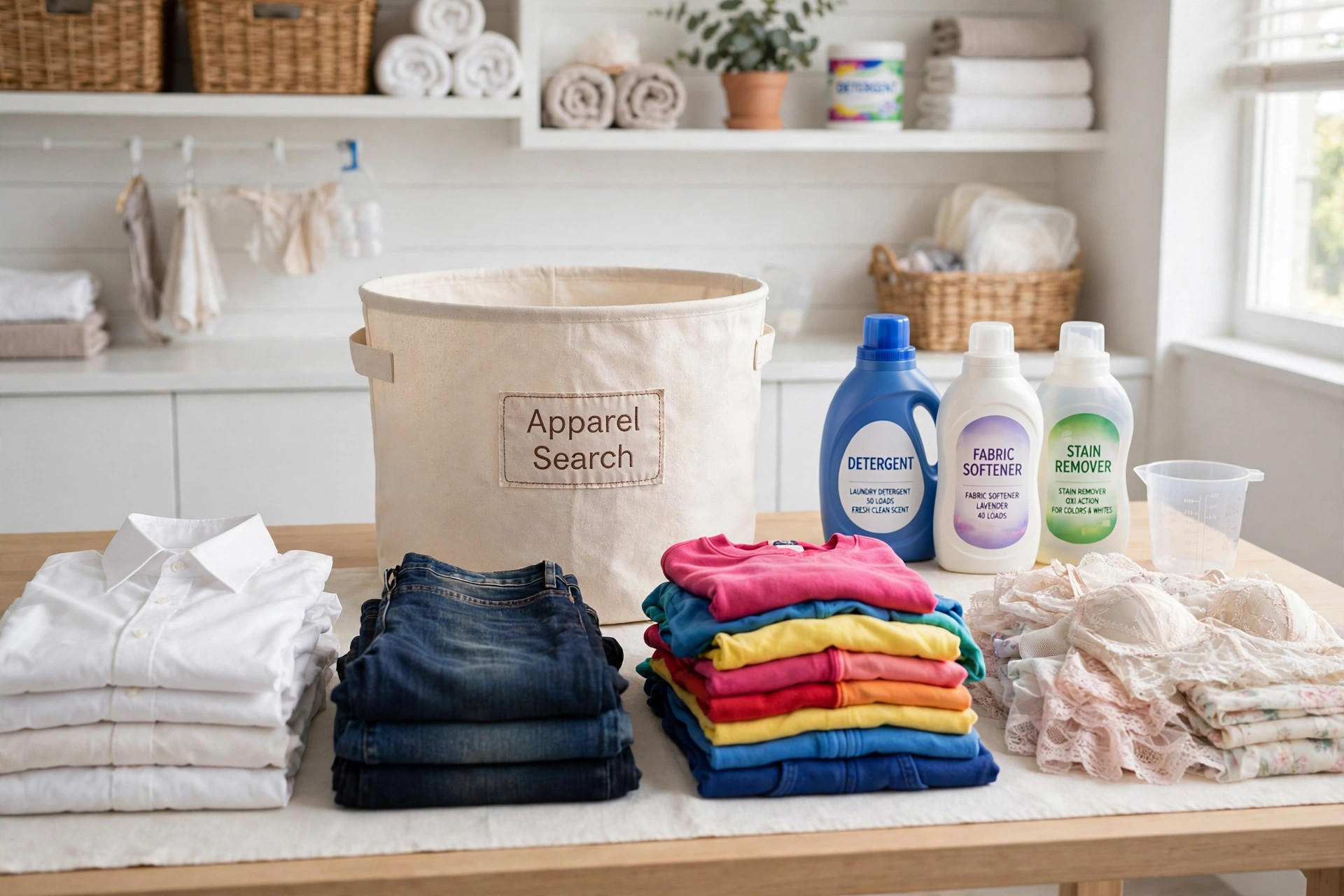
Sorting: Three Separations, Not Ten
Color is the separation everyone knows, and it is really about dye transfer. New, dark and saturated garments shed loose dye in their first washes, and light fabrics pick it up. Once a garment has been washed several times the risk falls sharply — which is why the practical rule is strict at the start and relaxed later: whites on their own if you want them to stay white, new darks and brights apart for their first washes, established colors free to share a cold load.
Fiber and weight protect against mechanical damage and lint. Towels, fleece and flannel shed lint that clings to smooth dark fabrics; heavy denim, zippers and hooks batter lighter garments as the drum turns. Delicates — lace, lingerie, fine knits — belong in mesh bags or a gentle load of their own, and washable wool and silk follow their labels out of the general run entirely.
Soil is the separation nobody mentions. Genuinely dirty clothes — workwear, gardening clothes, greasy kitchen cloths — carry enough soil and oil to redeposit a gray film on lightly worn garments washed with them. Heavily soiled loads travel together, and they are also the loads that may honestly earn warmer water.
What is mostly habit: separating every shade into its own small load, sorting by owner, or running half-empty drums out of caution. A working default covers nearly every household — whites, lights, darks and brights, plus a mesh bag for delicates — four decisions instead of ten.
Build the Load
- Empty and close. Check every pocket, close zippers and hooks so they cannot snag neighbors, and turn dark and printed garments inside out so the visible face is protected from abrasion.
- Pre-treat stains now. The wash supports a treatment; it rarely replaces one, and tumble-dryer heat can set an untreated stain permanently. Work through the stain removal guide first, then wash.
- Read the labels of anything new. A garment's first wash is when its surprises happen — shrinkage, bleeding, a finish that hates heat. The care label symbols take ten seconds to check and set this load's limits.
- Load loosely. Fill the drum about two-thirds to three-quarters full of loose handfuls. Clothes clean by falling through water; a packed drum rinses badly, creases deeply and comes out dirtier than a smaller load would.
- Dose for this load. Measure detergent for the load in front of you — its size, its soil, your machine — not for the largest load the bottle imagines.
Water Temperature by Fabric
Temperature is a decision about soil and chemistry more than about bravery, and the care label sets each garment's ceiling.
- Cold (up to about 30°C / 85°F) is the default setting, and the right one for most of what most people wash: darks and brights, most synthetics, prints, elastic-rich garments, anything new, and any protein stain such as blood, which hot water sets instead of lifting. Modern detergents are built to perform here.
- Warm (about 40°C / 105°F) suits whites and lights that need brightening, sturdy cottons and linens with real soil, and the regular rotation of bedding and towels — a useful middle setting, not a compromise.
- Hot (about 55–60°C / 130°F and above) is the sanitizing setting: bedding and towels from a sickroom, cloth diapers, heavily soiled workwear, greasy kitchen cloths. Its costs — faster fading, shrinkage, aged elastic, higher energy use — are why it is reached for on purpose rather than by default.
Choosing the Cycle
- Normal for sturdy cottons, linens and everyday blends — the workhorse, with full agitation and a fast spin.
- Permanent press for synthetics and wrinkle-prone blends: gentler action and a cool-down that leaves fewer creases set in.
- Delicate for lingerie, lace and fine knits, and for washable silk or wool where the label allows machine washing — low agitation, and mesh bags as a second line of defense.
- Heavy duty for towels, bedding and work clothes: a longer, stronger wash for loads that are bulky, absorbent or genuinely dirty.
- Spin speed is part of the choice. A faster spin means less drying time and more set creases; knitwear and delicates are better off with a slower spin or none.
Detergent: Types and Dosing
- Liquid dissolves reliably in cold water, doubles as a pre-treatment dabbed on a stain, and suits most everyday washing.
- Powder is traditionally strong on whites and ground-in soil; kept dry in storage it stays effective, but an overdose in a cold, packed drum can leave residue on dark fabrics.
- Pods and pacs trade control for convenience: the dose is fixed, which makes it too much for a small load and impossible to reduce. They also need safe storage away from children, who mistake them for sweets.
- Delicate and wool washes are milder, lower-suds formulas made for fibers that resent strong chemistry — the right partner for the delicate cycle.
Dosing is where laundry most often goes wrong, and it goes wrong upward. Excess detergent cannot rinse out of the fabric, so it stays behind — dulling colors, stiffening towels, trapping odor and eventually feeding the musty smell people blame on the machine. High-efficiency machines need notably less, and low-suds HE detergent, because a drum of foam cushions the very falling action that cleans. Use the cap's printed lines for load size and soil; hard water may call for slightly more, soft water for less. The opposite error exists too — persistent graying over many washes usually means too little detergent or a drum loaded too full for the dose.
The Residue Test
If clean clothes come out stiff or faintly soapy, or the machine smells musty despite an empty hot run, suspect overdosing before you blame the detergent brand. An extra rinse, a few loads at a measured smaller dose, and looser loading settle most cases — what feels like a cleaning problem is usually a rinsing problem.
The strictest sorting case in this guide is the chef whites load: coats and aprons washed alone, after every shift, with the bleach matched to the fabric. See the chef clothing fit and care guide for the full kitchen application of these rules.
The same dosing care is the laundry half of dressing for sensitive skin: measured detergent and a second rinse leave less in the fabric. Our eczema-friendly clothing guide covers the choosing half — fibers, seams and labels — that this washing routine supports.
Common Questions
Do I really have to sort laundry?
Three sorts cover nearly everything: color risk, fiber and delicates, and soil. Beyond those, no — a cold mixed load of established colors is perfectly reasonable for everyday clothes, and most households sort far more finely than their clothes require. Sorting is risk management, not ritual: it exists to stop dye transfer, lint, battering and redeposited soil, and once those four are handled, the rest is preference.
Does cold water actually get clothes clean?
Yes, for everyday soil. Modern detergents are formulated to work in cold water, and for the soil most clothes carry — body oils, light dirt, city dust — cold water and the right dose clean fully. Cold also protects the things washing damages: color, prints, elastic and fit. Warm and hot water are for specific jobs — whites that need brightening, heavy soil, and loads that need sanitizing — not a stronger clean for ordinary laundry.
How much detergent should I use?
What the cap's lines say for your load size and soil level — and in a high-efficiency machine, less than instinct suggests, with HE detergent. The commonest dosing error is using too much: the surplus cannot rinse away, so it stays in the fabric, dulling colors, stiffening towels and feeding the musty smell inside the machine. Too little shows up differently, as a slow graying over many washes. When in doubt, measure — do not pour.
Can I wash everything together on cold?
Mostly, once two conditions are met: the colors are established (new dark and bright items washed separately for their first few washes, while loose dye remains), and the delicates are protected in mesh bags or held out. Keep whites in their own load if you want them to stay white, since they pick up a gray cast from mixed loads over time. And any label that directs its own treatment overrules the convenience.
Back to the Laundry Guide
The whole of wash day in order — sorting through drying, finishing and putting away.