Apparel Search Consumer Guides
Period Underwear Care & Washing
The rinse-wash-dry routine that keeps absorbent underwear absorbing: cold water, no fabric softener, air to dry, and a rotation that rests each pair.
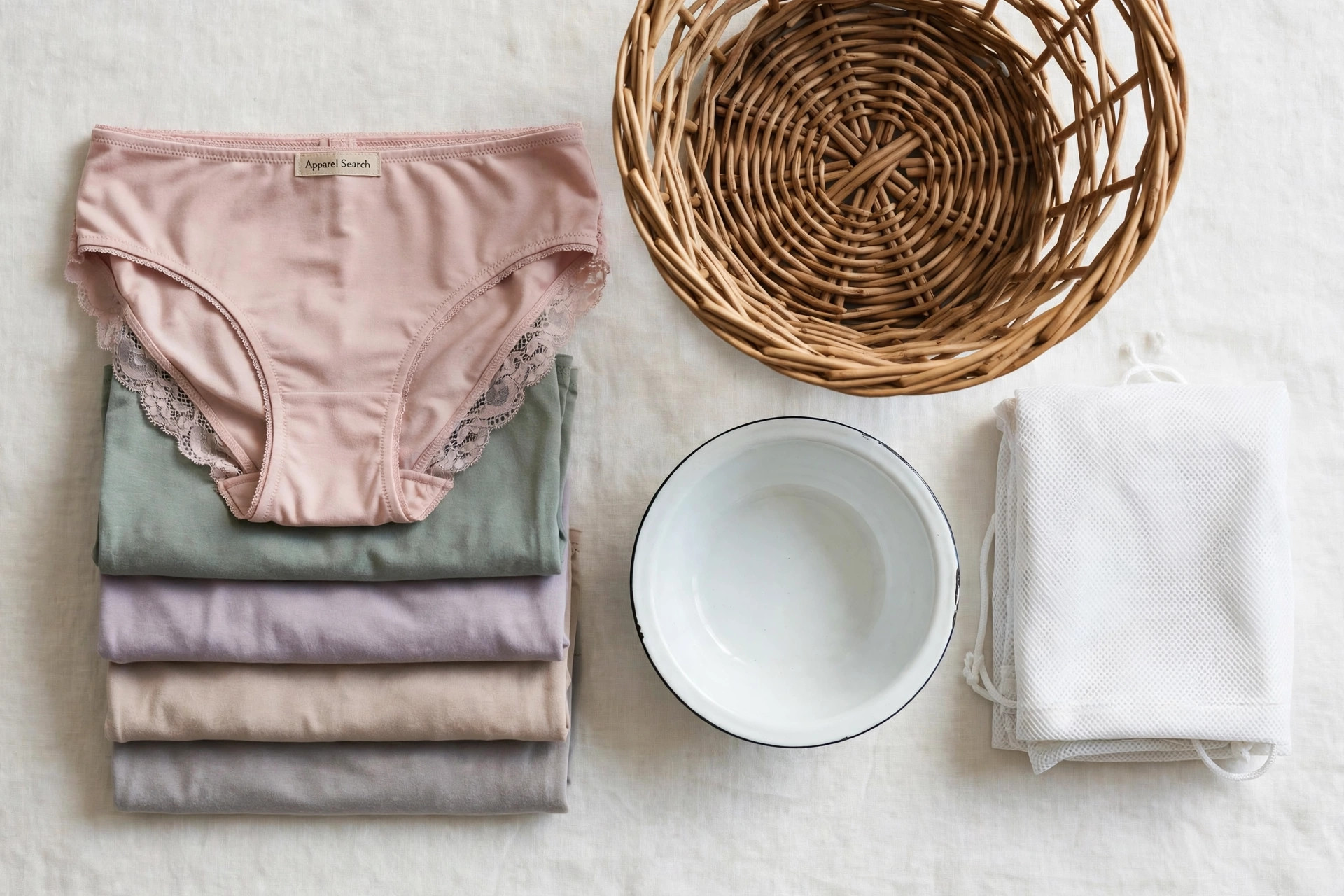
Period underwear asks for a slightly different laundry routine than the rest of the drawer, and the difference is not fussiness — it is the garment’s construction, set out in our period underwear buying guide: a layered absorbent gusset that has to stay absorbent. Every step below follows from that one fact. The routine takes a minute at the sink and a place in an ordinary wash load, and it sits naturally inside the wider system of our laundry guide.
The Wash Routine in Five Steps
- Rinse cold, soon after wear. Hold the gusset under cold running water and rinse until the water runs mostly clear, squeezing gently. Cold is the rule for protein-based stains — heat sets them, which is the same reasoning the stain removal guide gives for the wash itself. A pair that cannot be rinsed right away can wait in a wet bag or a covered bucket of cold water until wash day.
- Machine wash cold, on a gentle cycle. Turn the pair inside out, place it in a mesh wash bag so the absorbent panel is not abraded by zips and hooks, and wash at cold or cool temperatures with a measured dose of ordinary detergent. Period underwear washes happily in a mixed load of similar colors — the rinse already did the specialty work.
- Skip the fabric softener and the bleach. Fabric softener works by coating fibers, and a coated absorbent fiber absorbs less — it is the one common laundry product that directly undermines this garment. Bleach breaks down the absorbent core and the elastics over time. The detergent guidance in our guide to sorting and washing clothes covers dosing for loads like this one.
- Air dry. Hang or lay flat until fully dry. Dryer heat degrades the absorbent core, the leak-resistant backing and the leg elastics a little with every cycle, which is why most makers specify line drying. A minority of brands allow a low tumble — that instruction, where it exists, is printed on the pair’s own label.
- Store only when fully dry. An absorbent garment put away damp is an odor problem being scheduled. Dry pairs fold back into the rotation; the drawer math is in the next section.
Rotation and Lifespan
Absorbency is a wearing part. With every wash the core loses a little of its capacity, leg elastics relax a little, and the backing ages — slowly, but in one direction. Brands express the expectation differently (a number of washes, or one to two years of regular rotation), and the honest reading is the same either way: lifespan is counted in washes, so the more pairs share the work, the longer each pair lasts. Rotation is therefore a care practice, not just a supply question — the rest days between wears also let elastic recover its grip, exactly as our making clothes last longer guide argues for the rest of the wardrobe.
Retirement signs are practical ones: a pair that leaks at a flow it used to handle, leg elastic that no longer sits snug, a smell that survives a proper wash, or a gusset that feels thin and stiff. Retired pairs still work as light-days and backup underwear for a while before they leave the drawer entirely.
Odor Care
Odor in absorbent underwear is almost always a laundry problem rather than a product problem, and it has three usual causes: pairs washed before they were rinsed well, pairs stored damp, and detergent residue building up in the core. The fixes match the causes. Rinse thoroughly at the sink. Dry completely before the drawer — in a humid bathroom that may mean a rack near a window rather than the rail over the tub. And once in a while, give the rotation a long cold soak with detergent before the wash, which clears residue out of the absorbent layers. Strong fragrances and boiling water are not needed and hard use of either shortens the garment’s life.
Fitting It Into the Household Laundry
The system that works in real homes is a small one: a wet bag or lidded bucket where worn pairs wait for their rinse, a mesh bag that lives by the machine, and a folding habit that returns dry pairs to the front of the drawer so the rotation stays even. Sorting rules stay the household’s own — our sorting and washing guide covers where rinse-first garments fit a normal routine — and the garment care guide covers the general principles (read the label, wash cooler, dry gently) that this specialty garment simply takes seriously. Speaking of labels: the symbols on the waistband tape are decoded in our care label symbols page.
The Care Label Outranks This Guide
Brands build their gussets from different recipes, and a few specify warm washes or allow low tumble drying that this general routine avoids. When a pair’s own care label disagrees with a general guide, follow the label — it was written for the exact layers in your hand. The label is also where any warranty-grade instructions (some brands tie guarantees to their wash routine) will be found.
Common Questions
Can you put period underwear in the washing machine?
Yes — machine washing is the standard method. Rinse the gusset under cold water first until it runs mostly clear, then wash cold on a gentle cycle, inside out and ideally in a mesh bag, with ordinary detergent. The two products to keep away from the load are fabric softener, which coats the absorbent fibers, and bleach, which breaks the core and elastics down.
Why should you skip fabric softener on period underwear?
Because of how softener works: it leaves a coating on fibers to make them feel smooth, and absorbent fibers are in the garment precisely to take liquid in. A coated core absorbs measurably less, wash by wash. The same caution appears on the care labels of most absorbent and technical garments for the same reason.
How long does period underwear last?
Count it in washes rather than months. With the rinse-and-air-dry routine, a pair in regular rotation typically serves for a few years before its absorbency fades; brands state their own figures, from dozens of washes upward. The retirement signs are a pair leaking at a flow it used to handle, loose leg elastic, or an odor that survives a proper wash.
Do you have to rinse period underwear right after wearing it?
Rinsing promptly in cold water is the best practice, because it keeps the gusset from holding a set stain into wash day. It is not a hard deadline: a pair can wait in a wet bag or a covered bucket of cold water, and travelers routinely rinse at the wash instead. What matters is cold water — heat is what sets protein stains.