Apparel Search Uniform Guides
Team Sizing Kits & Reorders
One wearer gets a fitting. Thirty wearers get a system — kits, forms, ratios and records that put the right size on every back, this season and next.
Ask thirty people their size and you will receive thirty answers in at least four different sizing languages — their jeans, their favorite brand, the size they intend to be, and the size they were in school. Group sizing fails on data, not on garments, and this page is about collecting it properly: physical sizing kits, honest collection methods, the ratios that govern stock orders, and the records that turn next season’s reorder from archaeology into arithmetic. It is the sizing half of our team uniform ordering guide.
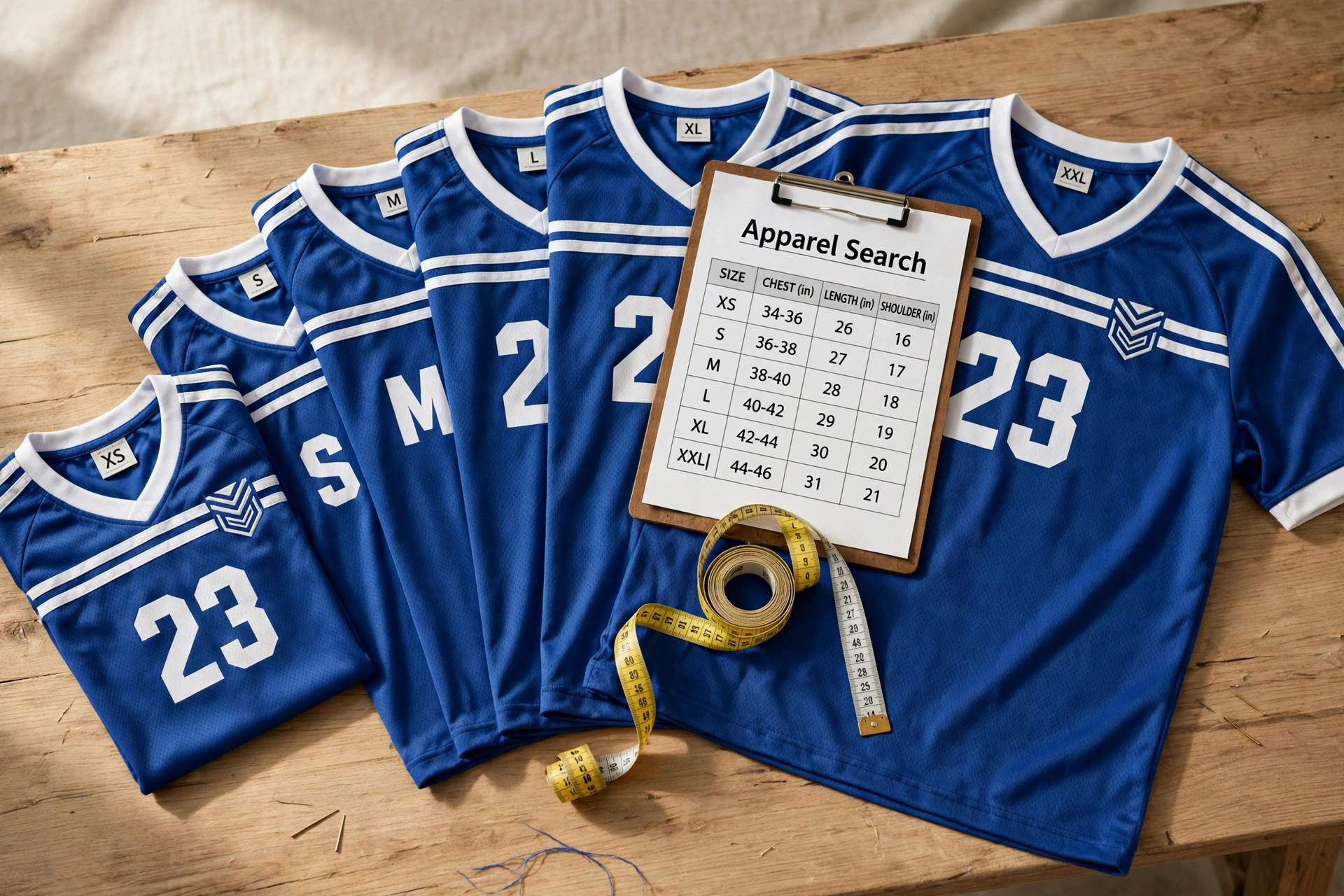
Sizing Kits and Sample Runs
A sizing kit is one garment in every size of the run — the actual jersey, in the actual fabric, not a cousin of it. Team dealers and manufacturers lend or sell kits for exactly this purpose, and a club ordering any volume should use one: sizes are labels, and labels lie differently in every brand, while a garment on a body settles the question in ten seconds. Run the kit like an event. Put it in the room where the group already gathers, work through the roster name by name, record the chosen size against each name and number, and have a second person read the list back. For groups that cannot gather, a sample run — one or two garments in the middle sizes, circulated with the maker’s measured size chart — is the workable substitute; our school uniform sizing guide works through the measure-first discipline for children, and the same four numbers — chest, waist, height, inside leg — anchor adult self-measuring too.
Collecting Sizes From a Group
Where forms are unavoidable, design them against the known failure modes. Ask for measurements or a tried-on size, never a bare letter: publish the garment’s own chart with the form, because a medium in this jersey is a measurement, not an opinion. Set a deadline tied to something real — no size by Friday means the organizer’s best guess from the spares pool. Chase by name, not by broadcast; a list of the six missing people, sent to the six people, outperforms three group reminders. And record everything in the roster document itself, beside the player’s number and name spelling, so the order, the decoration list and the distribution list are one file that cannot disagree with itself. The garment guides make the same point at single-wearer scale: our team jerseys guide fits shoulders and chest first, and our men’s uniforms guide warns that uniform grading is its own system, separate from fashion sizes — multiply that warning by a whole roster.
Size-Run Ratios for Stock Orders
Clubs that kit out whoever shows up — school programs, community leagues, work teams — cannot poll a roster that does not exist yet, so they order a ratio: a spread of sizes weighted to the middle of the adult bell curve. A typical stock pattern for an adult mixed group concentrates units in medium and large, carries a real but smaller count of small and extra-large, and a token presence at the extremes — then adjusts after season one, when the club’s own distribution data replaces the generic curve. Youth programs spread wider and shallower, because growth makes last year’s ratio stale. The discipline is to write down what you ordered and what you actually issued; the difference between the two columns is next year’s ratio, measured rather than guessed. Our children’s sports uniforms guide covers the parent’s side of the same problem — fit for movement and a season’s growth, with spares that win seasons.
Spares and Late Joiners
No roster survives a season unchanged. Players join late, kits are lost, a goalkeeper arrives in a size the curve never predicted. Spares are the buffer, and they work when they are planned as part of the order rather than begged from it afterwards: extra sets weighted to the middle sizes, at least one at each extreme the roster uses, and a decision — made in advance, with the decoration guide open — about whether spares sit blank for late personalization or pre-decorated with the design and no name. Single-piece reorders of decorated stock are usually possible but slow and expensive per unit; a sublimated replacement is a small production run of its own. The spare stock is what makes those facts survivable.
Reorder Consistency: Dye Lots and Discontinued Styles
A reorder is a promise that this year’s shirt matches last year’s, and two forces work against it. Dye lots: the same color name from a new production run can sit a shade off the original — usually invisible across a field, sometimes obvious in a team photo. Order spares from the first run where matching matters most, and expect to retire kits as sets rather than mix generations indefinitely. Discontinued styles: catalog garments have lifecycles, and a style dropped by its maker cannot be reordered at any price. Ask how established a style is before committing a multi-year program to it, and when a supplier warns a style is ending, that warning is your last economical chance to deepen the spares. Sport-specific guides see the same cycle from the wearer’s end — our softball uniforms guide advises ordering a full size run plus extras precisely because reordering one sublimated jersey later is slow and expensive.
The Record Is the System
Keep one file per program: roster with sizes and numbers, the supplier and order date, style numbers and colors, the artwork files and decoration specification, what was issued to whom, and what spares remain. Five seasons of organizers will thank the one who started it — usually by being able to reorder in a single phone call.
Common Questions
Players keep missing the size-form deadline. What actually works?
A fitting beats a form. Wherever the group can be gathered — registration night, a practice, a kit night — put the sizing kit in the room and let people try garments on, recording the size they chose against their name on the spot. Forms work for the remainder when they carry the garment's real measurements, a deadline with a consequence, and one named person chasing. Self-reported sizes with neither are how a roster ends up with six mediums nobody can wear.
How many spare uniforms should a club hold?
Enough to field the team when the inevitable happens: a common working pattern is a small stock of extra sets weighted to the middle sizes — a couple of mediums and larges rather than one of everything — plus at least one spare in any size the roster actually uses at the extremes. Spares cover late joiners, losses, damage and the player who grows two sizes between September and March.
The style we ordered has been discontinued. Now what?
First, ask the supplier what replaced it — makers usually carry a successor style, and a close match in the same colors often passes unnoticed, especially for new players. Second, buy time: move your best remaining stock to the most visible roles. Third, learn the lesson forward — when a kit matters for years, ask at ordering how long the style has been in the line and keep your spares deeper in its final seasons.
Should spare uniforms be decorated in advance or kept blank?
It depends on the decoration method, which is why the decision belongs in the first order. Heat-applied names and numbers turn a blank spare into a player's shirt in minutes, so blank spares work. Screen-printed spares must carry the design but not a name or number. Sublimated spares have to be finished shirts, ordered up front — there is no later.
Back to the Team Uniform Ordering Guide
The full process: roster and sizes first, garments, decoration, then timelines, deposits and the reorder plan this page supports.