Apparel Search Uniform Guides
Team Uniform Decoration Guide
A plain shirt is stock. A shirt with your crest, colors and numbers is a uniform — and the method that puts them there decides the cost, the timeline and how long it all survives the wash.
Every method in this guide does the same job — identity, applied to cloth — with a different tool, and the differences are practical, not aesthetic: what it costs to set up, what it costs per shirt, which garments it suits, and how it dies after fifty washes. Organizers who choose the method before the garment rarely regret it; organizers who choose it last discover that the garment has already chosen for them. This page compares the four working methods and then covers the two subjects every method shares: names and numbers, and where on the garment everything is allowed to go. It belongs to our team uniform ordering guide, which runs the full order from roster to reorder.
Screen Printing: The Workhorse
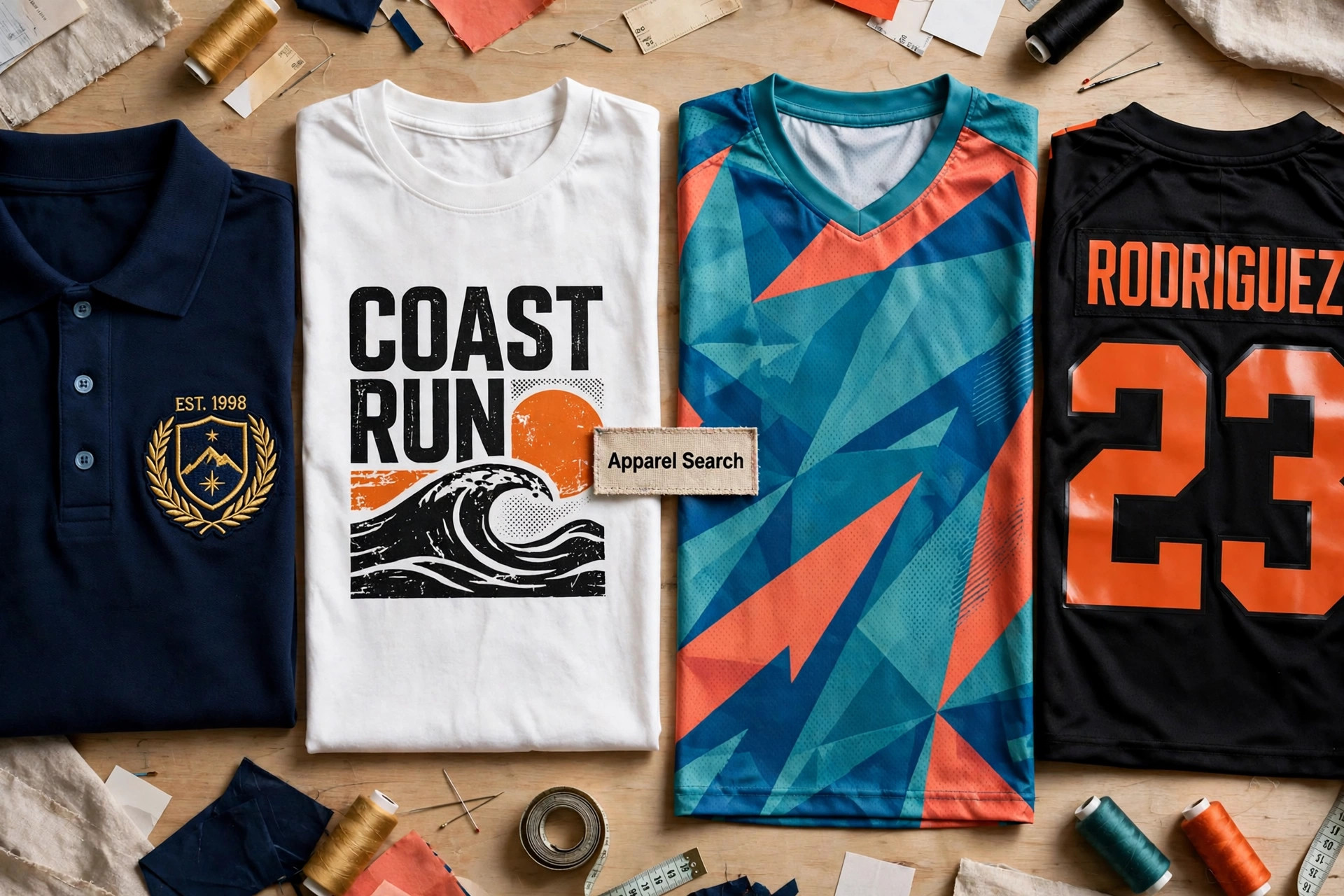
Screen printing forces ink through a mesh stencil — one screen per color — onto the garment’s surface. Its economics are the classic team-order shape: real setup cost in screens and preparation, then a low and falling cost per shirt as the run grows, which is why it rewards fixed designs and honest quantities. A cured plastisol print is opaque, bright and tough — it flexes with the fabric and shrugs off seasons of washing — but it sits on the cloth, so very large prints can feel heavy and can crack if under-cured or abused with heat. Best for: front and back designs on jerseys and tees at club quantities, one to three colors, bold shapes. Our screen printed shirts guide covers print quality checks and care from the buyer’s side.
Embroidery: The Quality Mark
Embroidery stitches the design in thread, from a digitized file that tells the machine every stitch. Setup is the digitizing; the running cost follows stitch count, so small and dense beats large and sprawling. Nothing else reads as quality at arm’s length — it is the standard for crests on polos, coaches’ and officials’ garments, caps, and staff and clubhouse apparel — and stitched thread outlasts most garments it decorates. Its limits are physical: fine detail and tiny lettering blur, large designs grow heavy and expensive, and stitching can pucker very light fabrics. Best for: left-chest crests, names on polos and jackets, headwear, and any garment whose wearer represents the club rather than plays for it.
Heat Transfer & Vinyl: The Personalizer
Heat-applied film — cut vinyl or printed transfer, pressed onto the finished garment — is the method of individual identity. Names and numbers are cut per player and applied at the end of the run, so a stock of identical jerseys becomes a named roster in an afternoon, and a blank spare becomes a replacement shirt in minutes. Per-piece cost is steady rather than falling, and there is effectively no setup, which makes it the small order’s friend. The trade-off is durability: film sits on the surface and is the first decoration to suffer under hot washing, tumble drying and ironing. Best for: names and numbers, small runs, late additions — and, in its modern performance films, lightweight numbering on technical fabrics where tackle twill would weigh too much.
Sublimation: The Design Is the Fabric
Sublimation dyes the design into polyester before or as the garment is made, so the graphic has no surface layer at all: nothing to crack, peel or fade, and no weight or hand-feel penalty. It is the only method that does true all-over design — gradients, patterns, photographic panels, sponsor art integrated edge to edge — and names and numbers are simply printed as part of each panel, perfectly matched forever. The constraints are structural: polyester (or high-polyester blends) only, light base colors for full effect, a longer custom timeline, and no way to decorate a finished blank later. Best for: fully custom team kits in sports where the design itself is the identity, and any program that can order its spares finished, up front. A neighboring digital route, direct-to-garment printing, suits short runs of detailed artwork on cotton tees — spirit wear more often than match kit.
Choosing, in One Pass
Fixed design, real quantities, cotton or blends: screen print it. A crest that must look and feel premium on staff garments: embroider it. Names and numbers, or a handful of shirts: heat-apply them. A design that covers the whole garment on polyester, with time to make it: sublimate it. Most mature club kits use two or three of the four — the methods are complements, not rivals.
Names & Numbers: The Rules Layer
Personalization is where decoration meets regulation. Leagues commonly specify number height, placement and stroke, whether player names appear at all, and whether numbers may repeat within a squad — check the current rulebook before artwork, because a non-compliant number set is a full reprint. Keep a single roster document as the source of truth for spellings: a name misspelled on a shirt was almost always misspelled first on the list the organizer supplied. Our team jerseys guide covers lettering methods and care from the garment side — sewn tackle twill, heat-applied and sublimated numbers each age differently, and the care routine follows the method.
Placement: Where Things Go
Convention is strong here, and leagues often codify it: the crest or club mark small at the left chest; the main design or team name across the front; the number large on the back, with the player name above it where names are used; smaller numbers repeated on the front or shorts in many sports; sponsor marks in the positions — and only the positions — the league permits. Two working rules prevent most errors: scale the artwork to the garment size rather than stamping one size on every shirt from youth small to adult XXL, and approve placement on a real garment, not a screen mock-up, because chest position reads differently on a body than on a rectangle.
Durability, Sport by Sport
Contact and sliding sports punish surface decoration: screen prints and vinyl take abrasion that sublimation simply does not feel, which is one reason sublimated kits dominate sports played on the ground. Indoor and low-contact sports can carry any method, so cost and look decide. Wash load matters as much as play: a kit washed after every game accumulates more decoration stress in a season than a kit washed weekly, and heat in washing and drying is the common enemy of every applied method. Whichever method you choose, its care instructions belong in the handout that goes home with the kit.
Common Questions
Which decoration method lasts longest on a team uniform?
Sublimation, where the garment suits it: the design is dyed into polyester fibers, so there is nothing on the surface to crack, peel or fade in the wash. Embroidery is the durability runner-up and the quality standard for crests and staff polos. Screen printing with properly cured ink commonly outlasts the fashion of the garment, while heat-applied vinyl is the most vulnerable to heat and hard washing — which is why it is usually reserved for names and numbers.
Can one kit mix decoration methods?
Yes, and most good kits do. A common pattern: a sublimated or screen-printed jersey front, an embroidered crest or sponsor mark where the garment is a polo or jacket, and heat-applied names and numbers so each shirt can be personalized at the end of the run. The methods are chosen per location and per garment, not per order.
What artwork does a decorator need from us?
Clean vector files (AI, EPS or PDF) for logos wherever possible, the exact colors specified, and the design at the size it will be produced. A low-resolution image pulled from a website forces the decorator to redraw it — usually at a charge, always at a delay. Approve a physical proof or a sewn/printed sample for any run that matters; screens and monitors lie about color and scale.
Can spares be decorated later to match?
That depends on the method, and it is worth deciding before the first order. Names and numbers in heat-applied vinyl are designed for exactly that — a blank spare becomes a player's shirt in minutes. Screen printing a single spare means remaking screens at setup cost. A sublimated design cannot be added to a finished garment at all, which is why sublimated programs order spare finished shirts up front.
Back to the Team Uniform Ordering Guide
The full process: roster and sizes first, garments, this decoration decision, then timelines, deposits and the reorder plan.