Apparel Search Uniform Guides
Team Uniform Costs & Timelines
A group order’s price is a stack of separable costs, each with its own logic — learn the stack and you can predict a quote, challenge one, and plan a season around it.
This page deliberately quotes no prices. What a jersey costs in one town, in one season, from one supplier, tells another organizer almost nothing — but the structure of the cost is the same everywhere, and structure is what lets you compare quotes, find the savings that are real, and understand why the timeline on the quote is the timeline. It is the money half of our team uniform ordering guide, and it uses the same economics as the wider uniform trade: our wholesale uniforms directory introduction makes the point for workwear programs — a uniform is a standing specification, reordered over years, not a one-season purchase — and team kit obeys the same law.
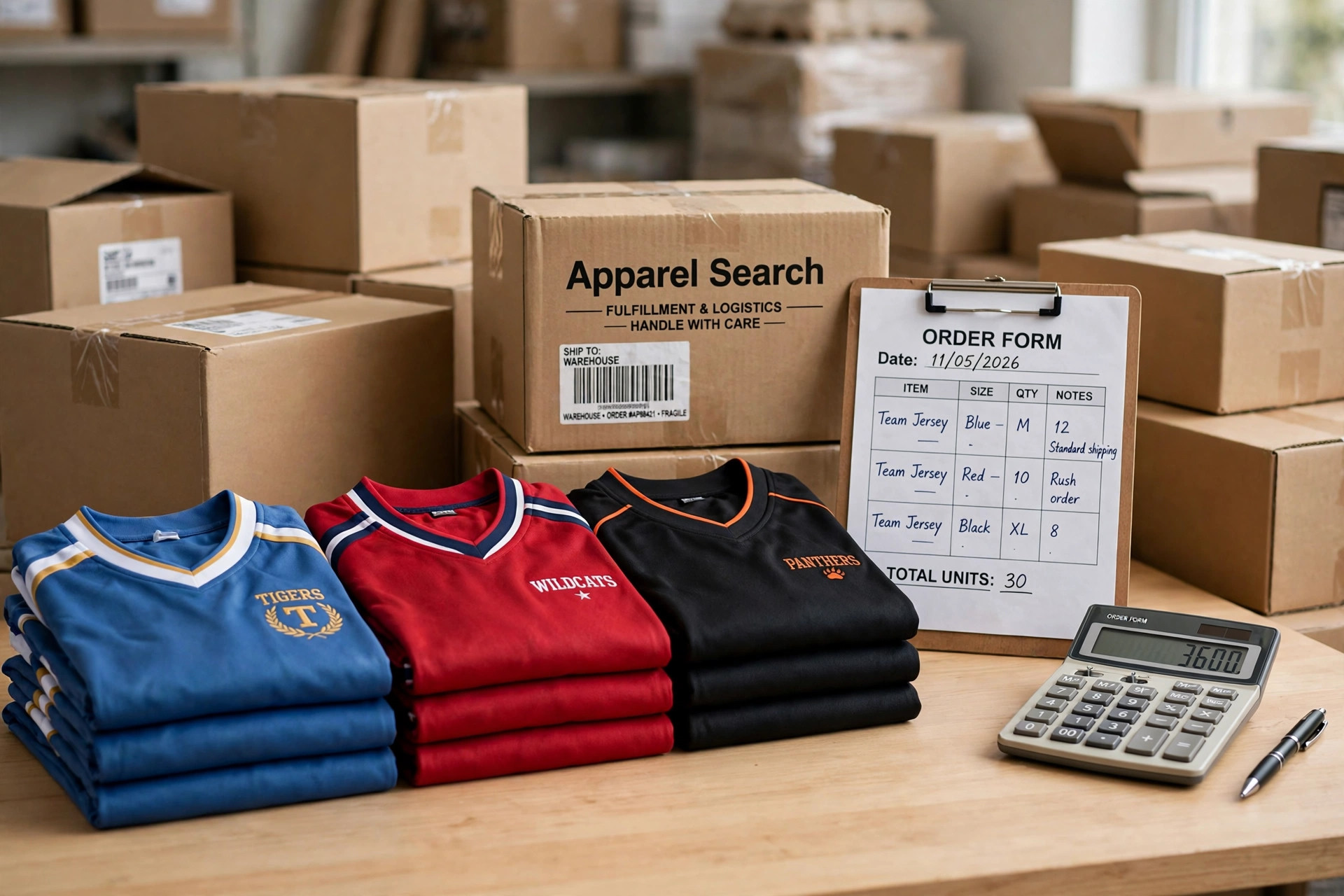
The Cost Stack, Layer by Layer
The blank garment is the visible layer — the jersey, shorts, socks and warm-ups at their undecorated price, which falls with quantity and rises with fabric and construction quality. Decoration is priced per location and per method: a front print, a back number and a sleeve mark are three charges, and names are a per-shirt personalization charge on top. Setup is the fixed layer — screens made, embroidery digitized, artwork prepared — charged once per design, and it is the layer that makes small orders expensive and reorders cheap. Around those sit the quiet layers: freight, which on cartons of kits is never trivial; spares, bought at main-order prices instead of reorder prices; and the organizer’s allowance for the defects, losses and size exchanges every real order contains. A quote that shows only a unit price is hiding the stack, not simplifying it — ask for the layers.
Quantity Breaks: Why the Count Changes Everything
Suppliers price in breaks — one unit price to a threshold, a lower one beyond it — because their own costs step down the same way: setup spread over more garments, machine runs long enough to be efficient, cartons packed full. Two consequences matter for organizers. First, the marginal shirt is cheap: once an order is placed, adding spares and a size-run buffer costs far less per unit than any later top-up, which is the arithmetic behind our sizing and reorders guide’s advice to buy the buffer with the order. Second, combining orders is leverage — two squads, a junior and senior section, or this season plus the known core of next season, ordered together, can cross a break that neither reaches alone. The minimums behind all of this are the same ones factories quote every apparel buyer; our minimum order quantities guide explains where they come from and which of them can move.
Lead Times, by Method
Timelines follow the decoration decision, so they are ranges with a logic rather than dates with a promise. Decorated stock — catalog garments printed, embroidered or heat-applied locally — is the fast route: commonly a few weeks from approved artwork, and days at the shortest when garments are on the shelf and the design is simple. Embroidery programs sit in the same band, paced by machine time per garment. Fully custom and sublimated production is the slow route by construction — design, printing, cutting and sewing a garment that does not yet exist — and is honestly quoted in longer ranges, commonly six weeks and upward, before freight. Every range assumes the inputs are final: artwork approved, sizes closed, deposit paid. A supplier’s clock starts when the order is complete, not when it is first discussed, and most “late” uniform orders were, by that definition, placed late.
Rush Orders: What Money Can and Cannot Buy
Rush fees buy queue position and freight speed — a printer’s overtime, an air shipment instead of a ground one. They cannot buy a manufacturing slot that was never booked, shorten a dye or print process below its working minimum, or substitute for artwork that has not been approved. The honest rush options are therefore structural: switch the design to a faster method, switch the garment to stock that exists, simplify the decoration to fewer locations, or split the order — match-day essentials now, warm-ups and extras following. An organizer facing a fixed date should ask the supplier which of those levers they can pull, and treat a promise to simply “do it faster” at the same specification as the risk it is.
Deposits and Payment Norms
Group orders run on a deposit-then-balance rhythm, for a sound reason: a decorated uniform fits exactly one team on earth, so the supplier cannot resell it if the buyer vanishes. Expect a deposit to start production, the balance before dispatch or on collection, and payment terms stated on the written quote alongside the delivery date. The organizer’s mirror-image discipline: collect the money before committing it. Clubs should approve the spend through whatever treasurer process they have; player-funded kits should be collected at the size-list stage, when commitment is highest. Our private label costs and minimums guide lays out the same stack for branded production — garment, decoration, setup, freight — and its central lesson transfers exactly: the first order carries the fixed costs, and reorders of a proven specification are where the economics turn kind. Kitchen programs run the identical calculation, as our chef clothing buying guide shows from the employer-issued side.
Budget the Program, Not the Order
The first order is the expensive one: setup, full roster, no data. Every season after runs on replacements, new players and a known size curve — a fraction of the first order’s unit economics, provided the specification and records survive. Clubs that budget the program across three seasons make calmer decisions in season one than clubs that must justify every carton as if it were the last.
Common Questions
Why did the per-unit price drop so much at a higher quantity?
Because the fixed costs stop dominating. Screens, digitizing, artwork preparation and machine setup cost roughly the same for twelve shirts as for fifty, so at small quantities they land on very few garments. Cross a quantity break and the same setup is spread thin, while the garment and decoration time — the costs that do scale — are all that remain. This is also why a one-shirt reorder costs what it does, and why spares bought with the main order are cheap insurance.
What deposit is normal on a team uniform order?
A deposit before production is the trade's standard pattern — commonly a substantial share of the order, with the balance due before the kit ships or when it is collected. Custom and decorated goods cannot be resold to anyone else, so suppliers reasonably refuse to carry the whole risk. Get the deposit, the balance trigger and the delivery date in writing on the quote, and collect players' contributions before the deposit goes out, not after.
Can a fully custom order be rushed?
Only within limits physics allows. A rush can buy priority in a print queue and faster freight; it cannot compress a custom manufacturing slot that does not exist, and sublimated production — printing, cutting, sewing — has a floor of weeks. If the deadline is truly fixed and close, the honest rush product is decorated stock: garments on the shelf, decorated locally, in days to a couple of weeks. Suppliers who promise otherwise are usually describing the deposit, not the delivery.
What should season two cost, compared with season one?
Less per unit, if the program was documented. The setup costs are already paid, the artwork exists, the size distribution is known from real issues rather than a generic curve, and the order is mostly replacements and new-player kits rather than a full roster. Programs that keep their specification and records reorder at something close to the marginal cost of garments and decoration; programs that start over pay season-one prices every year.
Back to the Team Uniform Ordering Guide
The full process: roster and sizes first, garments, decoration, and the timelines, deposits and reorder planning this page prices out.