Apparel Search · Private Label Guide
Private Label Costs & Minimums
Every cost layer from blank to retail price, realistic minimums by route, and why reorders — not first orders — are where the margin lives.
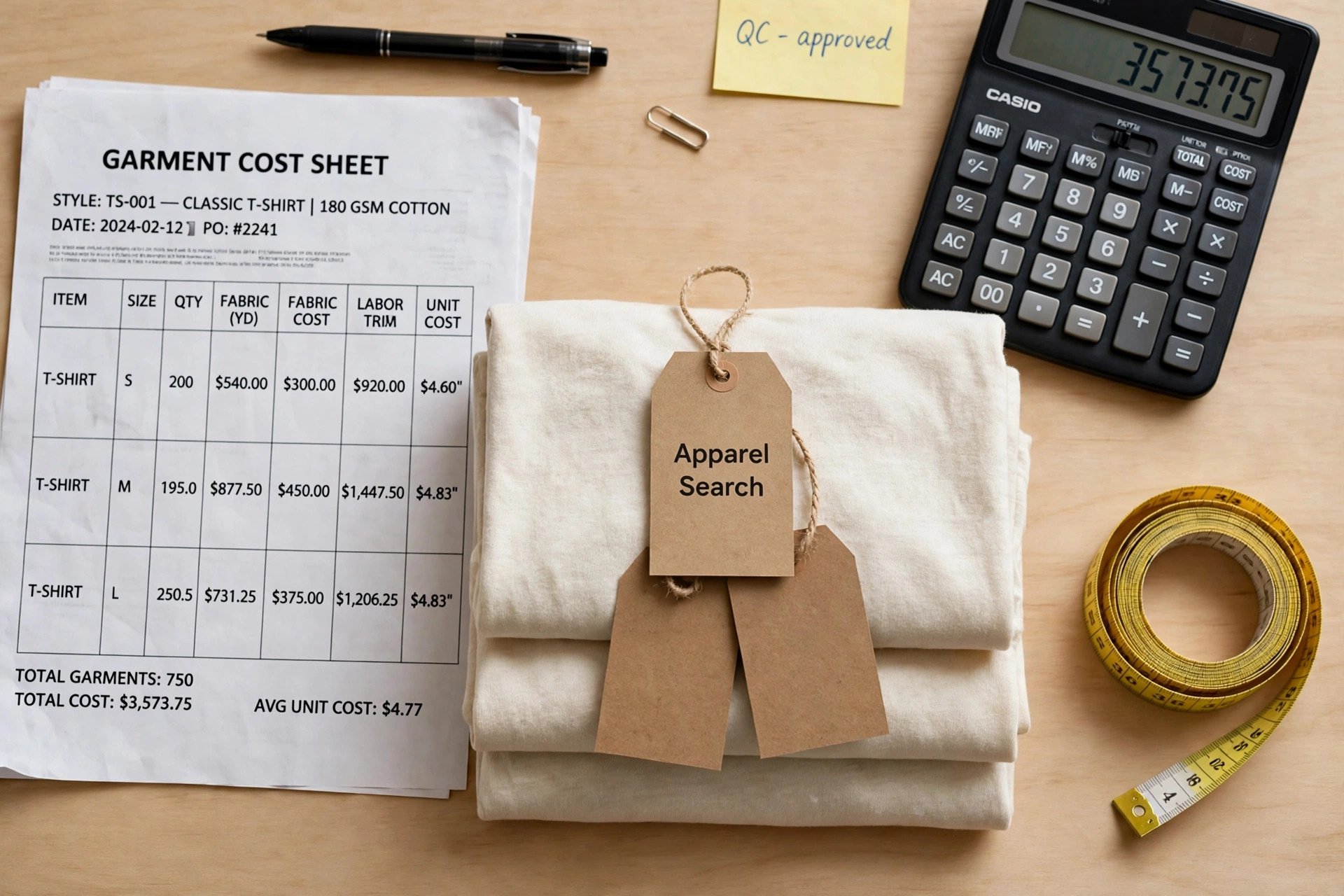
Private label looks cheap from the outside — no patterns, no fabric development, no factory minimums in the thousands. It is cheaper than cut-and-sew, but the garment price on a supplier's page is only the middle of the cost stack. This guide lays out every layer, the minimums each route really carries, and a worked margin example, so a first order is priced on complete numbers. It builds on our minimum order quantities guide and the wholesale and retail pricing guide.
The Full Cost Stack
| Cost layer | What it covers | How it behaves |
|---|---|---|
| The garment | Unit price of the stock, decorated or modified garment | The biggest layer. Falls as quantity rises and as the route simplifies |
| Decoration | Print, embroidery, patches on route 2 | Per unit; setup or digitizing fees on top at small runs |
| Labels | Woven brand labels, printed content/care labels | Labels are cheap per piece (cents to tens of cents) but bought in their own minimum runs — often 500–1,000 pieces |
| Relabeling labor | Removing/inserting labels where the supplier charges for it | Per unit, small — but ask; some programs include it, some itemize it |
| Hangtags & packaging | Tags, string/pins, polybags or boxes, size stickers | Per unit plus print setup; your brand's most visible spend |
| Sampling | Samples in every size/color, wash and wear testing, resamples | Fixed per style; sample units often cost 1.5–2x the production unit price |
| Freight & duty | Shipping to you; import duty and brokerage where applicable | Per unit in effect — build it into landed cost, never treat it as overhead weather |
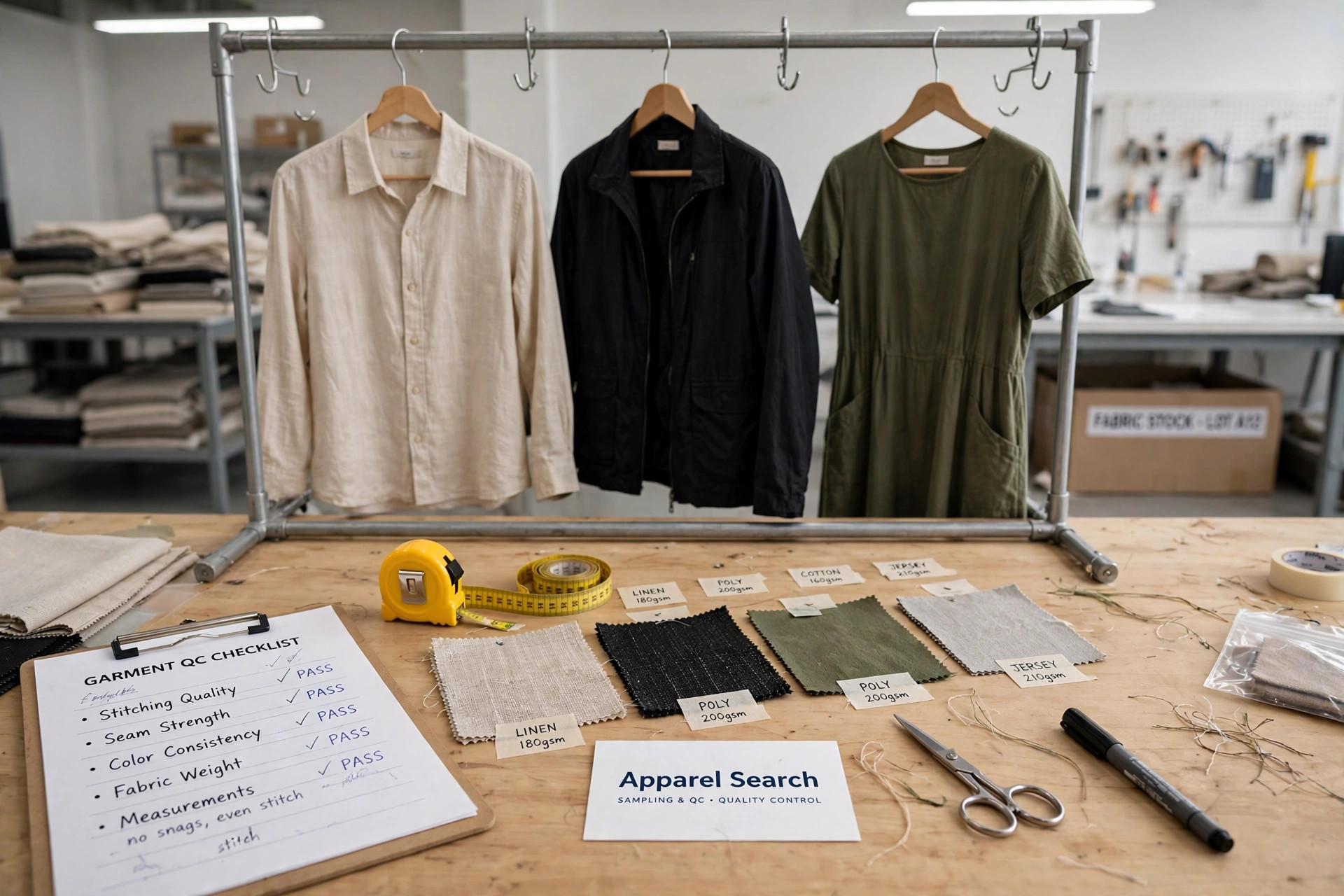
| Inspection & QC | Checking production against the approved sample | Your time, or a per-day inspection service on larger orders |
| Selling costs | Photography, listings, marketplace fees, shipping to customers | Per unit or per order — where thin margins quietly disappear |
Minimums, Route by Route
Minimums follow the setup each route asks a supplier to do — the routes guide explains why. Typical ranges across the trade (indicative, not quotes):
- Relabeled stock: often dozens to a few hundred pieces per style — some stock programs relabel from a single case pack. The binding minimum is frequently the label run, not the garment run.
- Decorated blanks: from one unit (print-on-demand) through screen-print runs where a dozen or two dozen pieces per design is a common floor, set by screen setup.
- Modified styles: a few hundred pieces per style, usually with a per-color minimum inside it, because fabric is cut for your order.
- Full custom: several hundred to a thousand-plus per style — the territory of our MOQ guide, where negotiation levers live.
- No-minimum wholesale: exists for plain resale stock — our no-minimum wholesale guide covers where it is real and what it costs per unit.
A Worked Example: From Blank to Retail Price
An illustrative mid-range case — a decorated blank sold under your label, bought in a modest run. Substitute your own quotes; the structure is the lesson.
| Line | Per unit |
|---|---|
| Blank garment | $6.50 |
| Print decoration | $2.00 |
| Woven label + relabeling | $0.45 |
| Hangtag & packaging | $0.40 |
| Freight to your door | $1.15 |
| Landed cost | $10.50 |
| Wholesale price (2x landed — a 50% wholesale margin) | $21.00 |
| Retail price (retailer doubles wholesale — keystone) | $42.00 |
Two cautions belong on this arithmetic. First, if you sell direct to consumers yourself, you keep the retail margin but also buy the selling costs — photography, fees, shipping, returns — that the wholesale/retail split normally pays the retailer to carry. Second, the first order also carries the fixed costs the table spreads invisibly: label and tag print runs, sampling, and setup. On a 200-piece first order, $600 of fixed costs adds $3.00 a unit; on the 1,000-piece reorder, $0.60. This is why first orders look unprofitable and reorders of proven styles are where private label actually makes its money — and why the startup costs guide treats the first collection as an investment to budget, not a margin to expect.
The Costs That Arrive Late
Defects and seconds — hold a small allowance; not every unit in a run is sellable at full price. Storage — minimums convert directly into shelf space and tied-up cash. Returns — in direct selling, a returned garment has been shipped twice and often cannot be resold as new. Reorder timing — a proven style that stocks out during its season costs more than its margin; the speed of routes 1–2 is worth money precisely here. The garment costing guide and its cost sheet walkthrough show how factories build the same stack from their side.
Group uniform orders run on the identical stack — blank garment, decoration per location, setup spread over the run — with a roster added. Our team uniform costs and timelines guide applies it to team and club kit: quantity breaks, lead times by decoration method, rush orders and deposit norms.
More to Explore
Back to the Private Label Guide
Costs understood, you have the full picture — return to the Private Label Clothing Guide for the sequence end to end.
Common Questions
What is the minimum order for private label clothing?
It depends on the route. Relabeled stock programs often start at a few dozen to a few hundred pieces; decorated blanks can start at a single unit through print-on-demand; modified styles typically need a few hundred per style and color; full custom production runs from several hundred upward. Often the real floor is your label and hangtag print run rather than the garments.
Why is my first private label order barely profitable?
Because fixed costs — label and tag print runs, sampling, decoration setup — are spread over the smallest order you will ever place. The same costs over a reorder of a proven style add cents instead of dollars per unit. First orders buy information and a selling track record; reorders are where the margin lives.
How should I price private label clothing?
Start from the full landed cost per unit — garment, decoration, labels, packaging, freight and duty — never from the garment price alone. A common structure is wholesale at roughly double landed cost and retail at roughly double wholesale, adjusted for your category and channel. If you sell direct, price against retail but budget the selling costs a retailer would otherwise carry.
Are no-minimum private label offers a good deal?
They are real, and useful for testing, but the unit price carries the flexibility — no-minimum stock is the most expensive way to buy the same garment. Use it to prove a style or a niche, then move proven sellers into minimum-based programs where the per-unit cost falls.