Garment Costing Guide · The Cost Sheet
The Garment Cost Sheet, Explained
Every line of the standard cost sheet — what it means, where the number comes from, and how the lines add up to a price.
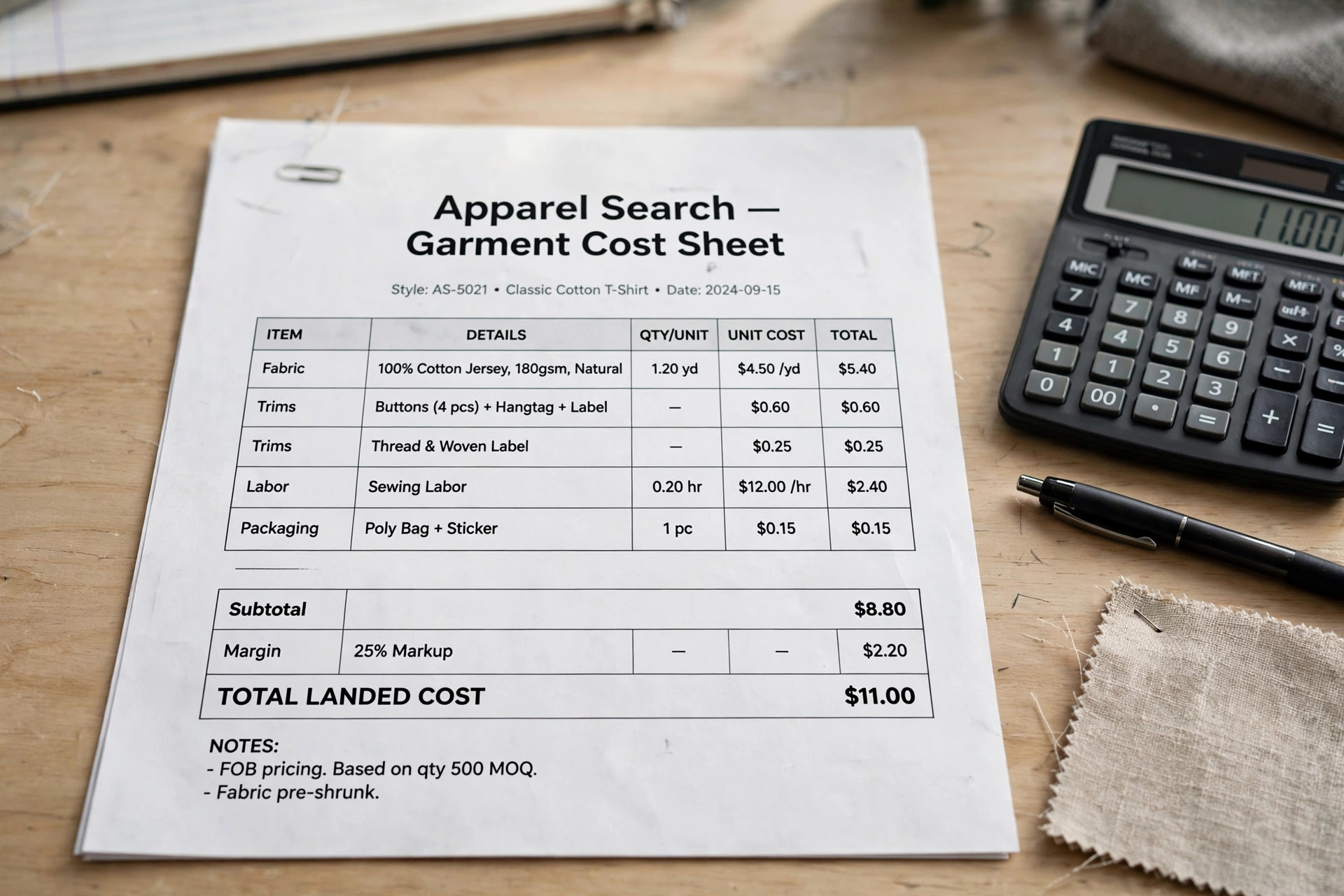
If the Garment Costing Guide is the map of how a garment's price is built, the cost sheet is where the building actually happens. A cost sheet is a single document — a spreadsheet, a printed form, or a screen in a costing system — that lists every cost belonging to one garment, in one currency, per unit, and totals them into the quoted price. Buyers ask for it, factories defend it, and most price arguments in the apparel industry are, at bottom, arguments about one of its lines.
A well-kept cost sheet does three jobs at once. It is the factory's calculation of what an order will cost to run; it is the buyer's window into that calculation; and it becomes the record both sides return to when something changes — a fabric price moves, a trim is substituted, a wash is added. Understanding each line is therefore not bookkeeping trivia. It is the core commercial skill of garment production.
The Header: What the Sheet Is Costing
Before any numbers, the sheet identifies the job: style number and description, the buyer, the season, the order quantity the prices are based on, the fabric and trim suppliers quoted, and the date. These fields matter more than they look. Material prices are quantity-dependent, so a cost sheet priced at 3,000 pieces cannot be held against an order that shrinks to 800. Likewise, a costing is a snapshot: fabric quoted in March may not be buyable at that price in June. Experienced merchandisers treat the header as part of the price.
The Lines, One by One
Fabric
The largest line on almost every sheet, calculated as consumption per garment × price per meter or yard. The consumption figure comes from the marker, and how it is derived is covered in full in our fabric consumption guide. The price comes from the mill's quotation at the order's quantity and width — note that fabric is bought by width as well as length, so a price is only meaningful tied to the width it was quoted on.
Fabric Wastage Allowance
Cutting never converts 100 percent of purchased fabric into garments. End losses at the start and finish of each lay, selvedge trim, splice overlaps and the occasional defective section all consume cloth. Cost sheets therefore carry an explicit wastage allowance, typically 2–5 percent of the fabric line, shown separately so both sides can see the assumption rather than having it buried in a padded fabric price.
Trims and Accessories
Every component that is not the main fabric: buttons, zippers, sewing thread, interlining, labels, hangtags, drawcords, elastic, shoulder pads. Each is costed at its per-garment usage — twelve buttons, not "a gross, divided somehow." Trim lines look small individually but commonly add 5–10 percent to the garment, and they are the lines most often forgotten in a quick estimate. Special processes are priced here too when a style carries them: a chest print, an embroidery, or a garment wash is an add-on line with its own rate, and our Textile Printing Methods Guide explains the processes behind those printing charges.
CM — Cutting and Making
The labor line: the cost of cutting the fabric and sewing the garment. On a detailed sheet it is built from the garment's standard minute value multiplied by the factory's cost per minute, the method covered in our SMV and labor cost guide. On a simpler sheet it appears as a single negotiated make price. Either way, it is the line that rises fastest with garment complexity — every extra seam, topstitch and pocket is paid for here.
Finishing, Checking and Packing
Thread trimming, stain removal, pressing, final inspection, folding, poly-bagging and carton packing. Some factories fold this into CM; others show it separately. What matters is that it appears once, and only once — double-counting finishing inside both CM and a separate line is one of the classic cost sheet errors.
Overhead
The factory's indirect costs — rent, power, water, supervision, machine maintenance and depreciation, office and compliance costs — recovered as an allocation per garment, per minute of SMV, or as a percentage of direct cost. Buyers sometimes challenge overhead as padding, but a factory that does not recover it is simply scheduling its own losses; the honest argument is about the rate, not the existence.
Testing and Inspection
Where the buyer requires laboratory testing (shrinkage, colorfastness, fiber content) or third-party final inspection, the fees belong on the sheet as their own line rather than being silently absorbed. They are small per garment on a large order and surprisingly large on a small one, which is exactly why they should be visible.
Margin
The factory's profit, applied to the accumulated cost. Note the convention: margin is usually expressed as a percentage of the selling price, not of cost — a distinction that changes the arithmetic and causes real confusion in negotiations, as our pricing and margins guide explains.
A Worked Example: Men's Long-Sleeve Woven Shirt
Here is a complete, simplified costing for a men's long-sleeve cotton poplin shirt, quoted FOB at an order quantity of 5,000 pieces. Follow the lines and check the arithmetic — that is what cost sheets are for.
| Cost line | Basis | Cost (US$) |
|---|---|---|
| Fabric — cotton poplin | 1.80 m per garment @ $3.50/m | 6.30 |
| Fabric wastage allowance | 3% of fabric line | 0.19 |
| Buttons | 12 pieces per garment | 0.24 |
| Sewing thread | Per garment usage | 0.09 |
| Labels & hangtag | Main label, size label, hangtag | 0.14 |
| Interlining | Collar, cuffs, placket | 0.22 |
| CM (cut & make) | SMV 26 min @ $0.06/min | 1.56 |
| Finishing, checking & pressing | Per garment | 0.35 |
| Packing | Poly bag, carton share | 0.18 |
| Factory overhead | Allocation per garment | 0.85 |
| Testing & inspection | Lab tests, final audit share | 0.12 |
| Subtotal — total factory cost | 10.24 | |
| Margin | 8% of selling price | 0.82 |
| FOB price per garment | 11.06 |
Two things are worth noticing. First, fabric alone is $6.49 of the $10.24 factory cost — nearly two-thirds — which is why consumption arguments dominate costing meetings. Second, the same shirt could be honestly costed at a different total by a different factory: a lower cost per minute, a cheaper fabric source, or a tighter overhead changes the stack. The cost sheet's job is to show where any two quotes differ.
Run your own numbers: the online garment cost sheet on Apparel Search totals these lines interactively, and the downloadable cost sheet template gives you the same structure as a reusable file.
Reading a Cost Sheet Like a Buyer
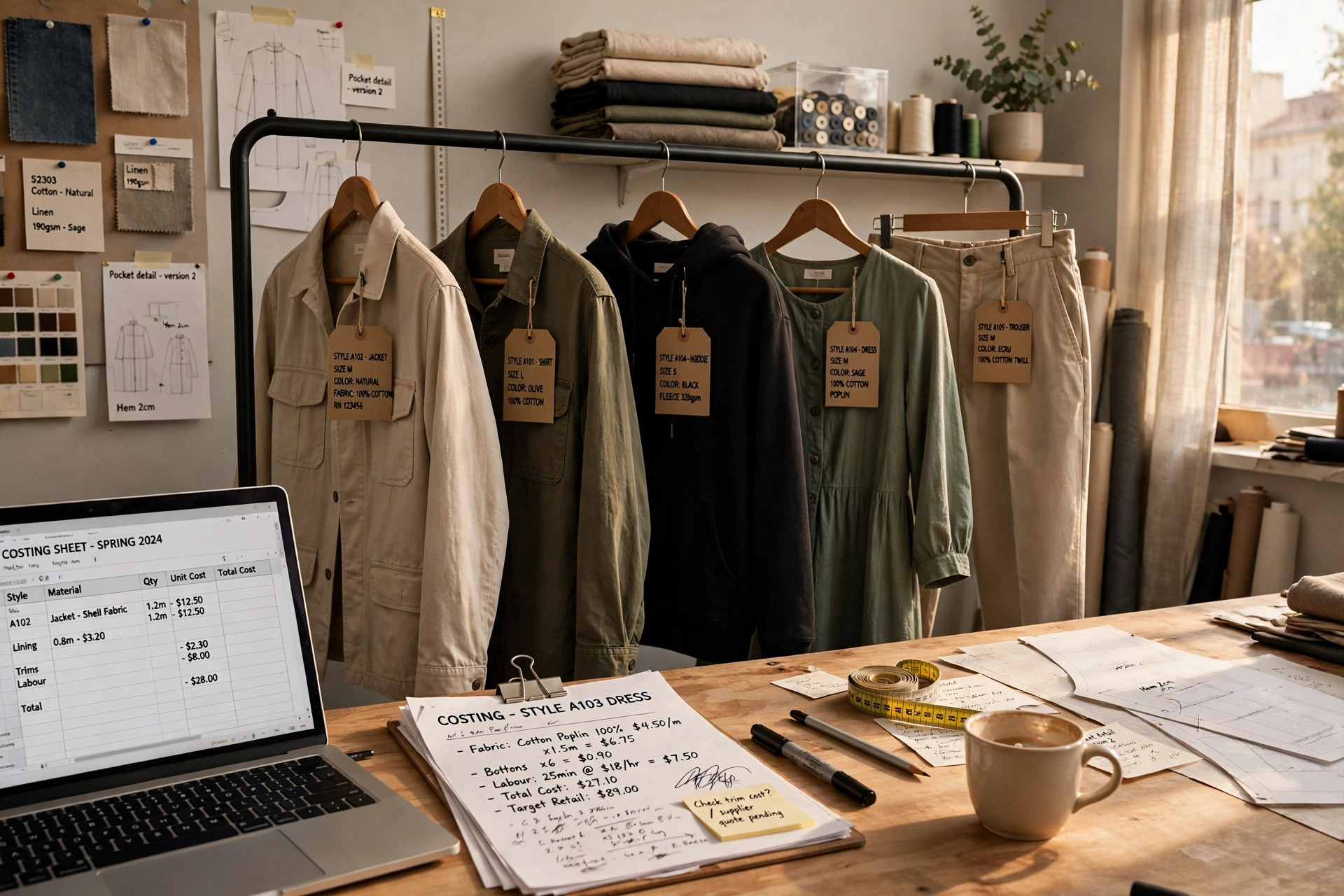
When a cost sheet lands on your desk, read it in this order. Check the header first: quantity, date and fabric width — a quote is only valid for the conditions it states. Then check the fabric line against the marker: ask for the consumption and the efficiency behind it. Scan the trims against the bill of materials for omissions (missing lines today become claims tomorrow). Confirm finishing appears exactly once. And when the total is too high, negotiate the lines with genuine movement in them — fabric source, consumption, order quantity — rather than demanding an across-the-board cut that the factory can only meet by quietly degrading the garment.
Keep Exploring the Costing Series
Common Questions
What is a garment cost sheet?
A garment cost sheet is the document that records every cost that goes into one garment — fabric, trims, labor, finishing, overhead, testing and margin — and totals them into the price quoted to the buyer. It is the working paper behind every apparel price negotiation.
What is the difference between a cost sheet and a tech pack?
A tech pack specifies what the garment is: its materials, measurements and construction. A cost sheet prices what the tech pack specifies. The cost sheet is built from the tech pack's bill of materials, but it is a financial document, not a technical one.
Should fabric wastage be a separate line on the cost sheet?
Yes. Cutting loss, end loss and defect allowances are real costs, and showing wastage as its own line — typically 2 to 5 percent on fabric — keeps the fabric price itself honest and shows the buyer exactly what allowance has been made.
How accurate is a first cost sheet?
A first cost sheet is an informed estimate based on the sample, quoted material prices and an expected marker yield. It is normally re-costed once bulk fabric is booked and the production marker is final, and small movements in fabric price or consumption explain most of the difference.
Back to the Garment Costing Guide
This page is one part of the Apparel Search Garment Costing & Production Economics Guide — return to the hub for the full costing workflow and every guide in the series.