Garment Costing Guide · Labor & SMV
Garment Labor Cost & SMV
Labor is priced in minutes. What a standard minute is, what a factory's minute costs, and how the two numbers make the make price.
Fabric is bought by the meter, but sewing is bought by the minute. Inside the Garment Costing Guide, this page covers the labor side of the price: the standard minute value that measures a garment's work content, the cost per minute that a factory attaches to its capacity, and the line efficiency that decides how much of that capacity turns into finished garments. Master these three numbers and the labor line on any cost sheet stops being a mystery number and becomes arithmetic you can check.
SMV: The Work Content of a Garment
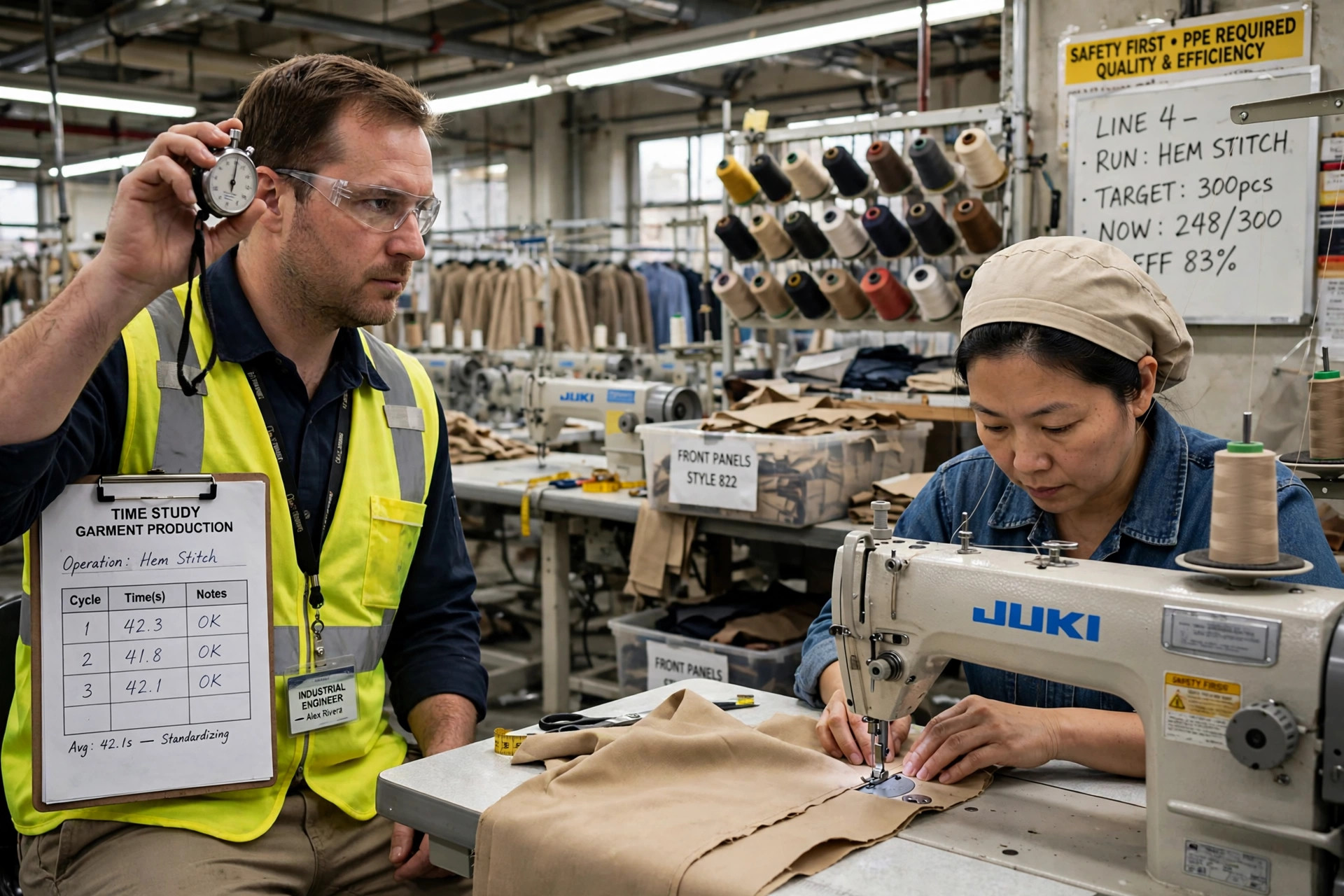
The standard minute value (SMV — called SAM, standard allowed minutes, in North America) is the time a trained operator, working at a standard pace with proper methods, needs to complete the work — including normal allowances for rest, personal needs and minor machine delays. A garment's SMV is the sum of its operations: every seam, hem, attach and press in the operation breakdown, each with its own standard time. A basic tee totals roughly 8–12 minutes; a polo 15–20; a woven shirt around 25–30; a lined blazer can pass 100. SMV is therefore also a complexity index — when a designer adds a placket, a yoke and two pockets, the SMV is where those decisions send the bill.
Standard minutes come from two sources. Time study — an industrial engineer with a stopwatch, rating observed pace against standard — is the traditional method. Synthetic systems (such as GSD, General Sewing Data) build times from coded motion sequences instead, and are faster and more consistent for pre-production costing, when no line has yet sewn the style. Either way, the SMV used in a costing should be agreed before the price is: a two-minute dispute on a 26-minute shirt, at any plausible minute rate, is a price dispute by another name.
Cost Per Minute: What a Factory's Minute Is Worth
The factory totals everything it spends to keep sewing capacity available for, say, a month — operator wages and benefits, supervisors, mechanics, power, rent, machine depreciation, and its share of office and compliance costs — and divides by the operator-minutes it had to sell. The result varies enormously by country, city and factory type: the same minute that costs a few cents in a low-wage region costs several times more in a high-wage one, which is the entire economic geography of the apparel industry in one ratio. Multiply a garment's SMV by the factory's cost per minute and you have its labor cost: a polo at SMV 18 minutes and $0.07 per minute carries $1.26 of labor — the figure that lands on the cost sheet as the CM labor content within CM and CMT pricing.
Line Efficiency: Standard Minutes vs. the Real World
No line produces standard minutes at 100 percent. Efficiency compares the standard minutes "earned" by actual output with the minutes the line was attended. Work an example: 30 operators attend for 480 minutes — 14,400 minutes of capacity. The line produces 550 polos at SMV 18, earning 9,900 standard minutes. Efficiency is 9,900 ÷ 14,400 ≈ 69 percent — a respectable figure; well-run lines typically sit between 55 and 75 percent depending on product and how familiar the style is.
Efficiency is where costing assumptions meet production reality. A factory that costs at its true average efficiency prices sustainably; one that costs at 100 percent and runs at 60 is donating the difference. The levers that move efficiency are unglamorous and effective: line balancing so no operator starves or drowns, operators trained and kept on operations they have mastered, machines maintained, work fed to the line without gaps, and styles introduced with a realistic learning curve — a new style's first days always run below its mature rate, and good costings allow for it.
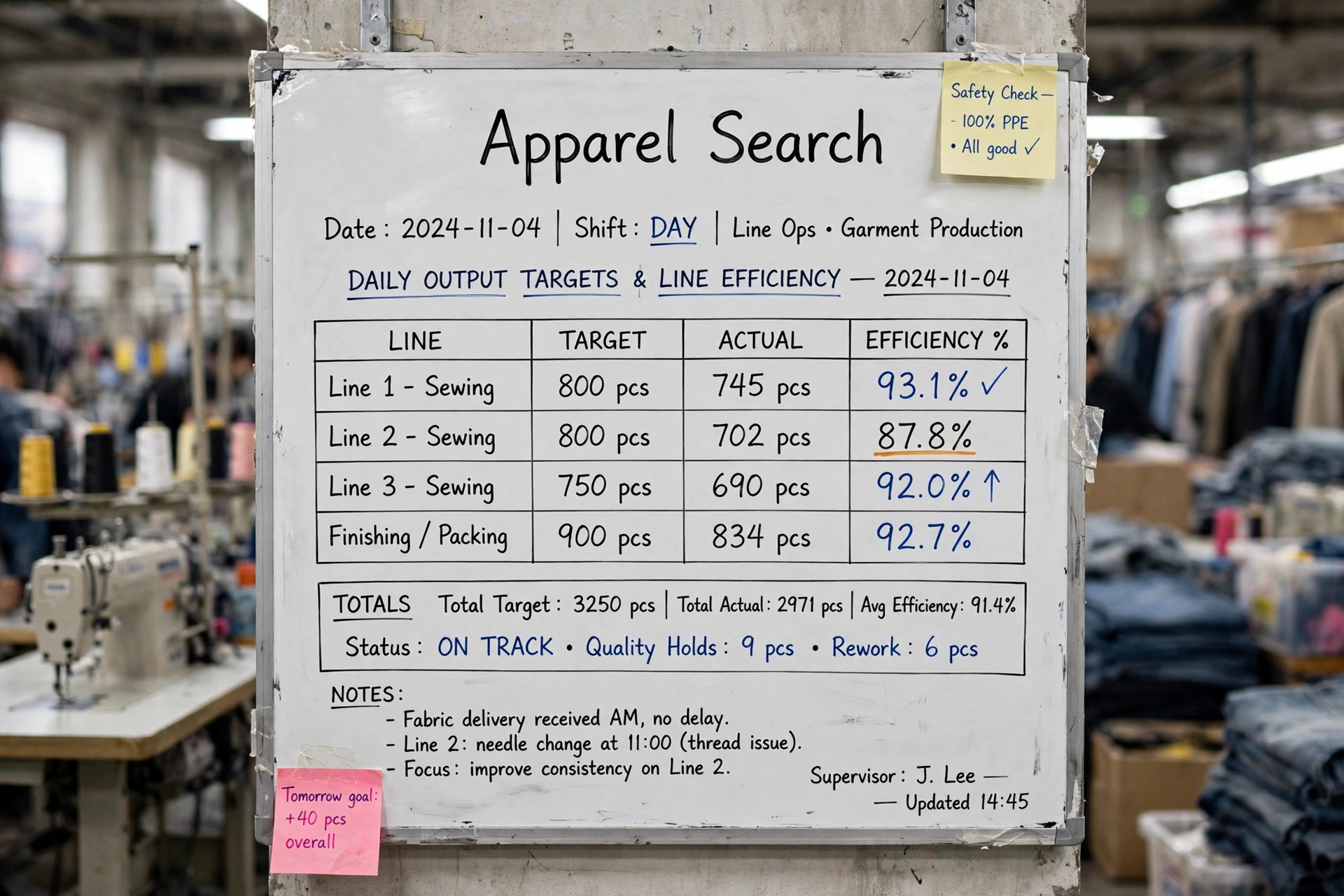
The human side of the numbers: costing and SMV analysis are the core of the costing analyst's job — if the work itself interests you, our costing analyst job description sets out the role in full.
Keep Exploring the Costing Series
Common Questions
What is SMV in garment manufacturing?
SMV — standard minute value, also called SAM (standard allowed minutes) — is the standard time a trained operator needs to make one garment at a normal working pace, including allowances for rest and machine delays. A basic tee might carry an SMV of 8 to 12 minutes; a lined jacket can exceed 100.
What is the difference between SMV and SAM?
Very little in practice: both terms describe the standard minutes allowed to produce a garment. SMV is the term most common in the Asian garment industry and SAM (standard allowed minutes) in North American usage; costings use them interchangeably.
How is a factory's cost per minute calculated?
The factory totals what it costs to run for a period — wages, benefits, supervision, power, rent and depreciation — and divides it by the minutes of operator capacity in that period (operators multiplied by minutes worked). The result is the cost of one minute of sewing capacity, which is multiplied by a garment's SMV to price its labor.
What is a good line efficiency in a sewing factory?
Well-run lines commonly achieve 55 to 75 percent efficiency against standard minutes, with the figure varying by product complexity and how new the style is to the line. Efficiency below 50 percent usually signals line balancing, machine or training problems worth investigating.
Back to the Garment Costing Guide
This page is one part of the Apparel Search Garment Costing & Production Economics Guide — return to the hub for the full costing workflow and every guide in the series.