Costing Analyst Job Description
Building up what a garment really costs — materials, labour, overhead, freight and duty — and what that means for margin and price
A costing analyst works out what a garment truly costs to make — and therefore what a business can afford to sell it for. Every style a fashion company produces or buys carries a cost built from many small pieces: fabric and trims, cutting and sewing labour, washing and finishing, packaging, factory overhead, freight and import duty. The costing analyst assembles those pieces into an itemised cost build-up, tests the result against the margin the business needs at the intended selling price, and compares the quotes different vendors submit for the same garment. It is analytical, financial work — quite different from allocation or assortment planning — and it sits at the point where product decisions become money.
More Planning Job Descriptions by Letter:
Building the Product Cost, Piece by Piece
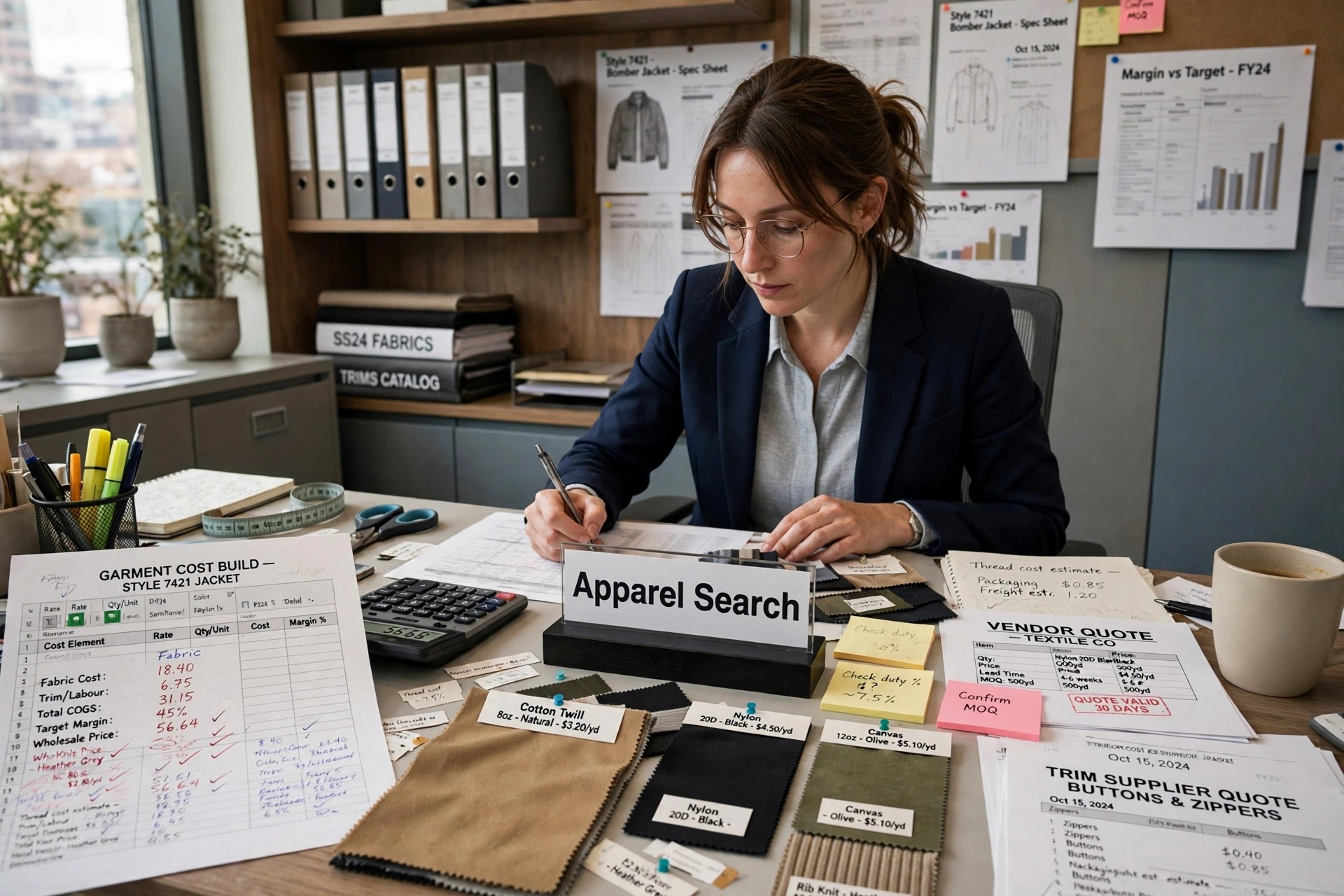
The core document is the cost sheet. For each style, the analyst builds the first-cost estimate from the garment's specification: fabric consumption per garment multiplied by the fabric price per metre or kilo, each trim itemised — buttons, zips, thread, labels, interlining, hangers and polybags — then the making cost, derived from the garment's operations and the standard minutes they take at the factory's labour rates. Washing, dyeing, embroidery, printing and other special processes are added as their own lines, followed by packaging, testing and inspection allowances, so the finished sheet shows not just a total but exactly where the money inside a garment sits.
Accuracy at this stage depends on consumption, and consumption depends on pattern efficiency. Fabric is usually the largest single cost in a garment, and small differences in marker yield — how tightly pattern pieces nest on the cloth — move the fabric cost per garment noticeably at volume. Costing analysts therefore work closely with pattern and technical teams on consumption estimates, challenge optimistic yields, and rebuild costings when a design detail changes: a longer length, an added lining or a heavier fabric quality all flow straight through the sheet into the margin.
Margin, Quotes and the Negotiation Table
A cost build-up earns its keep when it is compared with something. Analysts measure each style's cost against its target selling price to calculate the intake margin the business would achieve, flag the styles that cannot reach their margin target, and model the available remedies — a fabric substitution, a construction simplification, a volume increase, a price move — with the margin consequence of each shown in numbers. This is the analysis that lets buyers and product teams redesign intelligently instead of simply demanding that a factory charge less for the same garment.
Vendor quotes are the second comparison. When factories in different countries quote for the same style, the analyst normalises the quotes onto one basis — separating factory cost from freight, insurance and duty under the applicable trade terms, and applying each sourcing country's duty rates and freight costs — so the business compares true landed costs rather than headline numbers that hide different inclusions. In negotiation, the analyst's itemised sheet is the evidence on the table: discussions proceed line by line, over a consumption figure or a labour minuteage, instead of over a single take-it-or-leave-it price.
Skills and Abilities the Role Requires
This is the most financially oriented role in the planning category, and its skills match. Costing analysts need meticulous numerical accuracy, advanced spreadsheet modelling, and a feel for how small unit differences compound across tens of thousands of garments. They also need genuine garment literacy — fabric types and prices, construction methods, sewing operations and their relative time costs — because a costing built by someone who cannot picture the garment will accept consumption and labour figures that a factory visit would have corrected in minutes.
Commercial tact completes the profile. The analyst's findings regularly disappoint someone: a designer's preferred fabric breaks the margin, a favoured vendor's quote does not survive normalisation, a target price proves unbuildable. The findings have to be delivered plainly, with the alternatives costed as carefully as the problem, so the analyst is experienced as the person who rescues margins early rather than the person who says no late. Confidentiality matters too — cost sheets and vendor terms are among a fashion business's most sensitive documents, and analysts handle them accordingly.
Qualifications, Training and Career Path
Costing analysts arrive by two main routes. The finance route brings analysts from accounts, buying-office finance or business analysis roles, who then learn the garment side in post. The product route brings garment technologists, product developers, sample-room and production staff who are strong numerically and formalise their costing knowledge. Degrees in accounting, finance, business, textile technology or fashion product subjects all appear in the role; employers train analysts on their own cost-sheet formats, standard-minute systems and sourcing terms, and screen hardest for spreadsheet modelling skill and costing accuracy under time pressure.
Progression runs to senior costing analyst and costing manager roles — owning the costing standards, cost-sheet formats and vendor cost comparisons for a whole department or sourcing region — and sideways into merchandise planning, sourcing and production management, where a costing background is a lasting advantage. Analysts who add broader commercial experience move toward finance business-partner and sourcing leadership roles. In an industry where a single point of margin on a high-volume style is worth more than most salaries, rigorous costing is a specialism businesses protect and reward.
Common Questions
What does a costing analyst do in the fashion industry?
They build itemised cost build-ups for garments — fabric and trim consumption, making labour, processes, packaging, freight and duty — test each style's cost against its target margin, and normalise vendor quotes so sourcing decisions compare true landed costs.
How is a costing analyst different from an allocator or planner?
Allocators distribute bought stock to stores and planners build the buy and its budget. The costing analyst works earlier and more financially: what each garment costs to make, whether its price can carry that cost, and which vendor's quote is genuinely cheapest on a like-for-like basis.
What qualifications do costing analysts need?
Strong spreadsheet modelling and numerical accuracy are essential, with garment construction and fabric knowledge learned or brought from product roles. Backgrounds include accounting and finance, garment technology, product development and production; employers train analysts in their cost-sheet and standard-minute systems.
More to Explore
References & Further Reading
More Job Description Categories
- Buying Job Descriptions
- Design Job Descriptions
- Marketing & PR Job Descriptions
- Miscellaneous Job Descriptions
- Planning & Allocation Job Descriptions (current)
- Production & Sourcing Job Descriptions
- Sales & Selling Job Descriptions
- Transportation & Warehouse Job Descriptions