Allocation Job Description
Deciding how many garments each store and channel receives — initial allocation, replenishment and transfers driven by sales, stock and store capacity
Allocation is the planning discipline that decides where the stock goes. A buyer may choose the right garments and a planner may buy the right total quantity, but the business only sells them if each store and channel receives the right depth, in the right sizes and colours, at the right moment in the season. Allocators — also titled allocation analysts in larger businesses — turn the total buy into store-level quantities, then spend the season correcting the first answer as real sales arrive: replenishing winners, transferring stock between stores, and protecting the shops that can sell a line from the shops where it is sitting still.
More Planning Job Descriptions by Letter:
The Initial Allocation: Splitting the Buy
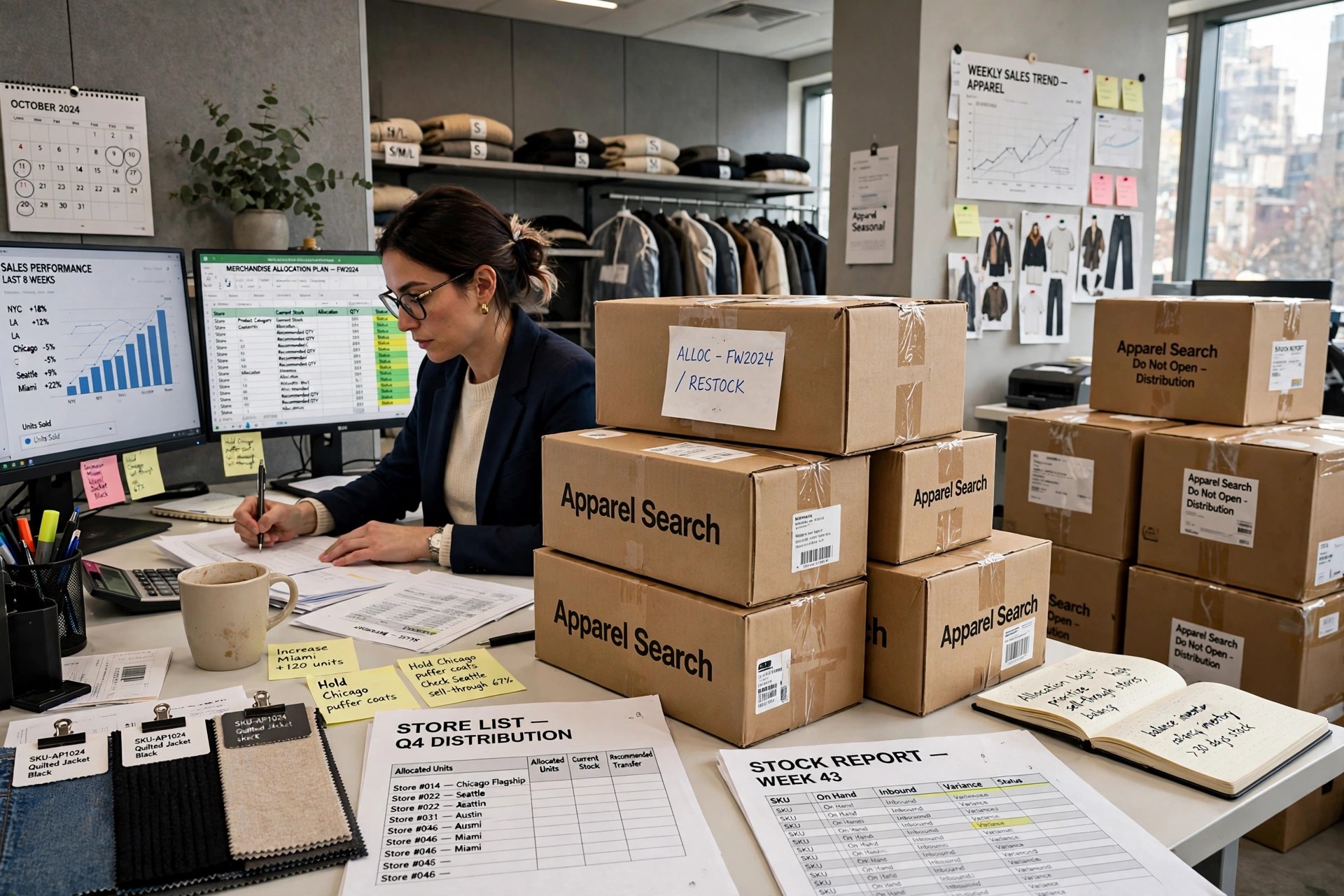
The work begins before the goods arrive. Working from the planner's buy quantities, the allocator builds the initial allocation for every style: how much each store receives at launch, how much is held back centrally as replenishment reserve, and how much goes to e-commerce and other channels. Stores are not treated as identical — they are graded or clustered by sales volume, customer profile, climate, selling space and past performance by department, so a flagship with a proven appetite for a category receives depth, while a small store with limited fixtures receives a tight, carefully chosen representation of the range.
Within each store's allocation, the detail is size and colour. Allocators build size curves from each store's own selling history — the proportions in which that store's customers actually buy small, medium, large and extended sizes — and weight colours by local evidence rather than by the national average. Getting this split right matters out of proportion to its visibility: a store can hold the correct total units of a style and still lose most of its sales if the units sit in the wrong sizes, because the customers who came for the missing sizes rarely buy a substitute.
Replenishment, Transfers and In-Season Correction
Once trading starts, allocation becomes a weekly evidence discipline. Allocators read sell-through, rate of sale, stock cover and size availability by store, and push replenishment from the central reserve to the stores demonstrating demand — while the reserve lasts, which is why holding back the right proportion at launch is a judgement the whole season depends on. Where no central stock remains, the correction tool is the inter-store transfer: moving units from stores where a style is stalled to stores where it is selling through, weighed against the freight cost and remaining selling weeks so the transfer earns more than it costs.
The same reading drives the difficult calls at the season's end of life. Allocators identify broken size ranges and slow tail stock early enough to act — consolidating remnants into fewer stores where they can still sell at full price, before markdown becomes the only remaining tool. Throughout, allocation works as the planner's eyes at store level: the patterns allocators see first, such as a size curve shifting across a region or a store cluster outperforming its grade, feed directly into the next buy's quantities and the next season's grading.
Skills and Abilities the Role Requires
Numerical fluency is the entry requirement: allocators live in spreadsheets and allocation systems, handling thousands of style-store combinations without losing accuracy, and they must be able to explain a quantity — why this store, this depth, this size split — from the data behind it. Commercial judgement sits on top of the arithmetic. The data never quite decides by itself: a launch weekend's weather, a local event, a competitor's opening or a store's refit all argue for adjusting what the model suggests, and the allocator's value lies in knowing which signals to follow and which to let the system handle.
Communication decides whether good allocations survive contact with the business. Allocators field constant queries from store teams who want more of what is selling and less of what is not, negotiate transfer and replenishment priorities with planners and buyers, and flag problems upward early — a buy spread too thinly across too many stores is an allocation finding long before it is a sales result. Organisation under seasonal pressure is essential: launch weeks concentrate thousands of decisions into days, and the allocator who stays methodical keeps the errors small and visible instead of large and buried.
Qualifications, Training and Career Path
Allocators usually enter from allocation or merchandising assistant roles, from store positions with strong stock and sales responsibility, or as graduates with degrees in fashion business, merchandising, retail management or numerate subjects. Employers train new allocators on their allocation and replenishment systems, store grading methods and size-curve tools; what they screen for at interview is spreadsheet confidence, comfort with sales data, and a genuine feel for how different stores sell differently. Retail floor experience is valued more than in most head-office roles, because allocating to stores you have worked in teaches lessons no report fully conveys.
The career path from allocation runs naturally upward through the planning function: senior allocator, then merchandise planner — where the focus widens from distributing the buy to building it, with open-to-buy and margin responsibility — and onward to planning management. Allocators also move sideways into replenishment management, e-commerce trading, and supply-chain planning, carrying the store-level stock instincts that distinguish them. It is one of the strongest training grounds in a fashion head office: few roles teach as quickly how a whole business's stock, stores and seasons actually connect.
Common Questions
What does allocation mean in fashion retail?
Allocation is deciding how a bought quantity of each style is divided among stores and channels: the initial quantities each location receives by size and colour, the central reserve held back, and the in-season replenishment and transfers that follow real sales.
How is an allocator different from a merchandise planner?
The planner builds the buy — total quantities, budgets and margin for a department. The allocator distributes that buy to individual stores and channels and corrects the distribution in season through replenishment and transfers, working at style-and-store level rather than department level.
What skills does an allocator need?
Strong spreadsheet and systems skills, confidence reading sell-through, rate of sale and stock cover, sound size-curve and store-grading judgement, and clear communication with planners, buyers and store teams under seasonal deadline pressure.
More to Explore
- Fashion Employment Agencies
- Employment Search Engines
- Fashion Job Description Directory
- Fashion Directory
- Fashion Industry News
- Fashion Schools and Education
- Fashion Careers
- Clothing Merchandising
- Retail Math
- Apparel Industry Calculators
- Costing Analyst Job Description
- Apparel Industry Links
- Clothing Retailers
- Apparel Wholesalers
- Apparel Manufacturers
References & Further Reading
More Job Description Categories
- Buying Job Descriptions
- Design Job Descriptions
- Marketing & PR Job Descriptions
- Miscellaneous Job Descriptions
- Planning & Allocation Job Descriptions (current)
- Production & Sourcing Job Descriptions
- Sales & Selling Job Descriptions
- Transportation & Warehouse Job Descriptions