Apparel Search Guide · Production Economics
Garment Costing & Production Economics
How the price of a garment is really built — fabric, trims, labor, overhead and margin — and how buyers and factories calculate it before a single yard is cut.
Every garment that reaches a store rail carries a price that was decided long before it was sewn. Garment costing is the discipline of building that price from the bottom up: what the fabric costs, what the trims cost, how many minutes the sewing takes, what the factory must add to keep its lights on, and what margin makes the order worth taking. Get the costing right and a style can be profitable for the brand, the factory and every hand in between. Get it wrong and no amount of sales volume repairs it — a garment costed too low loses money on every unit sold, and one costed too high never gets ordered at all.
This guide is written for both sides of the table. If you are a brand, buyer or product developer, it shows you what a factory's quote is actually made of, so you can negotiate the lines that can move and stop arguing about the ones that cannot. If you work in a factory — merchandising, costing or production — it sets out the standard method the industry uses, from the first estimate off a tech pack to the final re-costing against bulk fabric. Either way, the goal is the same: a price you can defend, line by line.
The Anatomy of a Garment's Cost
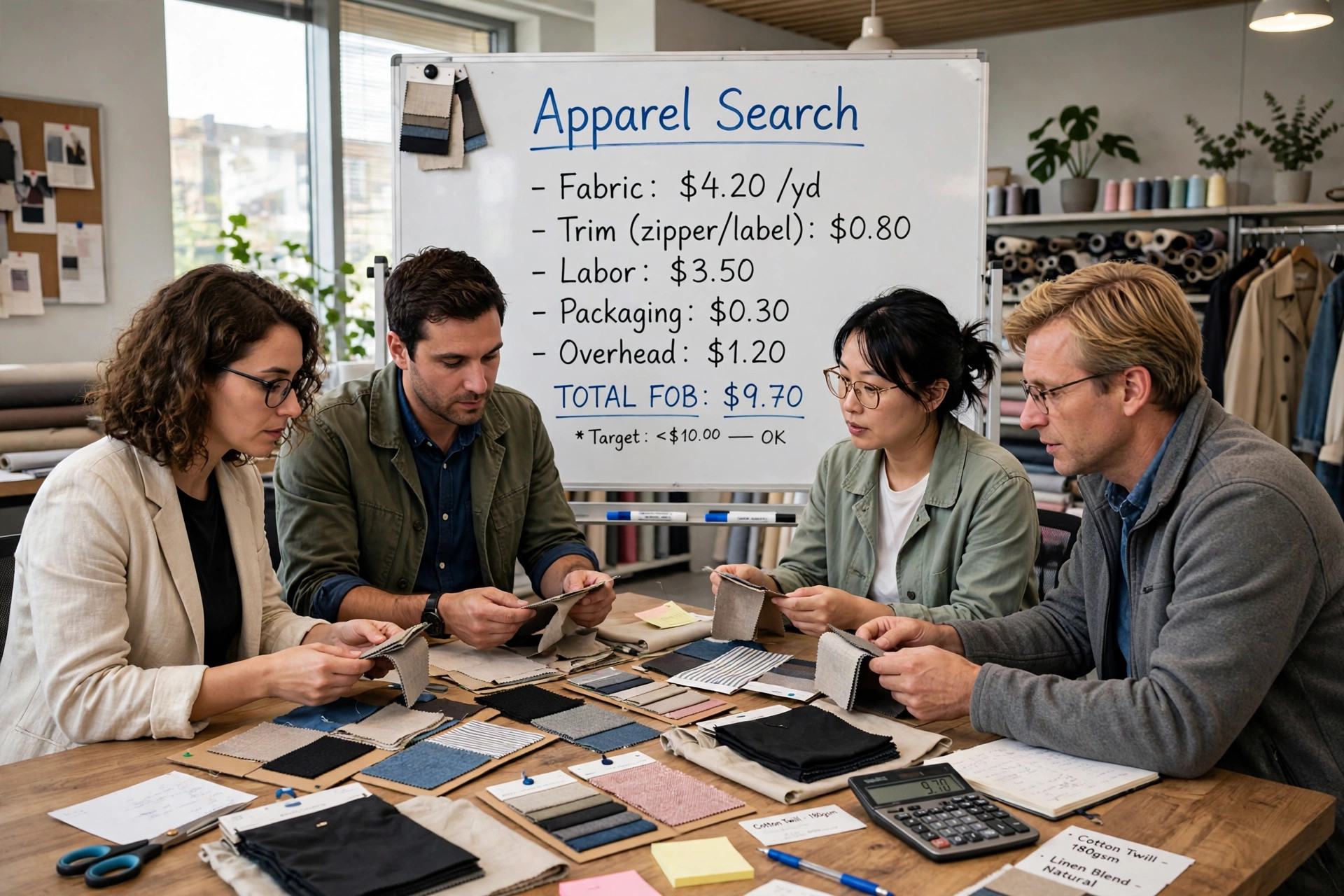
A garment's price is a stack of distinct blocks, and each block behaves differently. Materials — the fabric plus every trim, from zippers and buttons to labels and thread — are the largest block, commonly 50 to 70 percent of the total. Labor covers cutting, making (sewing) and finishing: pressing, checking, folding and packing. Overhead spreads the factory's rent, power, supervision, machine depreciation and office costs across every garment it produces. On top of the factory's own blocks sit testing and compliance charges where a buyer requires lab work, and the factory's margin — the profit that makes the order worth running.
What surprises newcomers is how sensitive the total is to the first block. Because fabric dominates, a five-cent change in fabric price or a two-percent change in how much fabric each garment consumes moves the final price more than hard bargaining over sewing rates ever will. That is why serious costing starts with consumption — the subject of two guides in this series — and why the cost sheet, the document that holds all of these numbers, is the most argued-over page in any apparel business.
A typical cost stack, in round terms: fabric 45–60%, trims 5–10%, cut-make labor 15–25%, factory overhead 8–15%, testing and packing 1–3%, margin 5–10%. The proportions swing with the product — a basic tee is mostly fabric; a tailored jacket carries far more labor — but the order of the blocks rarely changes.
The Costing Workflow: From Tech Pack to FOB
- Start from the tech pack. The costing begins with the technical package: the bill of materials listing every fabric and trim, the pattern, and the construction details. Nothing can be costed accurately that is not specified.
- Establish fabric consumption. A marker is made from the pattern pieces, and its yield sets how much fabric one garment uses — the number every material cost is multiplied by. Our fabric consumption guide works through the math.
- Price the materials. Fabric and trim prices come from mill and supplier quotations at the expected order quantity. Prices are quantity-sensitive: the same fabric costs less per yard on a 50,000-yard order than on a 3,000-yard one.
- Build the labor cost. Each operation is timed in standard minutes (SMV), the total minutes are multiplied by the factory's cost per minute, and the result is the make price. See the SMV and labor cost guide.
- Add overhead, testing and margin. The factory applies its overhead recovery and margin, adds any required testing or inspection charges, and the stack becomes a price.
- Quote, negotiate, re-cost. The price is quoted as FOB, CMT or another agreed basis, negotiated against the buyer's target, and then re-costed once bulk materials are booked — because the final fabric price and marker yield are what the factory will actually live with.
The Guides in This Series
- The Garment Cost Sheet, Explained — every line of the standard cost sheet, with a worked example you can follow number by number.
- CMT Costing Explained: CM, CMT and FOB — the three pricing models buyers and factories trade on, and exactly what each one includes.
- Fabric Consumption & Costing — how consumption per garment is calculated from GSM, width and marker yield.
- Marker Efficiency Guide — how markers are planned, why 80–88% efficiency is typical, and what a point of efficiency is worth.
- Garment Labor Cost & SMV — standard minute value, cost per minute and line efficiency, the engine inside every make price.
- Landed Cost for Apparel Imports — freight, insurance, duty and clearance: everything added to FOB before a garment reaches the warehouse.
- Wholesale & Retail Pricing and Margins — markup chains from FOB to wholesale to the retail ticket, including keystone pricing.
Costing Tools on Apparel Search
Reading about costing is one thing; running your own numbers is another. Apparel Search hosts free working tools built for exactly the calculations in this series. Use the online garment cost sheet to build a costing interactively, download the garment cost sheet template to keep and reuse, and run consumption figures through the fabric consumption calculator. Factories comparing software rather than spreadsheets can browse the costing software directory.
- Online Garment Cost Sheet
- Cost Sheet Template (Download)
- Fabric Consumption Calculator
- Costing Software Directory
Who Does This Work?
In most factories and buying offices, costing sits with merchandisers and dedicated costing analysts, who work between the design team, the pattern room and the sewing floor. If you are curious about the role itself, the costing analyst job description in our employment section sets out what the job involves day to day. However the work is organized, it rewards precision: the costing is the one document where a small error, repeated over fifty thousand garments, becomes a very large one.
Common Questions
What is garment costing?
Garment costing is the process of calculating what one garment will cost to make before production begins. It adds up fabric, trims, cutting and sewing labor, overheads, testing and packaging, then applies a margin to reach the price quoted to a buyer — usually an FOB price at the factory door.
What is the biggest cost in a garment?
Materials. Fabric and trims together commonly account for 50 to 70 percent of a garment's total cost, which is why consumption — how much fabric each garment uses — is the single most important number in the costing.
What does an FOB price include?
FOB (free on board) price includes everything needed to make the garment and deliver it onto the vessel at the port of export: materials, cutting, making, trims, finishing, packing, factory overhead and the factory's margin. International freight, insurance and import duty are added on top to reach the landed cost.
Why do factories cost a garment more than once?
The first costing is an estimate made from the tech pack and a sample. Once the bulk fabric, trims and marker are final, the factory re-costs with actual prices and actual consumption, because small changes in fabric price or yield move the final price more than any negotiation.
Related Guides
Costing does not sit alone. The quality a buyer specifies — and the testing used to prove it — is a real cost line, covered in our Textile Testing & Quality Standards Guide. And the way a garment is graded across its size range changes how much fabric every size consumes, which is why costing teams work closely with the methods in our Sizing, Fit & Pattern Grading Guide.