Garment Costing Guide · Marker Making
Marker Efficiency Guide
The marker is where fabric becomes garments — or waste. How markers are planned, and why a few points of efficiency are worth real money.
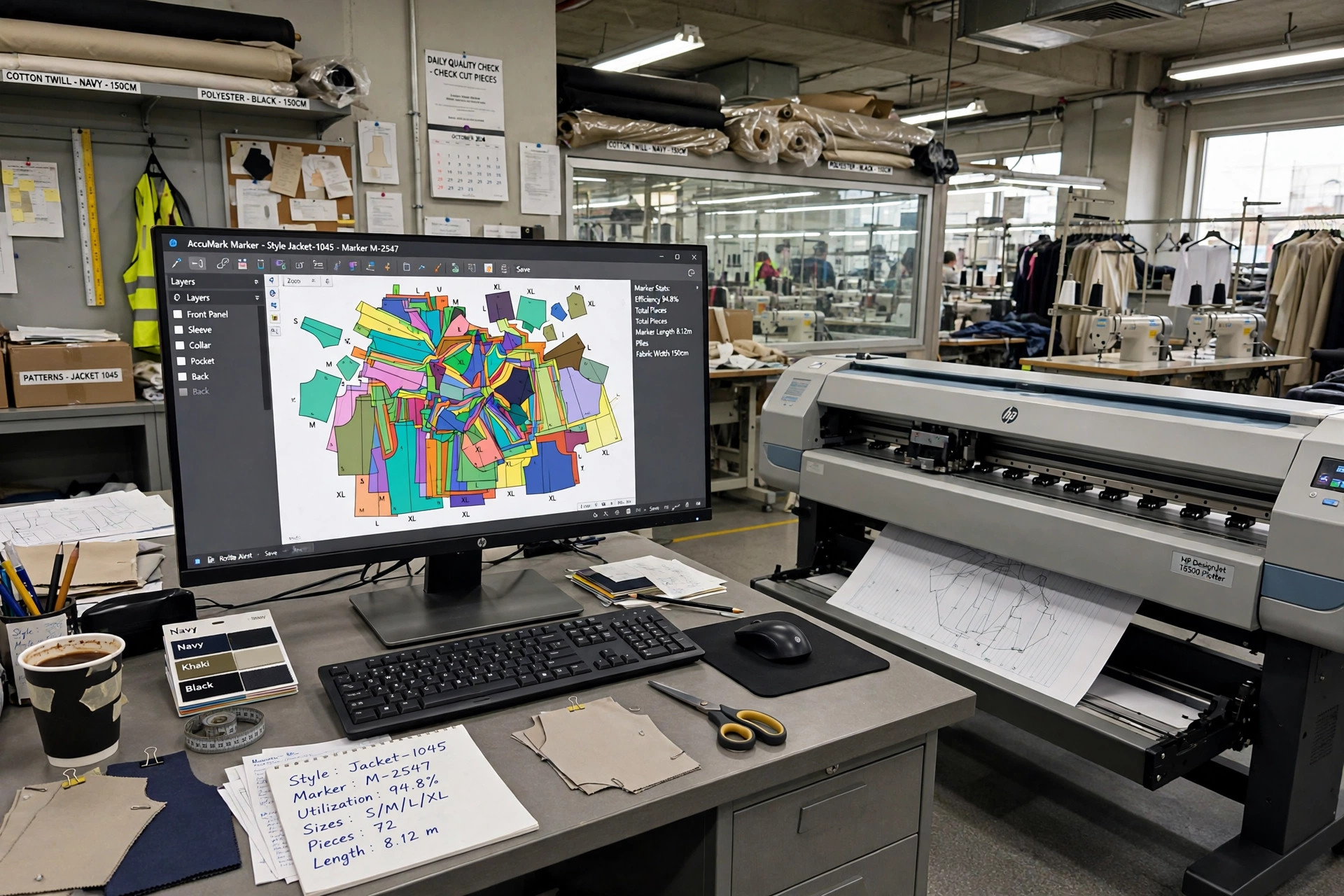
Before any fabric is cut, someone must solve a jigsaw puzzle: fit every pattern piece of every size in the order onto a rectangle of cloth, grain lines aligned, pattern matches honored, nothing overlapping. That layout is the marker, and the craft behind it — introduced in our glossary's marker making entry — is one of the quiet profit centers of the apparel industry. In the Garment Costing Guide series, this page explains the measure that governs that craft: marker efficiency.
The principle is simple. The pattern pieces have a fixed total area; the marker occupies a rectangle of fabric. Efficiency is the share of that rectangle the pieces actually cover. Every point of efficiency is fabric bought and used instead of fabric bought and binned, so on any real order the marker maker's patience, and the CAD software's nesting algorithms, pay for themselves many times over.
How Efficiency Is Calculated
The marker's area is its length × the fabric's usable width. The pieces' area is computed by the CAD system from the digital patterns. Because consumption per garment is marker length divided by the garments in it, efficiency and consumption are two views of the same thing: raise efficiency and the same pieces fit into a shorter marker, so consumption — and the fabric line on the cost sheet — falls in direct proportion. The full consumption method is set out in our fabric consumption guide.
What a Point of Efficiency Is Worth
Take a garment consuming 2.00 meters of fabric at an 80 percent efficient marker, with fabric at $4.00 per meter. The pieces themselves are fixed, so at 85 percent efficiency the marker shortens in the ratio 80/85: consumption becomes 2.00 × 80/85 ≈ 1.88 meters. That is 0.12 meters saved per garment, worth about $0.47. Trivial — until you multiply by the order: on 50,000 garments the five points of efficiency are worth roughly $23,500 of fabric. This is why factories invest in skilled marker makers and modern nesting software, and why buyers ask not just for consumption but for the efficiency behind it: it is the difference between a yield that was engineered and one that was merely accepted.
What Drags Efficiency Down
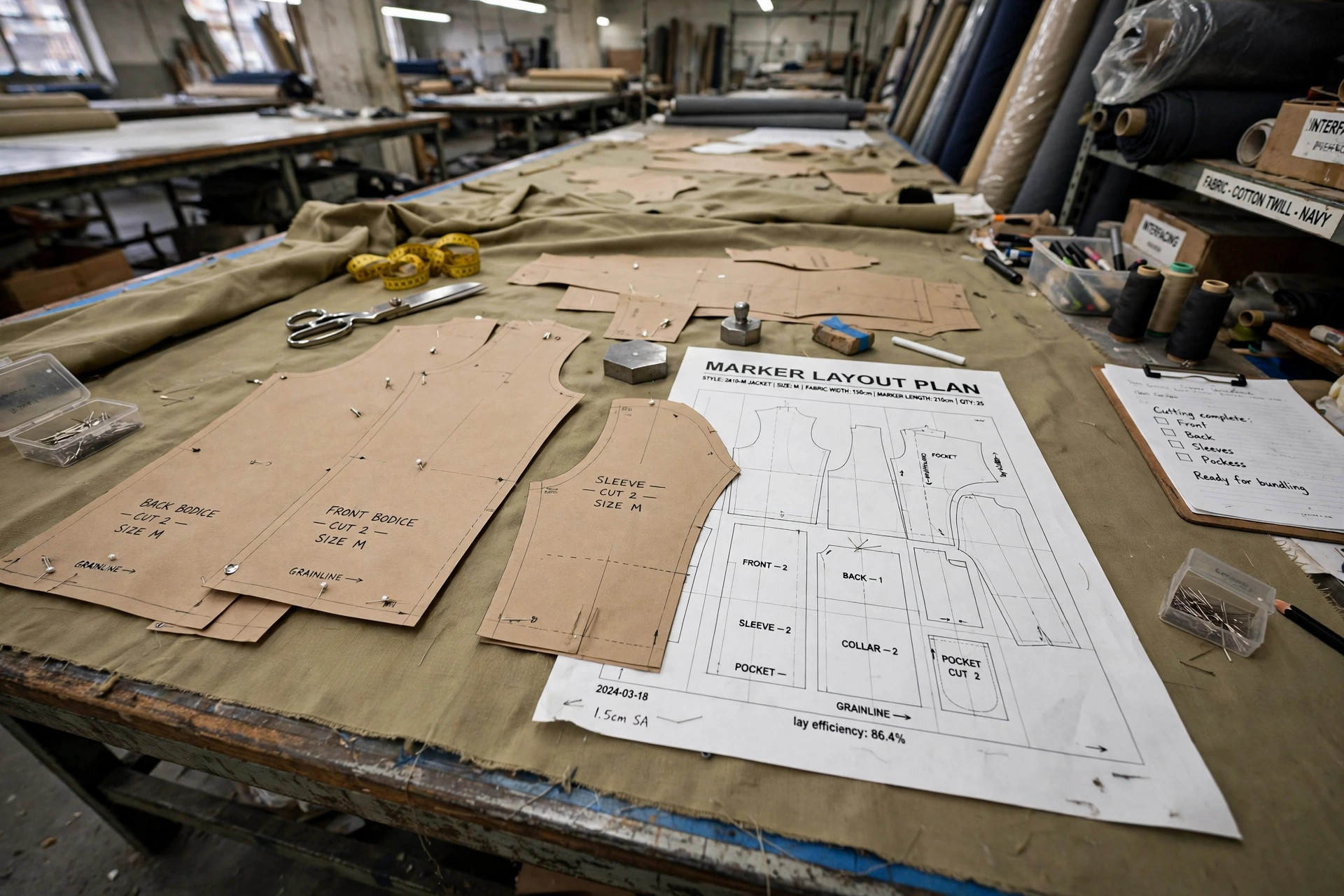
One-way fabrics. Nap, pile and one-directional prints force every piece to point the same way, removing the marker maker's best trick — rotating pieces 180 degrees to fill gaps. Velvet, corduroy and many prints are one-way by nature.
Checks, stripes and pattern matching. When a check must align across a front closure or a stripe must match at a side seam, pieces are placed to the pattern repeat, not to the tightest nest. Matching can cost several points of efficiency, and honest costings price it rather than discovering it at the cutting table.
Piece geometry and size mix. Large curved pieces — a flared skirt panel, a raglan sleeve — leave curved voids. A marker carrying a full size range nests better than one carrying a single size, because small pieces fill the gaps between large ones; single-size markers for replenishment orders are systematically less efficient.
Narrow fabric. The narrower the cloth relative to the largest pieces, the fewer arrangement choices exist. A fabric quoted cheaper per meter but woven narrower can easily cost more per garment — the reason consumption must always be tied to the width it was calculated on.
Raising Efficiency Without Cheating the Garment
The legitimate levers are: longer markers (more garments per layout give the nesting more freedom, within the cutting table's length), mixed-size markers matched to the order ratio, CAD auto-nesting run long enough to explore arrangements, and — at the design stage — pattern engineering, where a seam is moved or a panel split so pieces tessellate better. The illegitimate lever is tilting pieces off grain to squeeze them in, which produces garments that twist and hang badly; any efficiency gained that way is repaid in returns. Efficiency targets are therefore set per fabric and style, not as a blanket number: 80–88 percent is the honest working range for most garments, higher for simple pieces in plain cloth, lower where the fabric itself gives the orders.
Keep Exploring the Costing Series
Common Questions
What is marker efficiency?
Marker efficiency is the percentage of the marker's total fabric area that is actually covered by pattern pieces. If the pieces in a marker occupy 85 percent of the cloth's area, the marker is 85 percent efficient and the remaining 15 percent is cutting waste between the pieces.
What is a good marker efficiency?
Between 80 and 88 percent is typical for most garments. Simple, rectangular pieces in plain fabric can exceed 90 percent, while one-way fabrics, large checks or stripes that must match, and awkward piece shapes can pull efficiency into the 70s.
Why can't a marker be 100 percent efficient?
Pattern pieces are curved and irregular — armholes, necklines, shaped seams — so gaps between them are geometrically unavoidable. Grain lines must also stay aligned and some fabrics must run in one direction only, both of which limit how freely pieces can be rotated and nested.
How much is one point of marker efficiency worth?
On a garment using 2 meters of $4 fabric, moving from 80 to 85 percent efficiency cuts consumption to about 1.88 meters and saves roughly 47 cents per garment — about $23,500 on a 50,000-piece order. The exact figure depends on consumption and fabric price, but it is rarely small.
Back to the Garment Costing Guide
This page is one part of the Apparel Search Garment Costing & Production Economics Guide — return to the hub for the full costing workflow and every guide in the series.