Apparel Search Manufacturing Guides
Minimum Order Quantities Explained
Ask factories about making your clothing line and the first number you will meet is the MOQ — the minimum order quantity. It is also the first place new brands misread a factory's intentions: a high MOQ is rarely arrogance, and a low one is rarely generosity. Both are arithmetic. This guide explains where minimums come from, the several different MOQs hiding inside a single quote, how negotiation actually works, and the realistic production routes for brands whose orders are small. It is part of our Factory Audits & Product Compliance guide.
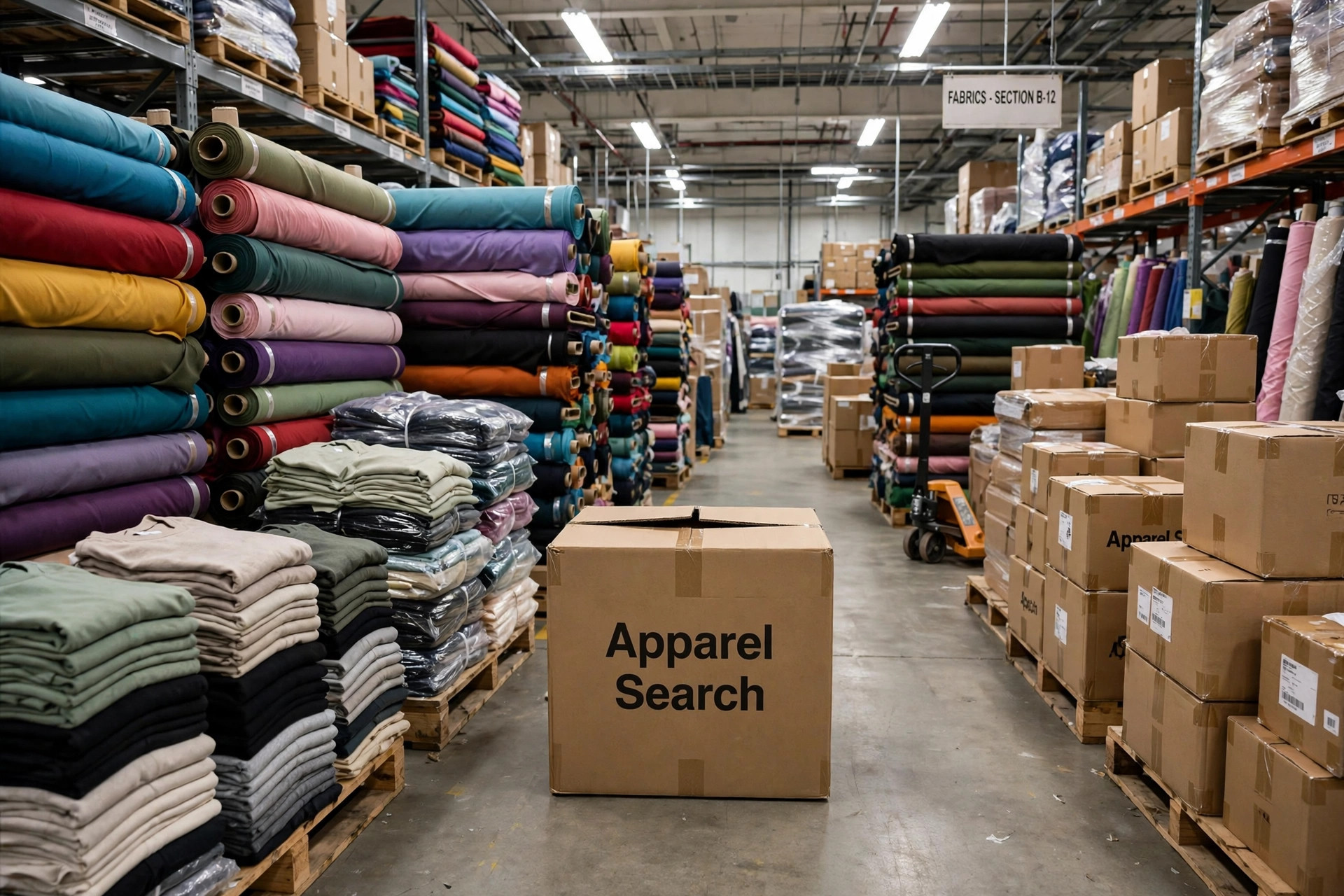
Minimum order quantity (MOQ): the smallest quantity a supplier will accept for an order — quoted per style, per color, per size run or per fabric depending on the supplier, and driven by the minimums of everyone upstream.
Why MOQs Exist
Fabric minimums and dye lots
The binding constraint is usually not the sewing factory but the fabric. Mills weave or knit fabric in production runs and quote their own minimums per fabric and per color; dyeing works the same way, because a dye bath prepared for a color costs much the same whether it colors a short or a long length of cloth. A factory ordering fabric for your 200-piece style in three colors may have to buy more cloth — in every color — than your order consumes. The mill's minimum becomes the floor under the factory's.
Setup and changeover
Every new style interrupts production: patterns and markers are made, machines are re-threaded and re-set for the fabric and operations involved, operators learn the garment's sequence, and the first pieces off the line are checked hardest. That fixed effort is the same for a short run as for a long one; spread over fewer garments, each garment carries more of it.
Cutting efficiency
Cloth is cut in lays — many layers at once, arranged in a marker that nests the pattern pieces. Short lays waste a higher share of fabric at the marker's ends and edges, and small size runs cut less efficiently than balanced ones. Your unit cost quietly includes that waste.
Trims and components
Buttons, zippers, elastic, labels and packaging all carry their own suppliers' minimums — sometimes surprisingly large ones for custom items like branded hardware or woven labels. A small garment order can find itself buying trims for several production runs at once. (Stock trims exist precisely because of this; custom trims are a commitment.)
Capacity and scheduling
A factory sells its line time. A small order occupies a slot a larger order would fill more profitably, and frequent changeovers lower the whole line's output. Minimums are how factories ration their capacity toward orders that keep the line running evenly.
The Several MOQs Inside One Quote
- Per style — the minimum total pieces of one design, across its colors and sizes.
- Per color — the minimum within each colorway, driven by dye lots and fabric buying; often the number that actually binds.
- Per fabric — the mill's minimum for the cloth itself, which can exceed the factory's own per-style minimum.
- Per size — occasionally quoted for knitted or sized goods made size by size.
When a quote disappoints you, ask which minimum is binding. The answer tells you what would have to change — fewer colors, a stock fabric, a different construction — for the numbers to move.
Team and club orders meet the same minimums from the buyer’s side — a roster of twenty-five sits exactly where setup costs bite hardest. Our team uniform costs and timelines guide shows how group orders work the arithmetic: quantity breaks, spares bought at main-order prices, and deposits that start production.
Negotiating, Honestly
Offer flexibility where it is cheap for you
Accepting the factory's stock fabric, standard trims or a later delivery slot can remove the exact constraint that set the minimum.
Consolidate
Fewer colorways, shared fabrics across styles, and combined orders all push quantity into the units factories count.
Accept a surcharge knowingly
Many factories will run below minimum for a small-order fee. Compare the fee against the true cost of over-ordering inventory you may not sell.
Trade a commitment
A credible repeat-order plan — realistic forecasts, on-time payment, growing volumes — is worth real concessions, because it converts your small order into the start of a program.
Ask what would change the number
Directly: "What would this MOQ be if…?" Factories answer this question readily, and their answers teach you their cost structure faster than any other conversation.
Realistic Routes for Small Brands
- Low-minimum factories. Some factories specialize in small runs as their whole business model — expect fewer fabric choices and higher unit prices, and honest arithmetic from both sides.
- Stock fabric programs. Using cloth already produced and held in stock removes the mill minimum entirely, at the price of choosing from what exists.
- Blanks and decoration. Buying finished blank garments and adding print or embroidery sidesteps garment MOQs altogether — the standard route for merch and graphic lines.
- Regional and nearshore production. Smaller factories closer to your market often run shorter minimums and faster turns; our nearshoring guides linked below compare the economics.
- Preorder and made-to-order. Selling before producing turns the MOQ question into a threshold question — produce only if orders justify the run.
The hidden math: a lower MOQ at a much higher unit price is not automatically the better deal, and neither is a cheap price that forces you to buy three seasons of inventory. The right comparison is total cash committed against what you can realistically sell — a smaller, dearer run that sells out usually beats a cheaper run that ends in a clearance rack.
Common Questions
What does MOQ mean in clothing manufacturing?
MOQ — minimum order quantity — is the smallest order a supplier will accept for a given item. In apparel it is rarely a single number: a factory may quote one minimum per style, another per color, and the fabric mill behind it imposes its own minimum per fabric and dye lot. The effective MOQ for your order is usually the highest of the minimums that apply to it.
Why won't a factory just make 50 pieces?
Because most of its costs do not shrink with the order. Setting up machines, making patterns and markers, preparing a dye bath and inspecting output take roughly the same effort for 50 pieces as for 500, and fabric itself is sold with mill minimums. At 50 pieces those fixed costs land on very few garments, and the factory either loses money or quotes a unit price the brand cannot sell at. Some factories still accept tiny orders — at prices that reflect exactly this arithmetic.
Can MOQs be negotiated?
Often, at the margins — but by changing the terms, not by arguing with arithmetic. Flexibility on fabric, colors and delivery dates, accepting stock materials, consolidating colors, committing to repeat orders, or paying a small-order surcharge can all move a minimum. What rarely works is demanding a low MOQ and a low price and a fast turnaround at once; experienced factories recognize the combination.
How do small brands produce below factory MOQs?
By choosing routes designed for small runs: factories that specialize in low minimums, stock-fabric programs (using cloth the mill already has), printing or embroidering blank garments, domestic cut-and-sew shops, and preorder or made-to-order models that remove the guesswork from quantities. Each trades something — fabric choice, unit cost, speed or margin — and our guide walks through the options honestly.
More to Explore
- MOQ — Minimum Order, In Depth — the term explored in full, including worked negotiation examples.
- Nearshoring & Onshoring Apparel — closer-to-home production, where smaller runs are a selling point.
- Nearshoring vs Offshore: Total Cost Framework — comparing production routes on total cost, not unit price alone.
- Sourcing — the Apparel Search sourcing overview: finding and evaluating factories.
- Manufacturing Guides — the wider set of factory and production guides.
- Private Label Routes Compared — where relabeling, modified styles and custom programs set their own minimums.
- Private Label Costs & Minimums — how minimums combine with labels, sampling and freight in a real order budget.
- Apparel & Textile Compliance Guide — the rules landscape that shapes factory terms: safety, chemicals, labeling and audits.
Search Apparel Search