Children's Shoes Guide
Children's shoes cover every footwear job except the sneakers detailed in their own K guide: school shoes, boots, sandals, dress shoes and rain boots. This guide is the category overview the original pointed outward from - to types of shoes and to the boot and sneaker specialists - and those links are carried in this page. Shoes are the one children's category where fit is a health question as much as a comfort one, because feet are still forming and a child cannot always articulate that a shoe is wrong; the adult's measuring discipline has to do that work.
Shop Children's Shoes Now
Shop Children's Shoes on Amazon Shop Children's Shoes on eBayThe Amazon and eBay links on this page are affiliate links. If you make a purchase through them, Apparel Search may earn a commission.
Children's shoes cover every footwear job except the sneakers detailed in their own K guide: school shoes, boots, sandals, dress shoes and rain boots. This guide is the category overview the original pointed outward from - to types of shoes and to the boot and sneaker specialists - and those links are carried in this page. Shoes are the one children's category where fit is a health question as much as a comfort one, because feet are still forming and a child cannot always articulate that a shoe is wrong; the adult's measuring discipline has to do that work.
Children's feet grow in bursts, sometimes a full size in a few months, then plateau. That rhythm shapes everything here: measure often, buy for the foot measured this month, build in a thumb's width of growing room and no more, and treat a sudden tripping phase or toe complaint as a measuring appointment, not a mystery.
The Shoe Family
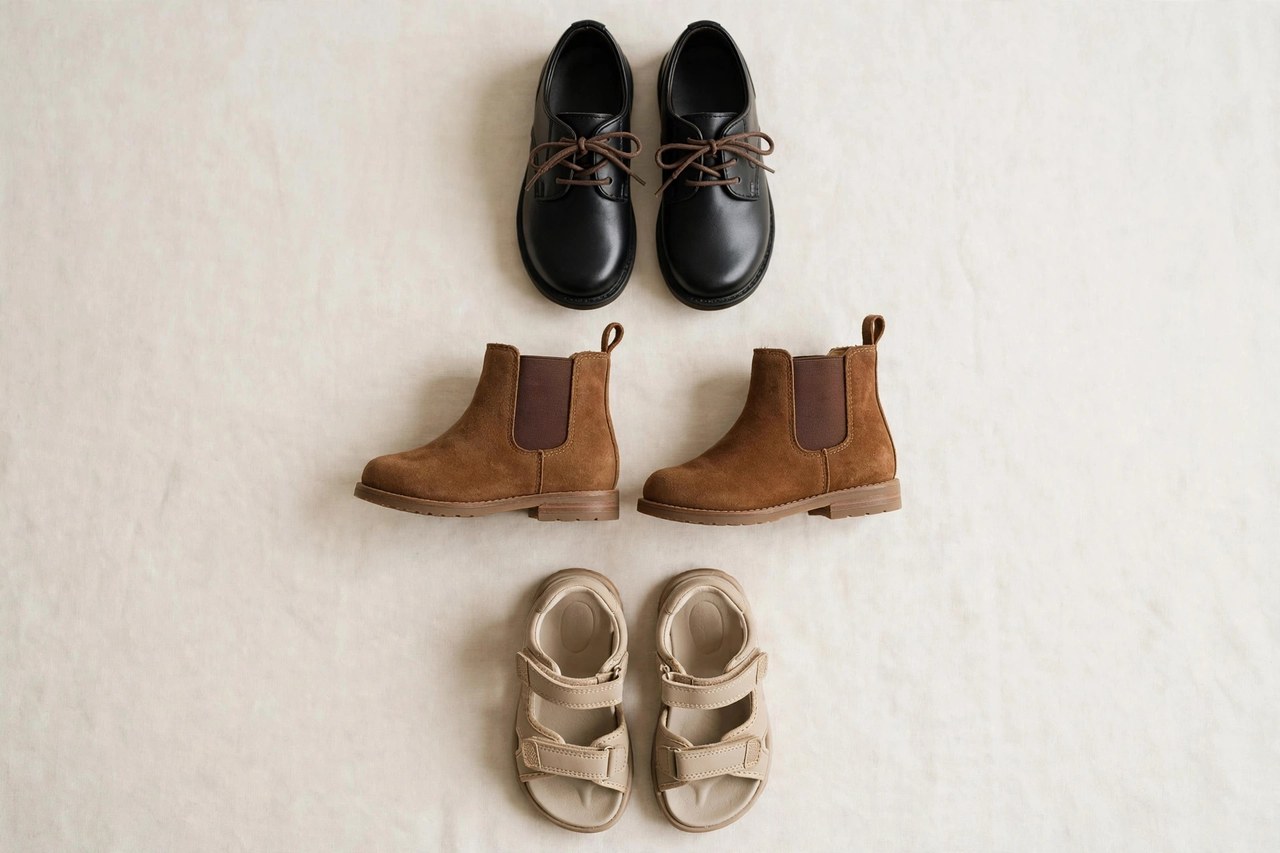
School shoes are the daily workhorse: leather or leather-look uppers, cushioned insoles, grippy soles and fastenings matched to age - touch-fastening straps for the youngest, laces once tying is mastered, slip-ons for older children. Boots add ankle support and weather sealing: rain boots for wet play, insulated boots for snow, sturdy boots for rough ground. Sandals cover summer with the same fit discipline, plus toe protection for younger children - closed-toe sandals save many playground tears.
Dress shoes are the occasion category, bought close to the event and checked for the one thing children do at events besides posing: running. A dress shoe a child cannot walk and play in comfortably will be removed at the first opportunity, usually into a puddle. Party shoes with a small heel for older children should stay low and stable.
Measuring and Fit
Measure both feet, standing, late in the day when feet are at their largest, and fit to the bigger foot. Growing room is about a thumb's width - roughly a centimetre to a centimetre and a half - between the longest toe and the shoe's end, checked by pressing the toe box while the child stands. Much more than that and the shoe trips and folds at the wrong point; less and the shoe is outgrown before it is worn in.
Width matters as much as length: toes should lie flat and be able to wiggle, the heel should not slip out with each step, and the shoe should flex where the foot flexes, at the ball. Fastenings should hold the foot back in the shoe so the toes are not doing the gripping. Walk, hop and turn in the shop - the fitting is a movement test, not a photograph.
Care and Replacement Rhythm
Rotate two pairs where you can - shoes need a day to dry and recover between wears, and rotation measurably extends life. Clean and polish leather school shoes weekly-ish; the polish is water resistance and leather food, not vanity. Rain boots just rinse; sandals air out. Check soles and toe boxes at each measuring - a worn-through toe or a heel worn to an angle is a replacement signal on its own.
Expect the replacement rhythm to feel relentless in growth-spurt years and to slow later; hand-me-downs work for rarely-worn dress shoes but daily shoes mold to their first wearer's feet and are the weakest hand-me-down in the wardrobe. Measured often, fitted with a thumb's width and rotated sensibly, children's shoes protect the feet that the whole wardrobe stands on.
Common Questions
How much growing room should children's shoes have?
About a thumb's width - one to one and a half centimetres - between the longest toe and the end of the shoe, measured standing on the bigger foot. More causes tripping and wrong flexing; less means the shoe is outgrown almost immediately.
How often should I measure a child's feet?
Every six to eight weeks for toddlers, every three to four months for school-age children, and immediately if tripping increases or toes complain. Growth comes in bursts, and a shoe can go from fine to harmful inside one burst.
Are hand-me-down shoes a good idea?
For occasionally worn dress shoes, usually fine. For everyday shoes, they are the weakest hand-me-down in the wardrobe: the insole and upper mold to the first child's foot and gait, so a second child inherits someone else's fit.
More in Children's Clothes Guide K
The K letter hub and the guides closest to this one:
More to Explore on Apparel Search
Looking for Children's Clothing Stores?
This guide helps you choose children's shoes. To browse where to buy, visit our children's clothing store directory, where you can find retailers that carry them.