Apparel Search Consumer Guides
Arch Support and Insoles Guide
Arch shapes described as fit, the wet test for a home reading, the insole categories on the shelf, and how an insole changes the fit of a shoe.
Of all the phrases in shoe marketing, "arch support" does the most work with the least explanation. It appears on everything from running shoes to sandals, it is sold as insoles in every shoe shop, and it is rarely described as what it actually is: a set of construction choices about the shape of the inside of a shoe. This page explains the subject as fit and product knowledge — the shapes arches come in, how to get a rough reading of your own, the categories insoles are sold in, and how a replacement insole changes the fit of a shoe. It belongs to our shoe fit guide, where the overall fit checks live.
Three Arch Shapes, in Fit Terms
The arch is the curved structure along the inner side of the midfoot. Its height decides how much of the middle of your foot meets the ground, and that decides how the inside of a shoe should be shaped to meet it. Described purely as fit, arches fall into three broad shapes.
- Medium arches show a clear curve: a footprint has a defined band connecting heel and forefoot along the outside, with open space under the inner midfoot. Most standard shoe footbeds are contoured with this shape in mind.
- High arches curve more steeply, so little of the midfoot makes contact and weight is carried more on the heel and the forefoot. Inside a shoe, a high arch can leave a gap under the midfoot — which is why cushioning under the heel and forefoot, and footbeds that rise to meet the arch, are the features commonly paired with this shape.
- Low arches sit flatter, so more of the midfoot contacts the ground and a footprint shows a broad, filled band. Watching a low-arched foot bear weight, the ankle tends to roll visibly inward as the arch settles — a description of the motion, and the reason firmer, structured support categories are commonly chosen for this shape.
The Wet Test: A Rough Home Indicator
The classic home method is simple. Wet the sole of your foot, step once onto a dry surface that shows the print — a sheet of brown paper or card, or a dry patch of paving — and look at the shape. A print showing heel and forefoot joined by a narrow band suggests a higher arch; a broad band filling much of the middle suggests a medium one; a print nearly as wide in the middle as at the ends suggests a lower arch. Take the result as an indicator, not a verdict: how wet the foot was and how hard you stepped both change the print, and shoe shops that assess arches use pressure mats and a fitter's eye for a reason. The wet test's real use is vocabulary — it tells you which of the categories on insole packaging is talking about feet shaped like yours.
Where Arch Support Lives in a Shoe
Inside a shoe, "support" can mean several different pieces of construction. The most visible is the footbed: many shoes are built with a contoured insole board whose surface rises under the arch instead of lying flat. Midsole shaping does similar work out of sight, with firmer material moulded under the midfoot. A firm heel counter — the stiffened cup around the back of the shoe — holds the heel in line so the arch sits where the shoe expects it. When a product description claims arch support, it is claiming one or more of these features; the photographs and the description of the footbed will usually tell you which, and a shoe you can handle tells you directly — press a thumb into the footbed under the arch and feel whether anything rises to meet it.
Insole Categories
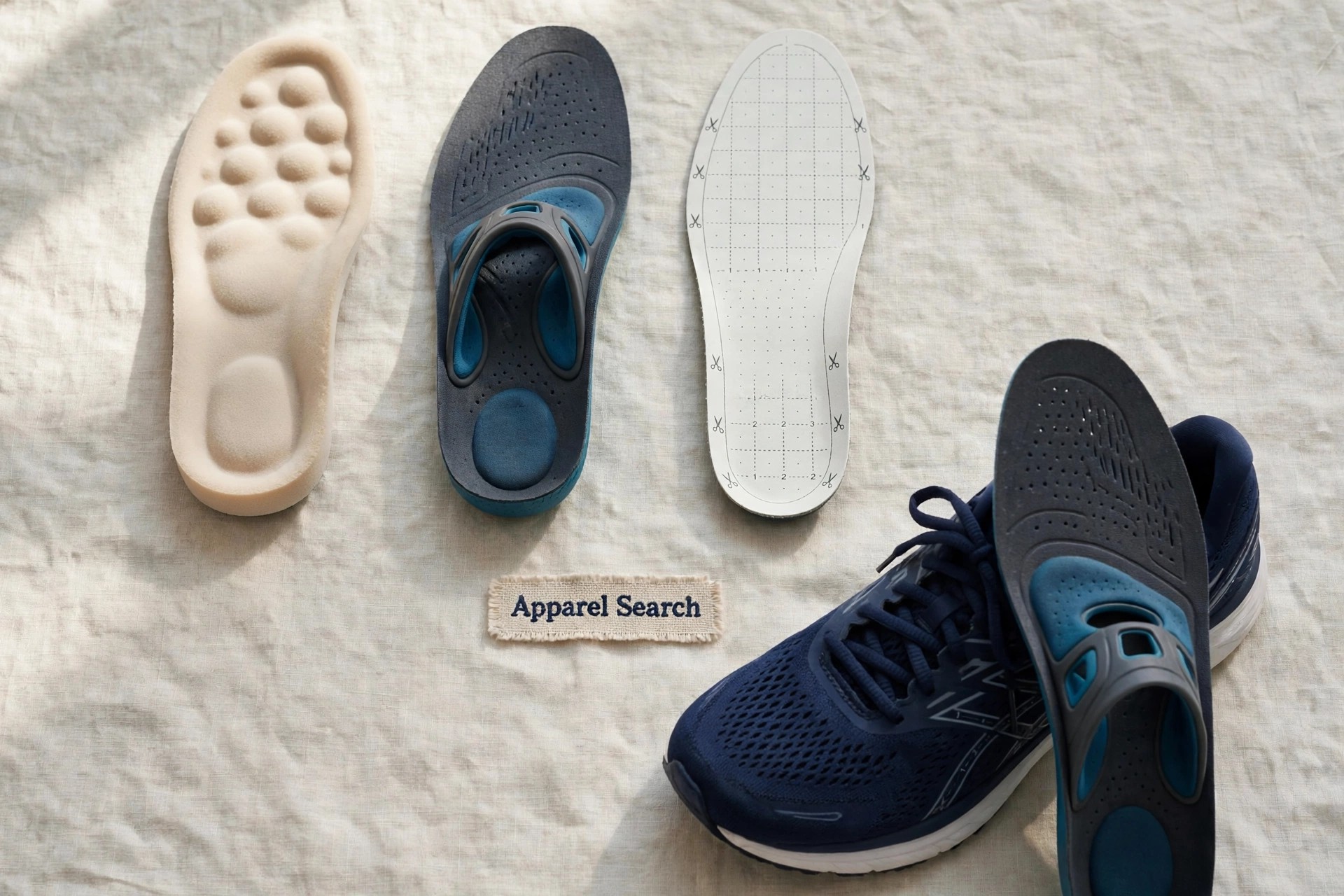
Replacement insoles are sold in families, and the families are defined by construction rather than by promises.
- Cushioning insoles are foam or gel pads, from thin liners to plush topped versions. They are bought for underfoot softness and to take up a little room in a roomy shoe; they add little structure.
- Support insoles are built around a firmer shaped shell under the arch and heel, topped with a foam layer. They are graded by the arch height they are shaped for, and they hold their shape far longer than plain foam.
- Heat-mouldable and trim-to-fit insoles adapt at home. Heat-mouldable versions soften in warm water or a low oven (each maker specifies its own method) and take an impression of your foot as they cool. Trim-to-fit versions carry printed size guides and are cut down at the toe end only, using your shoe's own insole as the template.
Most insoles are full-length, replacing the shoe's whole footbed. Three-quarter lengths exist for close-fitting dress shoes, sitting under the heel and arch and leaving the toe area to the shoe's own thin lining — a useful category where a full insole would crowd the toes.
Replaceable or Built-In: Making Room
An insole occupies space, and managing that space is the whole skill of using one. Every millimetre of insole thickness raises your foot inside the shoe: the toes sit closer to the top of the toe box, and the heel sits higher, which can start it slipping. Shoes designed to take an insole make this easy — a removable factory footbed (lift it out and the room is made) and a last with enough depth. Shoes with thin linings glued or stitched flat are not designed for one, and forcing a thick insole into them trades one fit problem for another.
One shoe category is built around exactly this space problem: extra-depth shoes ship with one or two removable insoles as standard, so the wearer’s own insole — or simply a thicker sock — has a designed place to go. Our diabetic-friendly shoes guide covers that category’s fit system end to end.
- Start from the shoe's own insole. If it lifts out, remove it before adding yours — stacking two full insoles is the most common way to crowd a shoe.
- Trim at the toe, never at the arch. Stand the old insole on the new one, trace its outline, and cut the toe end to match. The shaped arch and heel sections are the product; the toe is just sizing.
- Refit from scratch. With the insole in, redo the basic checks from our shoe fit guide — toe room standing, heel hold walking, with the socks you will actually wear. An insole that passes those checks has earned its place.
A Note on Foot Pain
This page describes products and fit. It does not claim that any shoe or insole will change how your feet feel over time, and nothing here substitutes for professional assessment. If foot pain persists, or keeps you from things you want to do, have it assessed by a podiatrist or a qualified footwear professional — that conversation is the right tool for that job.
Shop Insoles and Arch Support Products on Amazon
Ready to shop? Product links are kept in one place on the Apparel Search shopping guide:
Shop Clothing on AmazonThis link opens the Apparel Search shopping guide for Amazon, where the product links are kept in one place.
Common Questions
Do I need arch support if my feet feel fine?
Arch support is a product feature, not a duty. Many people wear flat-lined shoes comfortably for years, and many others simply prefer the feel of a contoured footbed. The categories exist so you can match a shoe's inside shape to your foot and your preference. Choose by how a shoe feels across a full day of wear, not by the idea that a feature is compulsory.
How long do insoles last?
It depends on the material and how hard they are used. Foam cushioning gradually compresses and stops springing back — after months of daily wear rather than years is the common pattern — while a structured support insole's firmer shell usually outlasts its foam top layer. Take an insole to be finished when it stays flattened, cracks, or when a shoe that felt right starts feeling different for no other reason.
Can an insole make a loose shoe fit better?
An insole changes a shoe's volume, not its length. A thicker insole can take up slack through the midfoot and reduce heel lift in a shoe that is roomy inside, and it is a standard way to fine-tune fit. It cannot shorten a shoe that is too long, and in a shoe that is already snug it can crowd the toes and lift the heel — so try the combination with the socks you will actually wear.
What is the difference between an insole and an orthotic?
An insole, or footbed, is a retail product: it is sold by shoe size and arch type, off the shelf. The word orthotic, used strictly, means a device made or specified for one individual's feet, usually through a clinician — though shops sometimes use the word loosely for firm retail insoles. The insoles in this guide are the over-the-counter category.
Back to the Shoe Fit Guide
Length, width, heel hold and toe box shape — the fit checks every insole decision should be re-tested against.