Apparel Search Consumer Guides
Diabetic-Friendly Shoes
Built for room: the depth, the smooth interior and the adjustable fit that define the category.
The shoe half of our diabetic socks and footwear guide is a study in volume. Where an ordinary shoe is shaped to a fashion outline, these shoes are shaped to hold a foot, a sock and often an insole of the wearer’s own, with nothing inside to rub. This guide goes feature by feature — depth, interiors, insoles, soles, closures — and ends with the fitting method, which matters here more than in any other shoe category we cover.
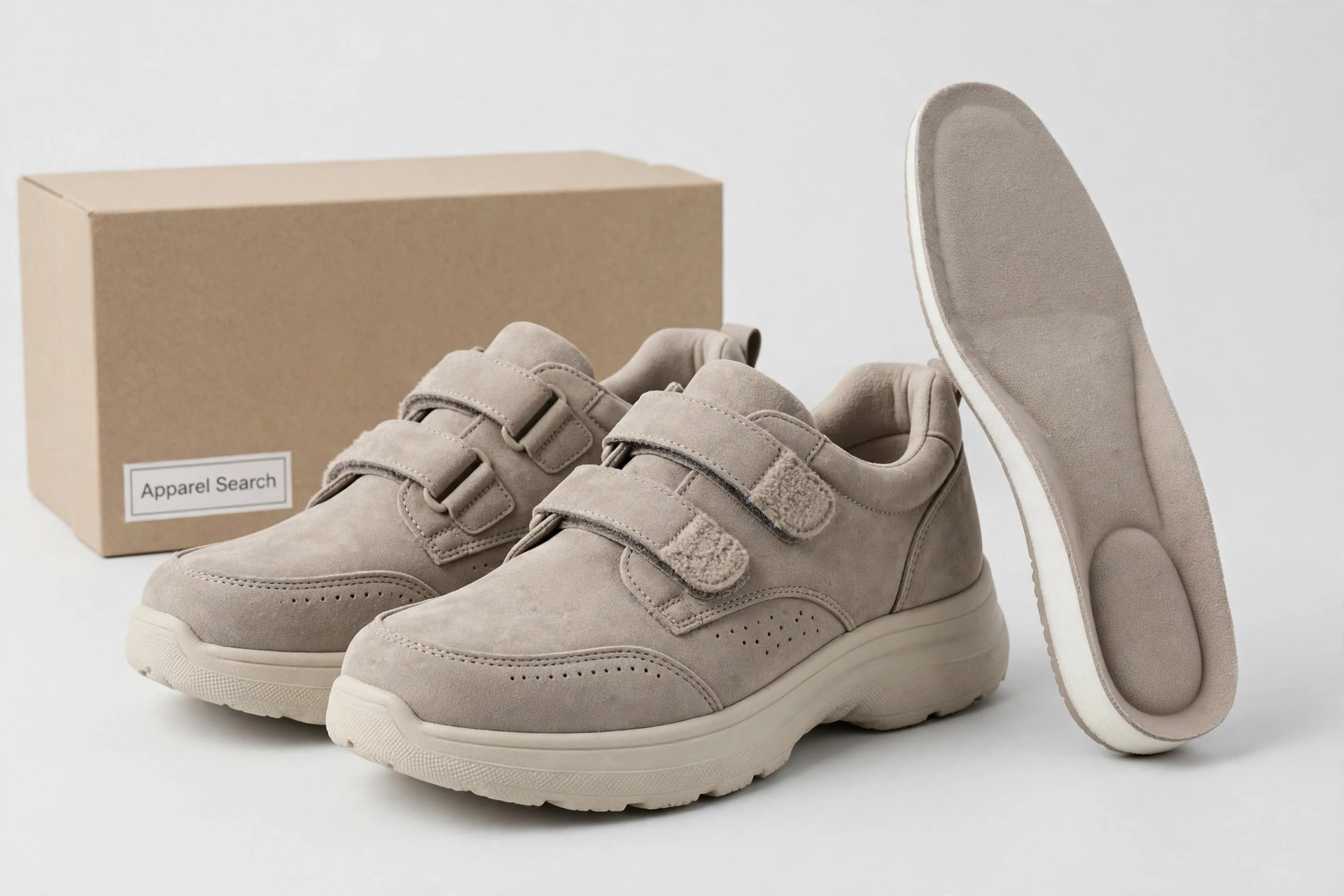
Depth First: The Toe Box
The defining measurement is depth. Extra-depth lasts carry more vertical room from sole to upper, and the toe box is tall and wide, so the toes lie flat and spread rather than stacking or curling. Width letters run wider than fashion equivalents, and many styles are offered in several widths on the same length. Our shoe fit guide works through width and toe-room checks in full; in this category, apply them generously — a fit that would be “roomy” in a fashion shoe is the starting point here.
Interiors with Nothing to Rub
Turn the shoe over and run a hand inside before anything else. The linings in this category are smooth and padded, the seams are placed away from the foot or eliminated, and there is no stiff counter edge or stitching ridge where the toes bend. Uppers are soft — stretch panels over the forefoot are common — so the shoe gives where the foot is widest instead of arguing with it. That hand test takes ten seconds and is the category’s whole promise in miniature: if your fingers find a ridge, your foot will find it too.
Removable Insoles, on Purpose
Most styles ship with one removable insole; the deeper ones ship with two, stacked. The arrangement is the feature. Lift one or both out and the shoe gains the room for a wearer’s own insole or orthotic; leave them in and it fits as a standard cushioned shoe. Our arch support and insoles guide covers the space arithmetic — every millimetre of insole raises the foot inside the shoe — and this category is simply that arithmetic, designed for in advance.
Rocker Soles and Cushioned Midsoles
The soles are thick, cushioned and stiff, and many curve up at the front into a rocker: instead of the shoe bending sharply at the ball with each step, the curved sole rolls the step forward. Rocker geometry is ordinary footwear engineering — it appears in mainstream walking shoes too — and here it is paired with a firm heel counter and a sole wide enough to feel planted. Judge it the way you would any walking shoe: the roll should feel even, without a tipping point.
Closures That Adjust Through the Day
Feet are not one size all day; they measure larger in the evening than in the morning, which is why our how to measure your feet page insists on late-day numbers. Closures are how a shoe copes: long lace runs that open wide for entry and snug down in stages, and hook-and-loop straps that can be eased a notch by evening without re-lacing. Straps have a second audience — hands that find laces slow going — and the adaptive side of that subject lives in our medical dressing guide.
Fitting: Borrow the Shoe Fit Method
- Shop late in the day, when your feet are at their largest — the fit you are buying is the evening fit.
- Wear the socks you live in, ideally the cushioned kind from our socks buying guide; a thick sock is part of the fit, not an afterthought.
- Fit the larger foot, both feet tried, standing — feet lengthen under weight.
- Check the thumb room in front of the longest toe, then walk: no heel slip, no toe strike, no ridge found by a toe that your hand missed.
- Test the insole swap in the shop if you wear your own insoles — remove the factory pair and refit before deciding.
A Garment Guide, Not Medical Advice
This page covers clothing: how socks and shoes in this category are designed, fitted and cared for. It describes what the garments are made of and how they are put together — nothing here is a claim about what any garment does for a medical condition. Questions about your feet belong to your own doctor or care team, and their guidance outranks anything in a product description — including the ones described here.
Shop Diabetic Socks & Footwear on Amazon
Ready to shop? Product links are kept in one place on the Apparel Search shopping guide:
Shop Clothing on AmazonThis link opens the Apparel Search shopping guide for Amazon, where the product links are kept in one place.
Common Questions
What makes a shoe “diabetic-friendly”?
A set of construction features: an extra-depth last with a tall, wide toe box, a lining without internal seam ridges, a removable insole — sometimes two — so there is room for the wearer’s own, a cushioned sole that often curves into a rocker, and closures that adjust. No single feature defines the category; the combination does.
Why do these shoes come with removable insoles?
Depth you can rearrange. Removing one or both factory insoles makes room for a wearer’s own insole or orthotic, or simply for a thicker sock; putting them back restores the standard fit. It is the same space-managing principle our arch support and insoles guide works through for ordinary shoes.
When should I try these shoes on?
Later in the day. Feet are at their largest after hours of standing and walking, and a shoe fitted to a morning foot can feel a size smaller by evening — doubly worth avoiding in a category bought for room. Fit both feet, wearing the socks you plan to live in, and judge by the larger foot.
Are rocker soles only found in specialist shoes?
No. The rocker — a sole curved so the shoe rolls forward instead of bending sharply — appears in mainstream walking and comfort shoes as well. In this category it is paired with a stiff, cushioned sole and the extra depth, but the geometry itself is ordinary footwear engineering.
Back to the Diabetic Socks & Footwear Guide
The full section: sock features, shoe features, and how the two halves of the category fit together.
Search Apparel Search
Please note: Apparel Search is a fashion and clothing guide, not a medical authority. Pages in this section describe clothing features and dressing ideas only. We make no claim that any garment or special product will improve, treat, or help with any medical condition, and descriptions of product features reflect how those products are designed and marketed, not a medical endorsement. Please check with your own doctor or care team about what is right for you.