Apparel Search Consumer Guides
Buying Diabetic Socks
Choosing by construction — the top band, the toe closure, the fiber and the cushion, checked one at a time.
A diabetic sock is a short list of construction choices wearing a category name. This guide works through the choices in the order a shopper meets them — fit at the top, fibers, cushion, height, quantity and care — as part of our diabetic socks and footwear guide. Everything here is garment talk: what the sock is made of, how it is knitted, and how to tell a well-made one from a relabeled ordinary sock.
Fit Without Constriction
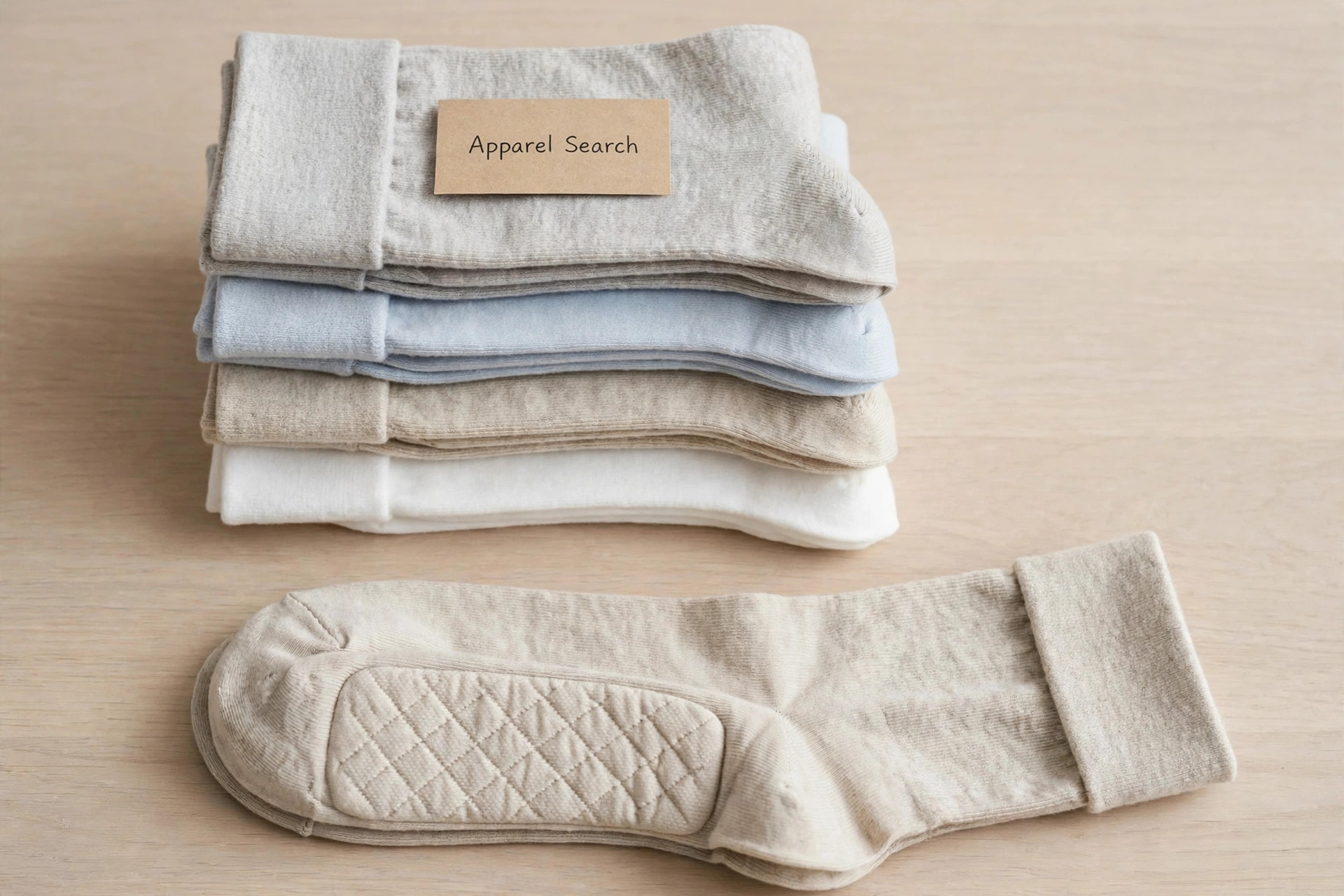
Start at the top. The band of a diabetic sock is knitted wide and easy, and the fit test is a finger: slide one under the cuff. It should slip in without a fight, while the sock still holds its place on the leg. Then check the heel: the sock’s heel pocket should sit on your heel, not under it or beyond it — a pocket in the wrong place is a size problem, and the spare fabric has to go somewhere, which is how bunching starts. Bunching matters in this category for a plain garment reason: folded fabric inside a shoe is a ridge, and the whole design brief of these socks is a shoe interior without ridges.
Fibers: The Moisture Question
Cotton is the familiar option and the one most ranges have moved away from: it drinks moisture in and holds it, dries slowly, and loses its cushion as it mats down through the day. Acrylic and polyester blends are the category’s workhorses — they move moisture along the fiber instead of storing it, dry quickly in the wash, and keep their terry padding springy for longer. Wool blends bring natural cushion and warmth; a merino mix is the warm-weather-to-winter bridge, and our thermal socks guide covers the heavy end of that family. A small percentage of elastane — two or three percent on the label — is there to hold shape, not to squeeze.
Cushion, Placed Where Foot Meets Shoe
Cushioning is terry loop piled into the knit, and makers place it three ways: a light pad over the whole foot, a full pad under the sole, or targeted padding at heel and toe with a thinner top. The trade is room. A thickly padded sock takes space inside the shoe — pair it with a shoe fitted for it, the way our shoe guide describes, or the cushion buys comfort at the price of a tight toe box. Thin-top, padded-sole styles are the usual compromise for ordinary shoes.
Heights
Ankle and quarter lengths serve summer and low shoes. Crew length is the default — it covers the calf where a shoe’s top line ends and stays up by a combination of band and length. Over-the-calf styles stay up by length more than by band, which suits shoppers who find any band too much; at that height, check that the top is the same wide, easy knit as the crew’s, because a knee-high with a tight top defeats the design.
How Many Pairs: The Rotation Arithmetic
- Count the days between washes. A fresh pair each day is the working assumption in this category, so a weekly wash sets the floor at seven pairs.
- Add spares. One or two extra pairs cover a missed wash day and a pair kept in a bag or a drawer at work.
- Rotate, don’t repeat. Resting a pair between wears lets the terry cushion recover and the elastic rest, so eight pairs rotated outlast the same eight worn in a fixed queue.
- Retire by hand-feel. When the sole has thinned to a shadow of its terry, or the top has gone slack — or, conversely, harsh and over-tight as the elastic perishes — the pair has left the specification it was bought for.
Washing
Turn the socks inside out, wash at the temperature on the label, and skip the fabric softener: softener coats the yarns, and coated yarns move moisture less well — the one feature these socks are bought for. Our laundry guide covers dosing and rinsing habits that suit a whole sensitive-wardrobe wash, and the same routine serves here.
Reading the Package Skeptically
Two kinds of words appear on these packets. Construction words — “seamless toe”, “non-binding top”, fiber percentages, cushion placement — describe the garment, and you can verify every one of them with a finger and a label. Outcome words promise what the garment will do for your body; those are marketing, and no sock packet can make them checkable. One more tell: a printed pressure range in mmHg belongs to compression, a different construction on a different shelf — if a sock carries one, it is not built to this category’s pattern, whatever the front of the packet says.
A Garment Guide, Not Medical Advice
This page covers clothing: how socks and shoes in this category are designed, fitted and cared for. It describes what the garments are made of and how they are put together — nothing here is a claim about what any garment does for a medical condition. Questions about your feet belong to your own doctor or care team, and their guidance outranks anything in a product description — including the ones described here.
Shop Diabetic Socks & Footwear on Amazon
Ready to shop? Product links are kept in one place on the Apparel Search shopping guide:
Shop Clothing on AmazonThis link opens the Apparel Search shopping guide for Amazon, where the product links are kept in one place.
Common Questions
How tight should the top of a diabetic sock be?
Snug enough to stay up, loose enough to forget. The band should hold by gentle contact: you should be able to slide a finger under the cuff without forcing it, and the sock should stay put through the day without hauling. If a top has to grip hard to stay up, the size or the style is wrong — a longer sock that stays up by length is usually the better fix.
Which fiber should I choose?
The one that suits your shoes and your day. Cotton feels familiar and washes easily but absorbs moisture and holds it. Acrylic and polyester blends move moisture along the fiber, dry faster, and keep their cushioning longer. Wool blends add warmth and natural padding. Most ranges blend two or three fibers, and the percentages on the label tell you the balance.
How many pairs make a working set?
Count backwards from the wash. A fresh pair every day with a weekly laundry means seven pairs in rotation, plus a spare pair or two in the drawer — eight to ten pairs in all. Rotating also rests the cushioning and the elastic between wears, so a larger set lasts longer per pair than a small set worn in constant rotation.
Can I just wear ordinary socks in a bigger size?
A bigger ordinary sock is still an ordinary sock: the toe seam ridge and the tight elastic top are built in, and the extra length moves the heel pocket to the wrong place, where the fabric bunches. The diabetic ranges differ in construction, not just in size — and the construction is what you are paying for.
Back to the Diabetic Socks & Footwear Guide
The full section: sock features, shoe features, and how the two halves of the category fit together.
Search Apparel Search
Please note: Apparel Search is a fashion and clothing guide, not a medical authority. Pages in this section describe clothing features and dressing ideas only. We make no claim that any garment or special product will improve, treat, or help with any medical condition, and descriptions of product features reflect how those products are designed and marketed, not a medical endorsement. Please check with your own doctor or care team about what is right for you.