Apparel Search Consumer Guides
Compression Garments Explained
What compression garments are, how makers label their levels, and how measuring and fit work — the garment facts, with the choices left to your care team.
Compression garments are the closest-fitting clothing most people ever wear, and deliberately so: they are knitted or wrapped to fit very snugly, and sold with a level attached. That combination — part garment, part specification — is what makes the category confusing to shop. This page stays strictly on the clothing side of the counter: what the main types are, how makers label their levels, how measuring and fitting work, and the aids that make the garments manageable. Which type and level you should wear is a decision for your care team; this page explains the garments, and leaves the choosing of levels to them. It is part of our post-surgery and medical dressing guide.
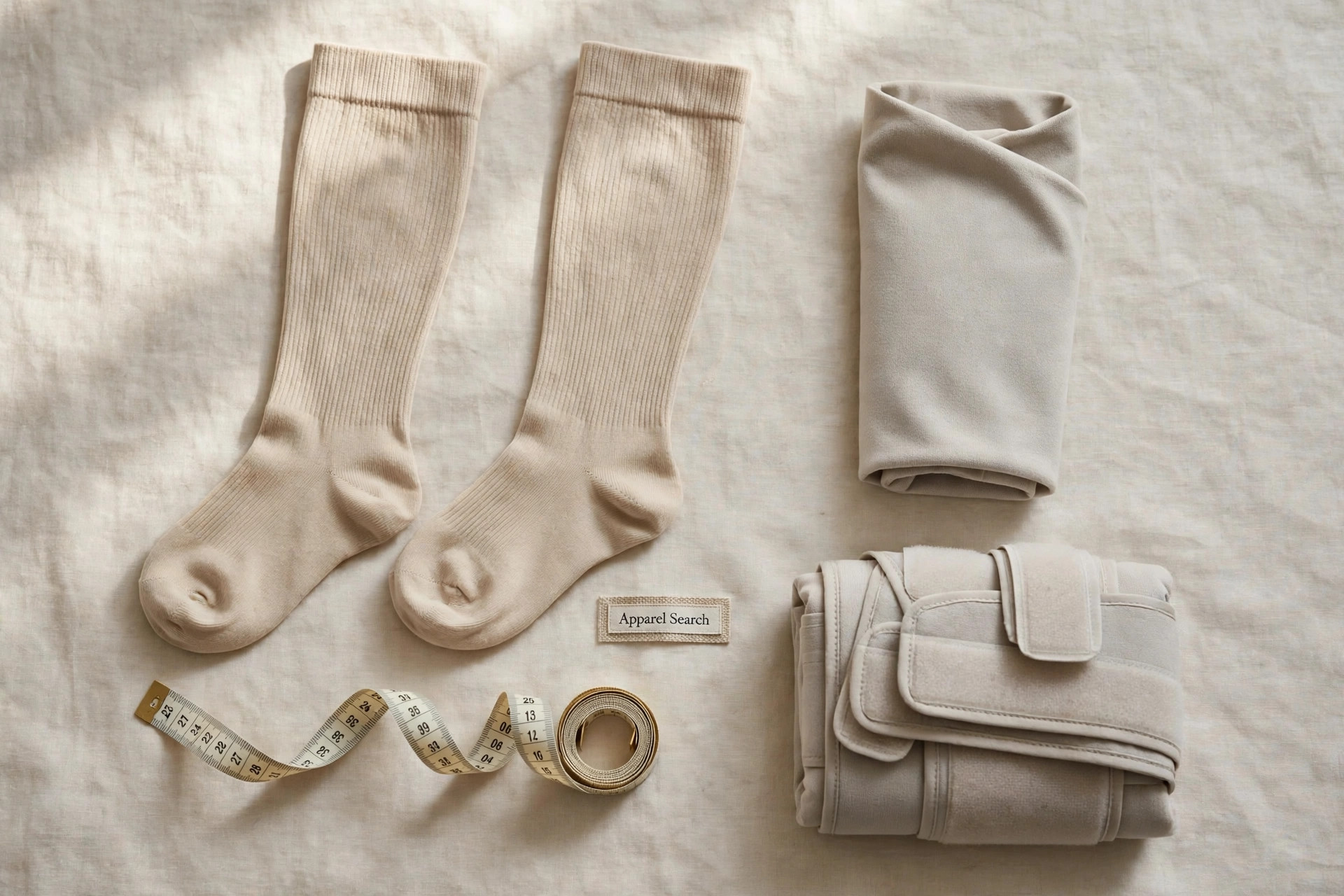
The Main Types
- Stockings and socks. The most familiar category: knee-high, thigh-high and full tights or pantyhose styles, in closed- and open-toe versions. Everyday ranges are sold by shoe size; specialist ranges are sold by leg measurements.
- Sleeves and gauntlets. Arm sleeves running wrist to upper arm, sometimes with a matching gauntlet or glove section covering part of the hand. Sold by arm measurements at several points.
- Adjustable wraps. Garments made of overlapping straps with hook-and-loop fastenings, wrapped around a leg or arm and adjusted strap by strap. They go on without pulling, and their fit can be re-tuned through the day — the practical alternative when pull-on garments are unmanageable.
- Lower-body garments. Leggings, shorts and brief-style garments applying the same close-fit principle to the hip and pelvic area, sold by waist, hip and thigh measurements.
- Post-surgical garments. A category of its own: front-closure compression bras, abdominal binders and body garments made to be put on immediately after an operation, with fastenings positioned for limited reach. Our mastectomy guide covers the bra side of this family.
Construction splits the category further. Everyday garments are usually circular-knit — seamless tubes of fine knit. Specialist ranges are often flat-knit: knitted flat, then sewn with a seam, which allows firmer fabrics and shaped or made-to-measure pieces. Neither is a quality ranking; they are different ways of making a close-fitting garment, and the seam on a flat-knit piece is a construction feature, not a flaw.
How Makers Label Levels
There is no single consumer standard for compression levels, and the labels take two forms. Everyday ranges are described in words — light, moderate, firm — which are each maker's own vocabulary: one brand's firm is another's moderate, and the words cannot be compared across a shelf. Specialist ranges print numbers instead: a pressure range in millimetres of mercury (mmHg) measured at a stated point on the limb. Printed ranges are more specific, but they too are the maker's own grading, and the ranges in common use differ between countries.
One construction term is worth knowing because it appears on so much packaging: many stockings are described as graduated, meaning the knit is made firmest at the ankle and progressively less firm further up the leg. That is a description of how the garment is knitted. What it adds up to, as ever in this category, is simple: the level printed on the box is a specification to be matched to what your care team has asked for — not a dial to set for yourself by choosing a firmer box.
One neighbouring category is worth naming precisely because it is built the other way: diabetic socks are knitted with wide, non-binding tops that deliberately do not squeeze, for shoppers whose footwear brief rules out a gripping cuff. The two families answer different briefs, and our diabetic socks and footwear guide sets out that category’s features — seamless toes, moisture-managing yarns, cushioned soles — with the shoes designed to match them.
Reading a Label, in One Pass
Find, in order: the type and size (by measurement chart, not dress size), the level (words for everyday ranges, a printed mmHg range for specialist ones), the construction (circular- or flat-knit, open or closed toe), and the maker's care instructions. If any of the four is missing from a listing, that is a reason to ask before buying rather than after.
Fit Is the Garment
A compression garment works as clothing only when it fits as measured, and the signs of a wrong size are visible: wrinkles and bunching mean fabric is folding instead of fitting; a top band that rolls is sitting on the wrong circumference; a garment that has gone slack with wear has reached the end of its elasticity, which makers regard as the end of its service — packaging usually states an expected wear life in months of regular use. Fit is not a one-time event, either: bodies change, and a size matched to measurements taken long ago may no longer be your size. The measuring routine below is worth repeating whenever a garment starts to feel different.
Measuring for a Compression Garment
- Measure bare skin, at the chart's points. For stockings: ankle at its narrowest, calf at its widest, thigh where the chart specifies. For sleeves: wrist, elbow and upper arm. The tape should sit flat and snug without digging in.
- Measure at the time of day the maker or fitter specifies. Many charts ask for early-day measurements; follow the instruction printed with the chart you are using, since the chart was built around it.
- Match numbers to that maker's chart only. Write the measurements down and read across the chart of the brand you are buying. Never convert from another brand's size label.
- Between sizes, follow the maker's instruction — or ask the fitter. Do not size down in pursuit of a firmer garment: the level comes from the garment's specification, not from squeezing into a smaller size.
- Re-measure when the fit changes. If a garment wrinkles, rolls or feels slack, measure again before reordering; the replacement may be a different size, or simply a fresh garment.
Getting Them On: Donning Aids
The snugness that defines these garments also makes them the hardest clothing in the wardrobe to put on, and an entire shelf of dressing aids exists for exactly this job. Thin rubber gloves give the grip to smooth a stocking up the leg without snagging the knit. Donning frames hold a stocking open so the foot can be placed before the garment is drawn up. Slippery foot slips, supplied with many stockings, let the tightest section pass the heel. Open-toe styles are easier to position than closed ones. And where pull-on garments are simply unmanageable, adjustable wraps fasten strap by strap with no pulling at all. These aids belong to the same family as the dressing tools in our post-surgery guide — small equipment that keeps getting dressed an independent job.
Common Questions
What does the mmHg number on compression packaging mean?
It is the maker's own measured pressure for that garment, printed as a range in millimetres of mercury, usually measured at the narrowest point of the limb the garment is made for. Ranges are a labelling system rather than a shared consumer standard: brands measure and grade in their own ways, and the ranges used differ between countries. Read the number as that maker's specification for that garment — and take the question of which range you need to your care team.
Why are compression garments so hard to put on?
Because a close fit is the design. A garment that slid on easily would not be the garment that was specified. The clothing trade answers with aids rather than apologies: thin rubber gloves for grip, donning frames that hold the garment open, slippery foot slips that come with many stockings, open-toe styles, and adjustable wraps that fasten with straps instead of being pulled on at all. If a pull-on style defeats you, ask about a wrap version of the same category.
How do I know my size in a compression garment?
By measurement, never by dress size or shoe size alone. Each maker publishes a chart keyed to circumference measurements at specified points — ankle, calf and thigh for stockings; wrist, elbow and upper arm for sleeves. Measure at exactly the points the chart names, match your numbers to that maker's chart, and do not convert from another brand's sizing: charts differ enough that a medium in one range is a different garment in another.
What is the difference between everyday compression socks and specialist compression garments?
Presentation and specification. Everyday compression socks are sold like hosiery — by shoe size, in light labelled levels, off the rail. Specialist garments are sold by measurement against a chart, carry printed pressure ranges, often come in flat-knit constructions and made-to-measure options, and are normally supplied with a fitter's involvement. Both are clothing; the specialist end is simply specified the way a tailored garment is, rather than a sized one.
Back to the Post-Surgery & Medical Dressing Guide
Front closures, soft seams and step-in styles for the weeks after surgery — plus the mastectomy and ostomy guides.
More to Explore
Search Apparel Search
Please note: Apparel Search is a fashion and clothing guide, not a medical authority. Pages in this section describe clothing features and dressing ideas only. We make no claim that any garment or special product will improve, treat, or help with any medical condition, and descriptions of product features reflect how those products are designed and marketed, not a medical endorsement. Please check with your own doctor or care team about what is right for you.