Apparel Search Consumer Guides
Lymphedema-Friendly Clothing
Ordinary clothes, chosen for the layer underneath: sleeves that pass over a compression garment, cuffs that sit flat, and shoes with room for volume.
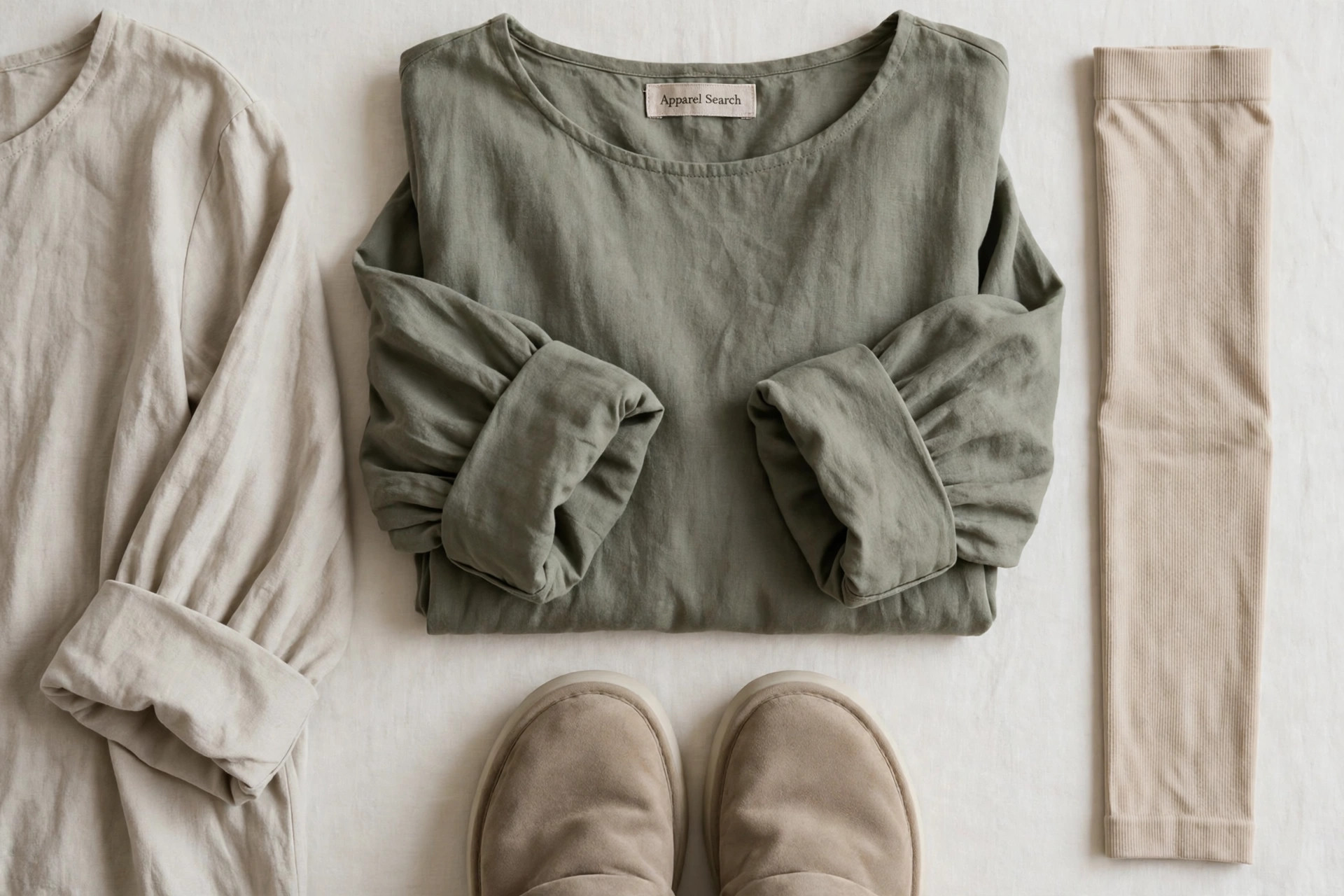
Two different wardrobes get confused under one name. The first is the compression wardrobe itself — the graded sleeves, gloves and stockings whose construction and pressure labels are explained in our compression garments explained page. The second, covered here, is everything worn over them: the ordinary tops, trousers, layers and shoes that have to accommodate a compression garment, and sometimes bandaging, underneath — and a limb whose size is not the same at breakfast as it is by evening. Lymphedema-friendly clothing is that second wardrobe, chosen by fit rules rather than by label. It belongs to the family gathered in our adaptive clothing guide and our post-surgery and medical dressing guide.
Tops: Sleeves That Go Over
The sleeve is where the two wardrobes meet, and its shape decides the morning. A compression sleeve adds circumference to the arm and a smooth, slippery surface; the top worn over it needs a sleeve that passes over both. Raglan and dolman sleeves, cut with room through the arm, and straight sleeves in stretch knits go on without a fight. Narrow set-in sleeves in firm fabrics are the recurring failure — they fit the arm or the sleeve, not both.
The cuff matters as much as the sleeve. A wide, soft cuff sits flat over a compression garment and stays where it is put. A narrow ribbed or elasticated cuff grips in a thin line — and a thin, tight line is precisely what the rest of the outfit is arranged to avoid, because the cuff ends up working against the graded fit underneath it. Where a compression glove or gauntlet is worn, the cuff question doubles: it should either cover the glove’s top edge cleanly or stop below it, and a cuff that lands halfway, bunching at the edge, does neither.
Bottoms: Waistbands and Legs
Trousers and skirts follow the same principle at the waist and leg. Waistbands should be wide, soft and non-binding — the standard from our diabetic socks and footwear guide, applied to a waist — and adjustable where possible: elastic backs, drawstrings and wrap styles all forgive a size that changes through the day. Legs need the room a stocking or bandaging adds, which in practice means straight and wide cuts over skinny ones, and hems smooth enough not to catch on the garment beneath when the wearer sits and stands.
Footwear Over Compression and Bandaging
Feet wearing compression stockings — and, at times, bulkier bandaging — need shoes built with spare volume, which is a specification this site already covers: the extra-depth lasts, removable insoles and adjustable strap closures of our diabetic-friendly shoes guide exist for exactly this fit problem, and the fitting method in our shoe fit guide — measure late in the day, fit the larger state — applies unchanged. Shoes that open wide and fasten with straps beat shoes that must be forced, because the foot underneath is already fully dressed.
Layering and Fabrics
Two layers run warmer than one, and the compression layer does not breathe like a fashion fabric. Lymphedema-friendly layering therefore favors breathable natural fibers and open weaves in the clothing layer, and pieces that can be shed — cardigans, overshirts — over a single heavy pullover. Linings and smooth facings earn their keep too: an outer sleeve that slides over a compression sleeve dresses faster and bunches less than one that drags, and soft seams matter most exactly where a seam line crosses the edge of the garment underneath.
The Order of Dressing
The routine is garment-first: compression on, then clothes chosen for that day’s layer — a sleeve day and a stocking day make different demands of the same wardrobe. The donning itself, including the gloves, frames and aids that make stiff compression garments manageable, is covered in the compression garments explained page; the clothing half of the routine is simply to keep the two checklists separate — fit the compression by its own rules, then dress over it by the rules on this page. Shoppers dressing a limb that is also recovering from injury will find the same wide-opening logic in our dressing with a cast or injury guide.
A Garment Guide, Not Medical Advice
This page covers clothing: how the garments are designed, organized, fitted and worn. It describes what products are made of and how they are put together — nothing here is a claim about what any garment does for a medical condition, and questions about your own situation belong to your own doctor or care team, whose guidance outranks any product description — including the ones described here.
Shop Adaptive Clothing on Amazon
Ready to shop? Product links are kept in one place on the Apparel Search shopping guide:
Shop Clothing on AmazonThis link opens the Apparel Search shopping guide for Amazon, where the product links are kept in one place.
Common Questions
What clothes go over a compression sleeve?
Tops with room through the arm: raglan, dolman and wide straight sleeves, and stretch knits that pass over the sleeve’s smooth surface. The cuff should be wide and soft so it sits flat over the garment. Narrow set-in sleeves in firm fabrics, and tight ribbed or elasticated cuffs, are the combinations that fight the layer underneath.
Why avoid narrow elastic cuffs over compression garments?
Because of where the grip lands. A narrow cuff fastens in a thin, tight line, and over a compression garment that line presses across a garment knitted to a graded pattern — the clothing layer ends up adding its own tight band at odds with the fit underneath. A wide, soft cuff spreads the same hold over more fabric and sits flat instead.
What shoes fit over compression stockings or bandaging?
Shoes with spare volume and adjustment: extra-depth lasts, removable insoles, wide fittings, and strap or lace closures that open wide and fasten to the size of the dressed foot. Fit them late in the day, over the stocking or bandaging actually worn — the same method as fitting any shoe over an already-dressed foot.
Is lymphedema-friendly clothing the same as compression clothing?
No — they are the two layers. Compression clothing is the graded garment itself: sleeves, gloves and stockings knitted to a stated squeeze. Lymphedema-friendly clothing is the ordinary wardrobe worn over it, chosen so sleeves pass over, cuffs sit flat, waistbands do not bind and shoes have room. This page covers the outer layer; the compression garments themselves are explained on their own page.
More to Explore
Search Apparel Search
Please note: Apparel Search is a fashion and clothing guide, not a medical authority. Pages in this section describe clothing features and dressing ideas only. We make no claim that any garment or special product will improve, treat, or help with any medical condition, and descriptions of product features reflect how those products are designed and marketed, not a medical endorsement. Please check with your own doctor or care team about what is right for you.