Apparel Search Consumer Guides
Dressing After Amputation
The clothing side of dressing with a limb difference — seated routines, fastenings one hand can manage, and garments cut to live comfortably alongside a prosthesis.
Losing a limb changes the mechanics of getting dressed long before it changes anyone's taste in clothes. Garments that assumed two hands, two feet to step through in turn, or a waistband pulled up while standing suddenly ask for a different approach — and the clothing industry has quietly built one. Adaptive ranges now include trousers that open flat down the side, shirts that fasten with a touch, and shoes that need no laces and no bending. This guide explains those garment features and the dressing techniques they support. It is part of our post-surgery and medical dressing guide, and it sits alongside the broader adaptive clothing guide, which covers everyday dressing ease in full.
Dressing Seated: The Working Routine
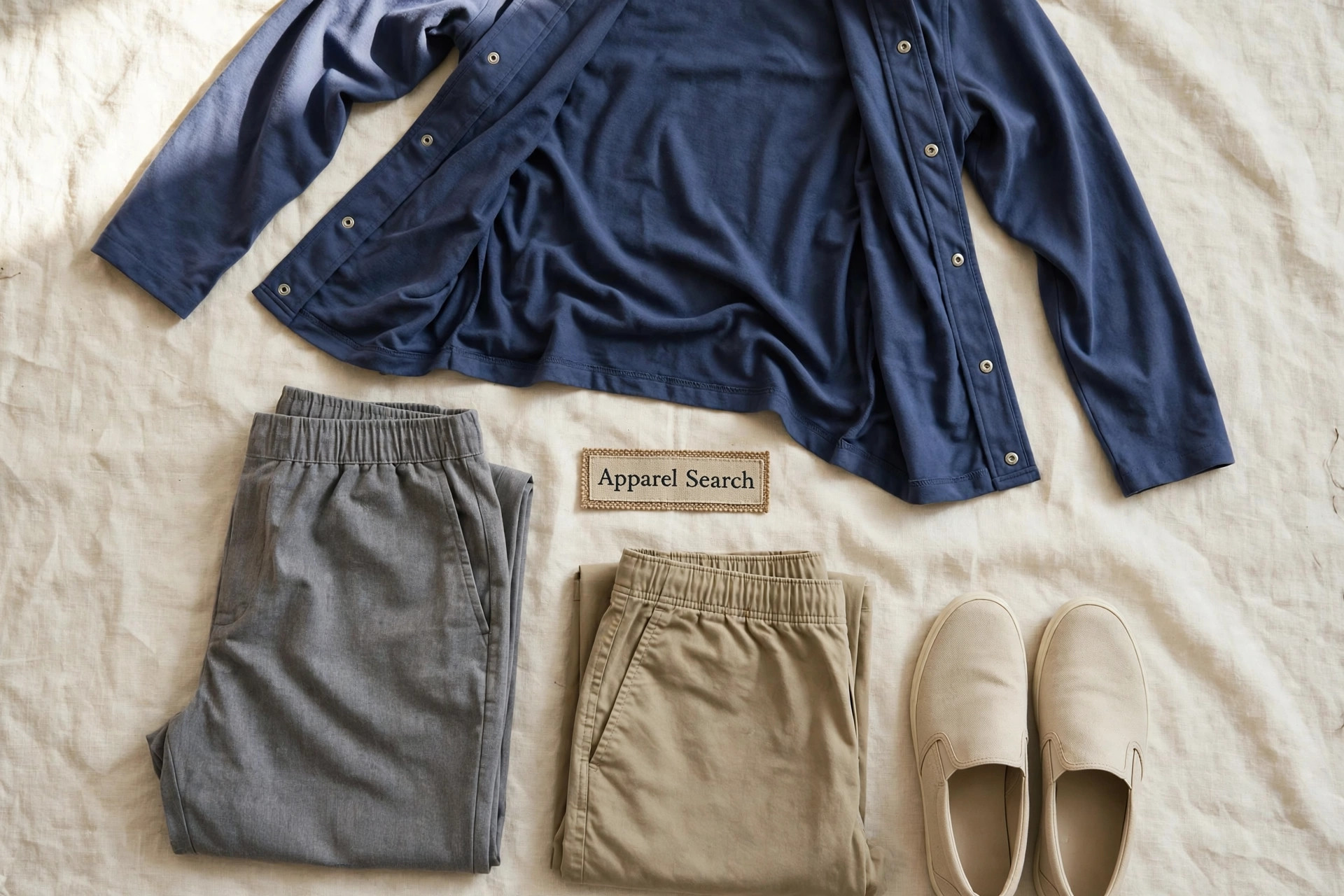
Most dressing after a lower-limb amputation happens seated — on the edge of the bed, in a chair, or in a wheelchair — and the routine matters as much as the clothes. The pattern that experienced dressers settle on is the same one used in our wheelchair clothing guide: sit somewhere stable, lay every garment out in the order it goes on, open all fastenings fully before starting, and dress the affected side first while reach and balance are freshest.
- Lay the outfit out in order. Underwear, trousers, top, socks and shoes arranged in sequence on the bed or chair beside you, fastenings already undone.
- Bottoms first, while seated. Gather a trouser leg, guide it over the residual limb, then the other leg; side-opening trousers can be laid flat, sat upon, and fastened around you instead of being stepped into at all.
- Use a reacher for the far side. A dressing stick or reacher guides hems, waistbands and shoe heels into place without leaning or twisting.
- Shoes last, still seated. Slip-on styles, elastic laces or hook-and-loop straps turn footwear into a one-handed, no-bending job, finished with a long-handled shoe horn.
One-Handed Fastening Strategies
An upper-limb amputation — or one arm in a sling, cast or prosthesis that is off at dressing time — puts every fastening under one hand's management. The closures that cope are the same vocabulary our adaptive clothing features guide catalogues: magnetic closures hidden behind a normal button front, which meet and hold with a light press; hook-and-loop tabs fastened by a palm; zips fitted with ring or tab pulls that one finger can draw; and large snaps that locate by feel. Small tools finish the set: a button hook draws a button through its hole with a single grip, elastic laces convert lace-up shoes to slip-ons permanently, and a zipper pull extends any small tab. Makers of magnetic-closure garments often print a caution about implanted medical devices — read their notes and check with your own care team where that applies to you.
Garment Features That Do the Heavy Lifting
- Full side openings. Trousers, skirts and shorts that open down one or both sides with zips or snaps can be laid flat and fastened around the body — no stepping in, no balancing on one leg, and easy access to a residual limb or a prosthesis at any point in the day.
- Wide, elasticated waistbands. Pull-on waists with drawstring adjustment go on seated and forgive the fit changes of a settling residual limb better than fixed waistbands and belts.
- Seated cuts. Trousers cut higher at the back and longer in the leg are made for people who spend the day sitting — the standard pattern in wheelchair clothing, and equally relevant here.
- Front and shoulder openings on tops. Front fastenings, and shoulder snaps that let a top be laid on rather than pulled over the head, keep dressing one-handed and seated from start to finish.
- Flat seams and smooth linings. Where fabric rests against a residual limb or inside a socket area, flat-finished seams and tagless construction are the comfort details to check first — our sensory-friendly clothing page covers seam and label construction in depth.
Clothing and a Prosthesis
A prosthesis adds a second fit question to every garment worn over or around it: the clothes have to fit the wearer and clear the hardware. At the garment level, the checks are practical ones. Trouser legs need enough width to pass over a prosthetic foot and ankle unit, and hems should sit cleanly rather than catching on the foot shell. Waistbands and shorts legs need to clear the top brim of a lower-limb socket — a waistband that lands exactly on the socket's edge will spend the day arguing with it, so adjustable waists and a choice of rises matter. Liners and sleeves worn against the skin under a socket, and the knitted shrinker socks many people wear when the prosthesis is off, are garments in their own right: they are sized, laundered and replaced like socks, and the shrinker belongs to the same knitted family as the garments in our compression garments guide, which explains how makers size and label them. For an upper-limb prosthesis, sleeve length, cuff openings wide enough for a terminal device, and shoulder seams that sit comfortably under a harness are the equivalent checks. Anything about the socket, liner system or fit of the prosthesis itself belongs to your prosthetist — the clothing side is making sure nothing you wear fights it.
Lower Limb and Upper Limb: Different Shortlists
The two situations share the fastenings and the seated routine, then diverge. Lower-limb dressing centres on bottoms: side-opening trousers, seated rises, hems and leg widths around a prosthesis, and shoes that go on without standing. Upper-limb dressing centres on tops and fastenings: one-handed closures, cuffs that open wide, and shoulder openings all matter more than anything below the waist. Many people shop both lists at once — a prosthetic leg and a sore shoulder are not mutually exclusive — so adaptive ranges are usually organised by feature rather than by limb, and it pays to search them that way. For older wearers, our adaptive clothing for seniors page covers the same features with assisted dressing in mind, and families dressing a child will find the children's adaptive clothes guide organised the same way.
Where to Look: Adaptive Brands and Ranges
Clothing for this market comes from three directions. Specialist adaptive makers design nothing else — side openings, seated cuts and one-handed closures are their starting point rather than an adaptation. Mainstream clothing brands now run adaptive ranges that rework their ordinary styles with magnetic closures, wider openings and seated fits. And prosthesis-adjacent suppliers stock the liners, sleeves and shrinker socks that sit between skin and socket. Apparel Search reported on clothing designed for amputee dressing as early as 2010, in "Dressing the Legs for the Amputees" — the styles have improved considerably since. Our adaptive clothing retail directory lists the specialist retailers in one place.
A Garment Guide, Not Medical Advice
This page covers clothing: features, fit, fastenings and dressing technique. Questions about your residual limb, your socket and liner, or your prosthesis itself belong to your prosthetist and care team, and their guidance outranks anything in a product description — including the ones described here.
Shop Adaptive Clothing on Amazon
Ready to shop? Product links are kept in one place on the Apparel Search shopping guide:
Shop Clothing on AmazonThis link opens the Apparel Search shopping guide for Amazon, where the product links are kept in one place.
Common Questions
What clothes are easiest to dress in after an amputation?
Garments that open rather than pull on: trousers with full side zips or snaps that can be laid flat and fastened around you, front-fastening tops, and pull-on waistbands. Dressing seated, with everything laid out in order and fastenings undone in advance, makes the wardrobe work harder than any single garment.
How do trousers fit over a prosthetic leg?
Look for leg width that passes over the foot and ankle unit, hems that sit cleanly without catching, and a waistband — ideally adjustable — that clears the top brim of the socket rather than landing on it. Side-opening trousers also let you reach the socket area during the day without undressing.
What are shrinker socks and liners, in clothing terms?
They are the garments worn between skin and prosthesis: liners and sleeves sit inside the socket system, and shrinker socks are snug knitted socks worn over the residual limb when the prosthesis is off. Both are sized, washed and replaced like ordinary socks and hosiery; which ones you should wear is your prosthetist’s decision.
Can one hand manage ordinary clothes?
Much of them, with the right closures swapped in: magnetic closures behind a button front, hook-and-loop tabs, zips with ring pulls, elastic laces in lace-up shoes, and a button hook for the buttons that remain. Our adaptive clothing features guide explains each closure and where it works best.
Back to the Post-Surgery & Medical Dressing Guide
Front closures, soft seams and step-in styles — plus the mastectomy, ostomy and compression guides.
More to Explore
Search Apparel Search
Please note: Apparel Search is a fashion and clothing guide, not a medical authority. Pages in this section describe clothing features and dressing ideas only. We make no claim that any garment or special product will improve, treat, or help with any medical condition, and descriptions of product features reflect how those products are designed and marketed, not a medical endorsement. Please check with your own doctor or care team about what is right for you.