Children's Adaptive Clothes Guide
Children's adaptive clothes are garments designed for easier dressing — closures that are simpler to manipulate, openings that reduce the range of motion needed, and soft fabrics chosen for all-day wear.
Shop Children's Adaptive Clothing Now
Shop Children's Adaptive Clothing on Amazon Shop Children's Adaptive Clothing on eBayThe Amazon and eBay links on this page are affiliate links. If you make a purchase through them, Apparel Search may earn a commission.
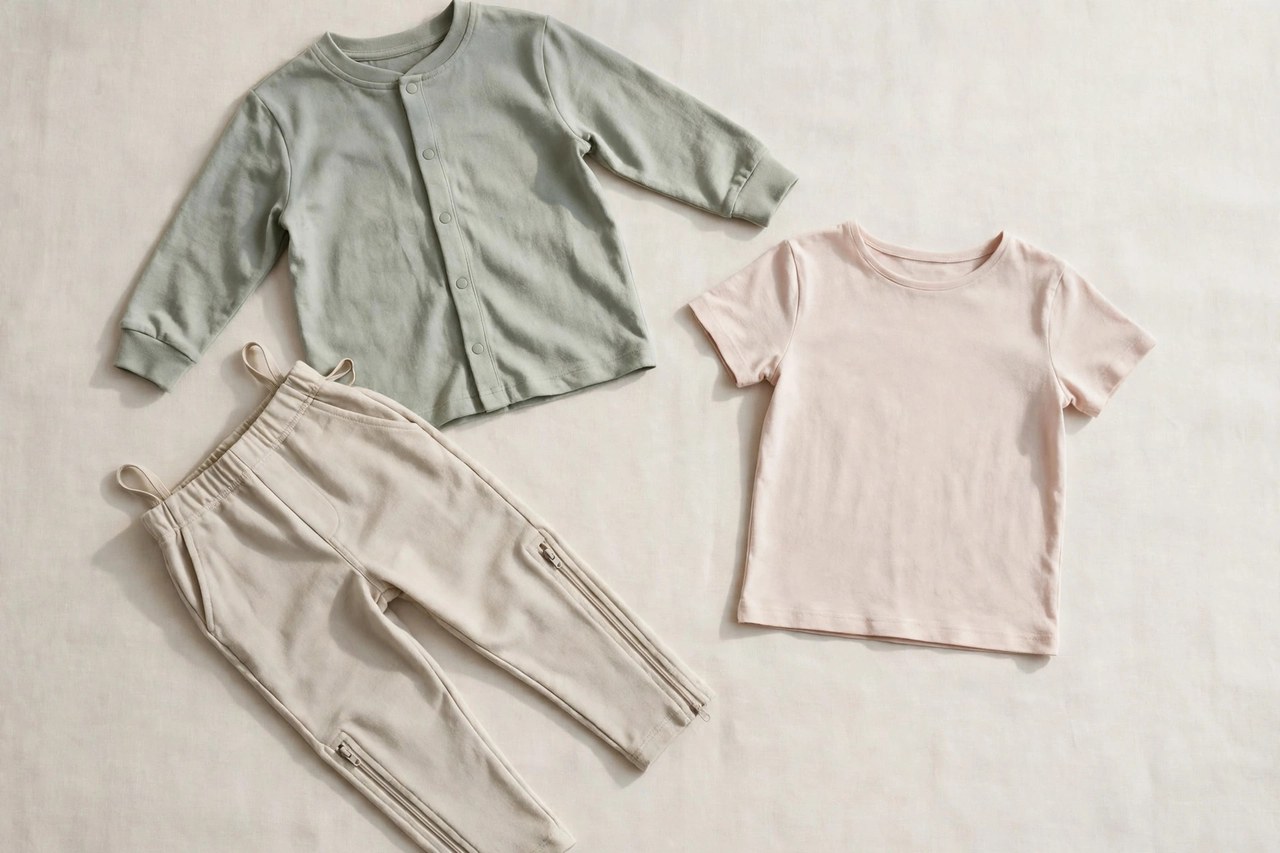
Adaptive clothing is clothing designed for people with physical disabilities. In addition to other purposes, this type of clothes can be for kids who may experience difficulty dressing themselves due to an inability to manipulate closures, such as buttons and zippers, or due to a lack of a full range of motion required for self-dressing. That definition names the two problems every garment in this category is designed to solve: fastenings that hands struggle with, and movements that dressing normally demands.
Good adaptive design solves those problems invisibly. The best children's adaptive clothes look like ordinary clothes — the same shirts, trousers, dresses and pyjamas as any other child's — with their help built into the construction: a closure that looks like a button but fastens magnetically, a trouser that opens flat, a top that goes on without being pulled overhead. This guide stays strictly with the products: closures, openings, fabrics and fit.
Closures That Are Easier to Manipulate
The closure is where adaptive design starts. Magnetic closures hidden behind a normal button placket fasten with a simple press and pull apart without gripping or twisting, and they are the signature feature of adaptive shirts and dresses. Hook-and-loop fastenings replace small buttons and hooks at cuffs, waistbands and flies, trading fine finger work for a flat press that most hands can manage. Large zipper pulls, ring pulls and zips with fabric loops extend the same idea to jackets and trousers.
Snaps and poppers sit between the two: easier than buttons for many wearers, and common on open-back and side-opening garments. When comparing garments, test the closure the way it will actually be used — one-handed, seated, without looking directly at it — because a fastening that only works under ideal conditions has not solved the problem it was bought to solve. Closures should also survive washing: magnets are sewn in or removable by design, and hook-and-loop lasts longer when closed before laundering.
Openings and Cuts That Reduce Motion
The second family of solutions changes how the garment goes on. Open-back tops and dresses fasten behind the shoulders so arms do not have to lift or reach behind; side-opening trousers and shorts unzip or unfasten along the leg so they can be put on seated or lying down; and wrap styles cross over and tie or snap at the side, removing the overhead pull entirely. Each design removes a specific movement from the dressing routine, so the right choice depends on which movement is the difficult one.
The same openings logic works at the very start of the size range. Preemie and NICU-friendly garments open at the front, side or shoulders so a baby can be dressed lying flat, with fasteners placed so none of them sits under the wearer — our NICU-friendly baby clothing features guide covers that smallest branch of adaptive design.
Fit details follow the same logic. Seated-rise trousers are cut higher at the back and lower at the front so they sit correctly in a chair rather than standing. Longer back lengths on tops, flat seams that do not press against skin during long periods in one position, and elastic or adjustable waistbands that fasten at the front all appear across the category. Sizing follows ordinary children's measurements, but the product description's opening and closure details matter more here than the size label itself.
Fabrics, Comfort and Everyday Wear
Adaptive clothes are worn the same long hours as any child's clothes, so fabric comfort is a product feature, not a luxury. Soft cotton and cotton-blend jerseys with tagless backs dominate the category; smooth seams and printed labels replace sewn-in tags; and stretch woven into tops and trousers gives ease without extra fastenings. For garments worn with braces, casts or medical equipment, look for wider openings at the relevant point, reinforced panels where hardware rubs, and fabrics that wash at the temperatures frequent laundering requires.
School and play set the same practical tests as for any child: the garment should look like what classmates are wearing, go through an ordinary wash, and be replaceable in the next size up without hunting. Many adaptive ranges are built as capsules — a few tops, bottoms and layers that all mix — which keeps morning dressing simpler for everyone involved.
Choosing and Caring
Choose by the dressing step, not by a general label. List the specific difficulties — small buttons, overhead pulling, reaching behind, fastening while seated — and match each to the feature designed for it: magnetic or hook-and-loop closures, wrap or open-back cuts, side openings, pull loops. A garment that removes the hardest step is worth more than a wardrobe of general easy-wear pieces. The organizations and specialist suppliers listed in the references below are the starting points for this category.
Care follows the closures: close hook-and-loop tabs before washing so they do not catch other garments, wash magnets as the maker directs, and check zipper pulls and loops as part of ordinary mending. Chosen step by step and cared for that way, adaptive clothes do their defining job quietly — they turn dressing from the hardest task of the morning back into a routine one.
A neighbouring wardrobe shares this page’s flat seams and soft fabrics: clothing chosen for children with eczema and sensitive skin, where the pajama features — fold-over mitten cuffs, enclosed feet, printed labels — are designed in from the start. Our eczema-friendly clothing for kids guide covers it garment by garment.
One more opening belongs in this guide. Some children’s garments are built around a feeding tube, with an access panel at the abdomen that opens for the tube while the rest of the bodysuit or shirt stays on. Our feeding tube and G-tube clothing guide explains those designs, for children and for adults.
Common Questions
What are children's adaptive clothes?
Clothing designed for people with physical disabilities, made for kids who may experience difficulty dressing themselves due to an inability to manipulate closures such as buttons and zippers, or due to a lack of a full range of motion required for self-dressing. The garments look like ordinary children's clothes; the help is in the construction - easier closures, wider openings and cuts that reduce the movements dressing demands.
Which closures are easiest in adaptive clothing?
Magnetic closures hidden behind a normal button placket fasten with a simple press and need no gripping or twisting, and hook-and-loop fastenings replace small buttons at cuffs, waistbands and flies with a flat press. Large zipper pulls and ring pulls help where zips remain. Test any closure the way it will be used - one-handed or seated - because a fastening that only works under ideal conditions has not solved the problem.
What do open-back and seated-rise designs do?
They remove difficult movements from dressing. Open-back tops fasten behind the shoulders so arms do not have to lift or reach behind, and side-opening trousers can be put on seated. Seated-rise trousers are cut higher at the back and lower at the front so they sit correctly in a chair. The right design depends on which specific movement is difficult, which is why adaptive clothes are best chosen step by step.
More in Children's Clothes Guide A
The other A topics, and the full A letter, are gathered here:
More to Explore on Apparel Search
Please note: Apparel Search is a fashion and clothing guide, not a medical authority. Pages in this section describe clothing features and dressing ideas only. We make no claim that any garment or special product will improve, treat, or help with any medical condition, and descriptions of product features reflect how those products are designed and marketed, not a medical endorsement. Please check with your own doctor or care team about what is right for you.
Looking for Children's Clothing Stores?
This guide helps you choose children's adaptive clothes by closure and cut. To browse where to buy, visit our children's clothing store directory, where you can find retailers that carry them.