Apparel Search Consumer Guides
NICU-Friendly Baby Clothing Features
Gowns and bodysuits designed to open where access is needed — front and side openings, shoulder snaps and footless cuts, explained as garment design.
A NICU-friendly garment is an ordinary baby garment re-engineered around one situation: a very small baby, dressed lying flat, with monitor leads and lines that the clothing has to work around rather than over. Every feature on this page is a construction answer to that situation — where the garment opens, what it fastens with, and what it leaves free. This page is part of our preemie clothing guide; it describes the garments only, and the questions worth putting to a care team are framed as garment questions at the end.
Why These Garments Open Where They Do
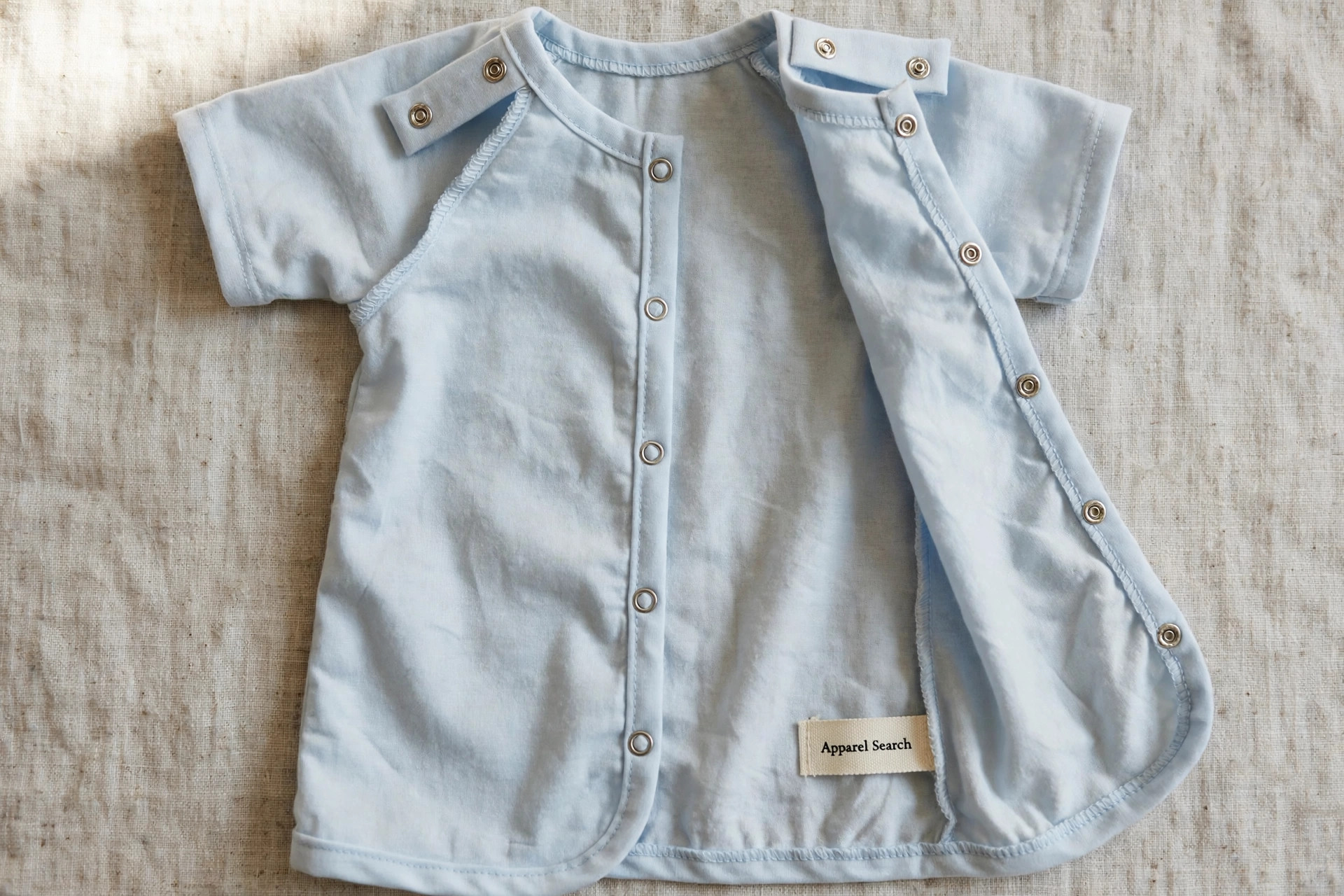
Ordinary baby clothes assume a dressing sequence: over the head, arms through sleeves, baby lifted and turned as needed. Ward garments drop every step of that sequence. The garment is laid open flat, the baby is placed on it, and the garment closes around the baby — nothing passes over the head, no arm is threaded anywhere, and the front can be reopened in sections rather than the whole garment coming off. Openings are also placed where equipment sits: a front that parts in the middle leaves room for chest leads to pass, and side closures keep the snap line away from the center of the body altogether.
Front and Side Openings
Full-front openings run neck to hem, the gown pattern: the whole chest and tummy are reachable by undoing two or three fasteners, and the garment doubles as a wrap when worn open over a vest. Side openings — the kimono or wrap pattern — cross the fabric over and fasten at one side; there is no center-front line at all, which suits babies whose middle is occupied, and the double fabric layer over the chest is a warmth feature in its own right. Our infant one-piece guide covers the ordinary end of this family — envelope necks and two-way zips — and the preemie versions push the same logic further.
Snaps, Hook-and-Loop, and Where They Sit
The fasteners are specified as carefully as the openings. Snaps are nickel-free metal or plastic, set on reinforced plackets so the pull of opening them lands on the tape, not the jersey. Hook-and-loop tabs appear where adjustability matters — shoulders, waist wraps — always with the soft loop side toward the skin and the hook side covered when open. Placement follows one rule: no fastener sits where the baby lies on it, which is why backs in this category are almost always plain, unbroken fabric. The children’s adaptive clothing guide works to the same rule for older children — openings and closures arranged around the wearer’s position, not the dresser’s convenience.
Open Shoulders and Footless Designs
Open shoulders undo at the top, widening the neck until the garment can be drawn up from the feet — the dressing route that avoids the head entirely — then snap down to an ordinary-looking neckline. Footless designs end the leg in a soft cuff instead of a closed foot: feet stay free for the ankle bands and socks of the setting, there is no toe seam to cramp a growing foot, and the garment keeps fitting through more of a fast-growing stage than a footed equivalent. Footed versions exist too, and trade that flexibility for one less separate sock to keep track of.
Fabric and Seams
The construction checklist from our preemie clothing guide applies at full strength here: cotton interlock or fine rib knit, seams sewn flat or turned outward, printed labels, nothing raised against the skin. Ward garments add one demand of their own — they are washed constantly, at institutional settings — so the better-made ones use interlock that holds its surface through repeated hot washes, and fasteners rated for the same. The seam-by-seam version of this checklist is our garment construction for sensitive skin guide.
During the Stay, and the Trip Home
The honest buying picture has two halves. During a hospital stay, many units supply the gowns themselves, and some limit or rule out personal clothing — the reasons are practical ones of laundry, access and monitoring. So the family’s own garments are usually bought for the second half: discharge day, the journey home, and the weeks after, with perhaps one or two pieces welcomed earlier for photographs or once a baby graduates to an open crib. Buying heavily for the stay itself is the common mistake; buying the homecoming outfit and the first home drawer is the reliable spend.
Questions Worth Asking the Care Team
Framed as garment questions, these settle what to buy: Are personal garments allowed in this unit, and are there styles to avoid? Which openings suit the equipment currently in use — front, side or shoulder? Are there fabric or laundry requirements for anything brought in, such as fragrance-free washing? And which size band should the homecoming outfit be, judged by the baby’s current weight? The answers differ by unit and by baby; the questions travel.
A Garment Guide, Not Medical Advice
This page covers clothing: how preemie garments are sized, sewn and fastened. It describes what the garments are made of and how they open and close — nothing here is advice about a baby’s care. Questions about your baby belong to your own doctor and care team, and their guidance outranks anything in a product description — including the ones described here.
Common Questions
What is a NICU gown?
A small open-front garment — usually a short gown or shirt — that fastens with snaps or hook-and-loop tabs down the front and often at the shoulders, so it can be laid open flat, placed under and around the baby, and closed without anything passing over the head. It is the hospital-ward counterpart of the footed sleeper: same job, opposite construction.
Why do preemie bodysuits open at the shoulder?
So the garment can go on from below. With the shoulder snaps undone, the neck opening widens enough for the bodysuit to be drawn up the body instead of pulled down over the head — the standard dressing route for babies who are dressed lying flat, and the reason envelope necks in this size range are usually backed up with actual fasteners.
Are snaps or hook-and-loop closures better?
They are different tools. Nickel-free or plastic snaps are flat, quiet and stay put through the wash, but each one is a deliberate two-handed close. Hook-and-loop tabs are faster and adjust over a range — useful across a feeding tube’s exit point or a fuller tummy — but the hooks must be covered or faced away from skin, and they lose grip as they clog with lint. Many garments mix both: tabs at the shoulders, snaps down the front.
Can families bring their own clothes to the NICU?
It depends on the unit, and asking first is the rule. Many units supply gowns during a stay and some restrict personal clothing — for laundry, access or monitoring reasons — so a family’s own garments are most reliably for discharge day, the trip home and photographs. If personal garments are welcome, the designs on this page are the ones that fit the setting.
Back to the Preemie Clothing Guide
The full section: weight-band sizes, the softness specification, and what families need first.
Search Apparel Search
Please note: Apparel Search is a fashion and clothing guide, not a medical authority. Pages in this section describe clothing features and dressing ideas only. We make no claim that any garment or special product will improve, treat, or help with any medical condition, and descriptions of product features reflect how those products are designed and marketed, not a medical endorsement. Please check with your own doctor or care team about what is right for you.