Children's Infant & Toddler One-Piece Guide
The one-piece is the defining garment of infancy, defined this way: often referred to as a onesie, an infant bodysuit is a garment designed to be worn by infants much like a T-shirt, distinguished from T-shirts by an extension below the waist, with snaps or Velcro that allow it to be closed over the crotch - the purpose of the opening being to facilitate access to the infant's diaper. Like T-shirts, infant bodysuits come in a wide variety of designs and may be worn as undergarments or as outer shirts.
Shop Children's Infant & Toddler One-Piece Now
Shop Children's Infant & Toddler One-Piece on Amazon Shop Children's Infant & Toddler One-Piece on eBayThe Amazon and eBay links on this page are affiliate links. If you make a purchase through them, Apparel Search may earn a commission.
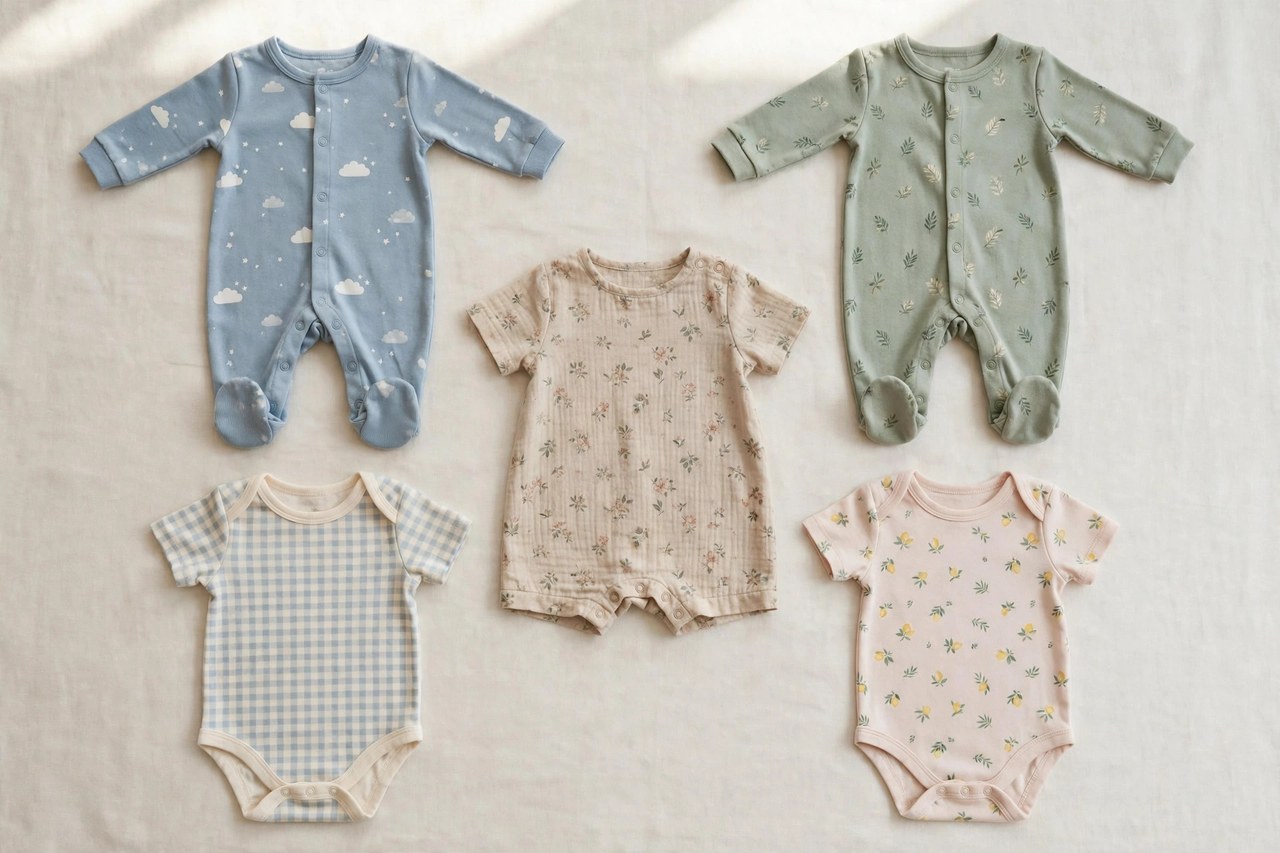
The one-piece is the defining garment of infancy, defined this way: often referred to as a onesie, an infant bodysuit is a garment designed to be worn by infants much like a T-shirt, distinguished from T-shirts by an extension below the waist, with snaps or Velcro that allow it to be closed over the crotch - the purpose of the opening being to facilitate access to the infant's diaper. Like T-shirts, infant bodysuits come in a wide variety of designs and may be worn as undergarments or as outer shirts.
Parents meet the whole name family on labels: other names include Onesies - a registered trademark often used in the United States as if it were generic - creepers, diaper shirts, or snapsuits. Around those names the wider one-piece family gathers: footed sleep-and-play suits, rompers, and any single garment that dresses a baby head to toe in one step.
Why One Piece Rules the First Year
A baby is dressed lying down, changed on a schedule measured in hours, and carried against bodies and blankets that pull at clothing. A one-piece cannot ride up to bare a back, cannot separate at the waist, cannot lose its other half in the laundry, and opens exactly where the diaper is. Every advantage a parent discovers in the first month - the 3 a.m. change, the car-seat transfer, the grandparent handover - traces back to that single-garment logic.
The footed one-piece, the sleep-and-play, extends the logic to the whole body: top, bottoms, and socks in one, with a zip or snap line from neck to ankle. For the pre-mobile months it is the default day garment of much of the world, and the wardrobe's quantities are built around it - five to seven in each band, because it is worn, fed in, slept in and changed out of, daily.
Zips, Snaps and the Change Test
Closures split the family. Snap lines are quiet, infinitely repairable and adjustable at the leg, but slow with a wriggling baby; two-way zips are fastest and open from the foot for a change that leaves the chest covered and warm; Velcro-style closures are quick and noisy and lose grip as lint builds. The right choice is the one the household's most tired member can operate one-handed in the dark, and many families run zips at night and snaps by day.
The closure question reaches its most engineered form in preemie one-pieces and gowns, where the garment must open around a baby lying flat — and around the leads of a hospital setting. Full fronts, side wraps and shoulder snaps replace the over-the-head pull entirely; our NICU-friendly baby clothing features guide works through that construction in detail.
Whatever the closure, check the chin guard on zips, the reinforcement behind snaps, and that the crotch opening is wide enough to work without fully undressing the baby. A one-piece that must come off entirely for a change has failed its only examination.
Sizing the One-Piece Years
Length rules one-pieces: the baby's torso plus diaper must fit between shoulder and snap line with the feet still free in footed styles. It is the first category to announce a size change - snaps straining, feet cramped against the toe seam - and the category where a too-big fit is most wearable in the meantime, since extra length simply folds at the ankle of a baby who is not yet standing on it.
Toddlers graduate out of one-pieces by mobility and toilet learning rather than by size tables: the romper keeps the form alive for daywear into the second and third years, while footed suits retire to sleepwear. The one-piece is a short reign - roughly the first eighteen months - but within it, no garment in this entire guide is used more.
Common Questions
What is a onesie, exactly?
An infant bodysuit worn like a T-shirt but extending below the waist, closing over the crotch with snaps or Velcro for diaper access. Onesies is a registered trademark often used as a generic name; creepers, diaper shirts and snapsuits are other names.
Are zips or snaps better on a one-piece?
Two-way zips are fastest and open from the foot so the chest stays covered; snaps are quieter, adjustable and repairable. Many families use zips at night and snaps by day.
How do you know a one-piece is outgrown?
Straining snaps, a neckline pulled down at the front, and feet cramped against the toe seam of footed styles. Length, not age, decides the move to the next band.
More in Children's Clothes Guide I
The I letter hub and the guides closest to this one:
Looking for Children's Clothing Stores?
This guide helps you choose children's infant & toddler one-piece. To browse where to buy, visit our children's clothing store directory, where you can find retailers that carry them.