Apparel Search Consumer Guides
Eczema-Friendly Clothing for Kids
Pajamas, day clothes and laundry for children whose skin chooses the wardrobe — described garment by garment.
Children’s sensitive-skin clothing is a wardrobe problem with a parent attached: someone else chooses the fabrics, runs the laundry, and packs the spare set. This page covers that wardrobe garment by garment — product by product, with no models and no claims — as part of our eczema-friendly clothing guide. The adult principles come from the fabrics guide and the construction guide; what follows is how they land in small sizes.
Nightwear Does the Heavy Lifting
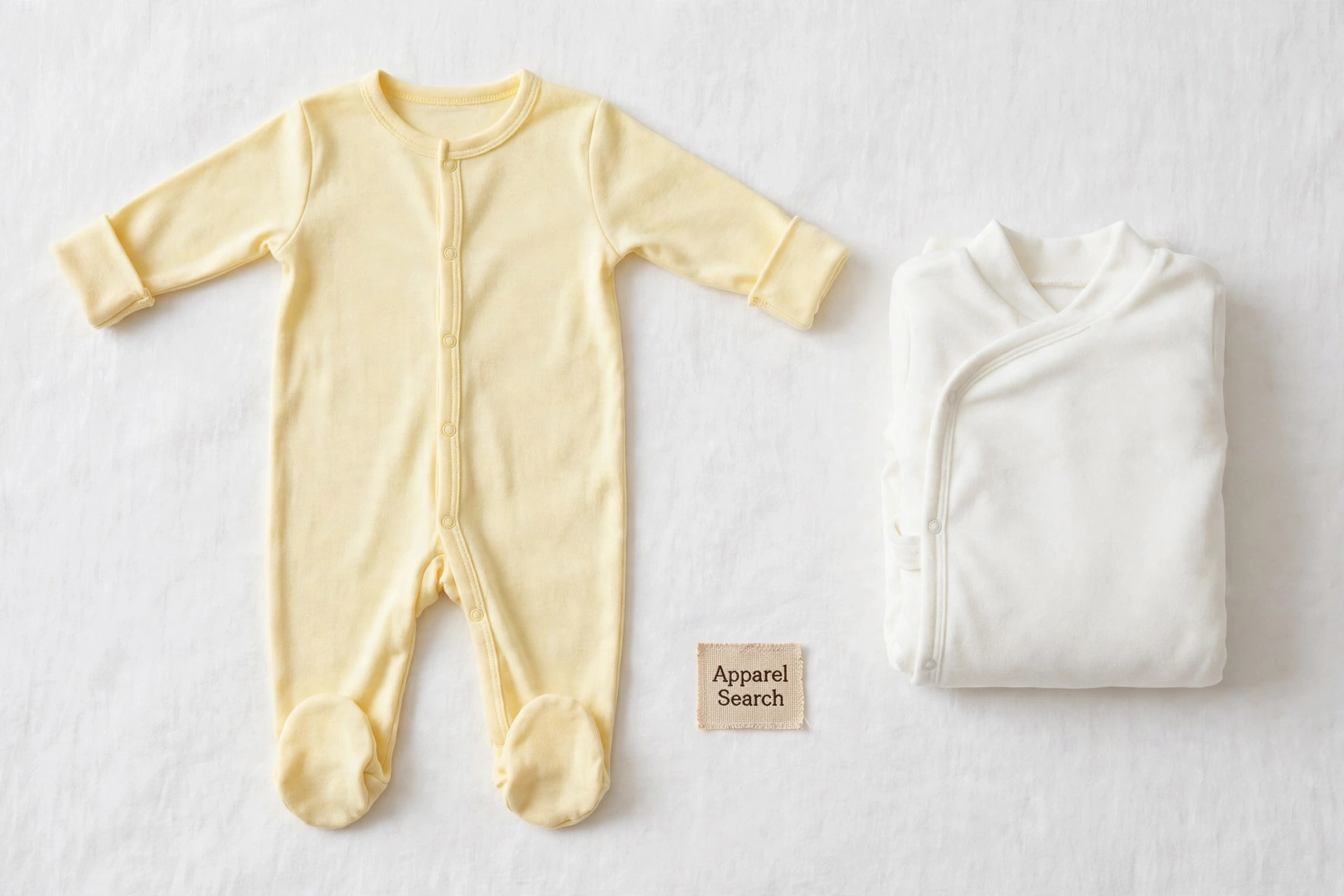
As with adults, the longest-worn garment matters most, and for children that is the pajama. Sensitive-skin children’s ranges concentrate here, with a set of features worth knowing by name:
- Fold-over mitten cuffs. Sleeves that end in a cuff which folds over the hand, built into the garment — a standard feature of newborn sleepwear, also sold in toddler and older children’s eczema ranges.
- Enclosed feet. Footed sleepers and pajamas where the foot is part of the garment, so there is no sock elastic at the ankle and nothing to pull off in the night.
- Flat seams and printed labels. The construction features of the construction guide, and already common in baby clothing, where printed neck labels are close to standard.
- One-piece designs. Sleepers and sleepsuits with no waistband at all — one smooth layer from neck to foot.
The mainstream category is gathered in the children’s pajamas guide and the infant and toddler sleepwear guide; read their fabric and fit advice alongside the feature list above.
Day Clothes: School and Daycare
Daywear follows the adult rules in miniature: soft cotton or lyocell tops, flat or outside seams, elastic waists without metal hardware, and a spare set — top, bottoms, underwear — kept at school or daycare in the same fabrics as the home wardrobe. Where a uniform is required, the features move to the layers underneath: a smooth vest or T-shirt under the uniform shirt, and seamless socks under school shoes. The children’s adaptive clothing guide covers the closures and cuts that make school dressing quicker in the morning.
Fabrics in Small Sizes
The fiber ranking from the fabrics guide holds for children — smooth cotton first, silk and lyocell for nightwear, wool as the family decision it always is. Baby clothing adds one advantage: undyed and white ranges are widely sold, so the simplest dye choice is often the easiest to find. Girls’ and older children’s pajamas are covered in the girls’ pajamas guide.
The Laundry, Run by Someone Else
Children’s sensitive-skin laundry is a routine, not a project: measured detergent rather than a full cap, an extra rinse on the loads that hold pajamas and underwear, and fragrance-free products where the household chooses them. Our laundry guide and sorting and washing guide give the stage-by-stage version, including the dosing mistakes that leave the most in the fabric.
A Garment Guide, Not Medical Advice
This page covers clothing: fibers, seams, labels and laundry. It describes what garments are made of and how they are put together — nothing here is a claim about what any garment does for a medical condition. Questions about your skin belong to your own doctor or care team, and their guidance outranks anything in a product description — including the ones described here.
Shop Sensitive-Skin Clothing on Amazon
Ready to shop? Product links are kept in one place on the Apparel Search shopping guide:
Shop Clothing on AmazonThis link opens the Apparel Search shopping guide for Amazon, where the product links are kept in one place.
Common Questions
What are mitten cuffs on children’s pajamas?
A design feature of baby and toddler sleepwear: the sleeve ends in a fold-over cuff that can be turned down to cover the hand completely, like a mitten built into the pajama top. Makers design them for the newborn period, when babies’ hands move unguarded in their sleep. Older children’s sensitive-skin pajamas sometimes carry the same feature in larger sizes.
Are enclosed feet only for babies?
No. Footed sleepers start in the baby sizes, but footed pajamas are made right through the children’s sizes and into adult ranges. In this section they are chosen for coverage — a foot that is part of the garment, with no separate sock elastic at the ankle.
What should go in the daycare or school bag?
A full spare outfit in the same soft fabrics as the home wardrobe — top, bottoms and underwear — plus any layer the setting asks for. Settings change children during the day for ordinary reasons, and a spare set in familiar fabrics keeps the change consistent with the rest of the wardrobe.
Do children need specialist brands for these features?
Usually not. Fold-over cuffs, flat seams and printed labels are standard features in mainstream baby and children’s ranges, because they suit babies generally. Specialist children’s ranges gather more of the features in one garment — fully enclosed pajamas, seamless socks — and label them clearly, which is what parents are paying for.
Back to the Eczema-Friendly Clothing Guide
Fibers, seams, labels and laundry — the full sensitive-skin clothing section, adults and children.
Search Apparel Search
Please note: Apparel Search is a fashion and clothing guide, not a medical authority. Pages in this section describe clothing features and dressing ideas only. We make no claim that any garment or special product will improve, treat, or help with any medical condition, and descriptions of product features reflect how those products are designed and marketed, not a medical endorsement. Please check with your own doctor or care team about what is right for you.