Apparel Search Consumer Guides
Fabrics for Sensitive Skin
Each fiber judged the way a wearer judges it — by smoothness against the skin, behavior in the wash, and what the label really says.
Fiber is the first decision in any sensitive-skin garment, and it is made before seams, labels or price enter the picture. This guide works through the fiber families one at a time — what each feels like against the skin, how it behaves in the wash, and where it earns its place — as part of our eczema-friendly clothing guide. The rule throughout is descriptive: these are the garment qualities shoppers compare, and the final judge is always the individual wearer’s own trial.
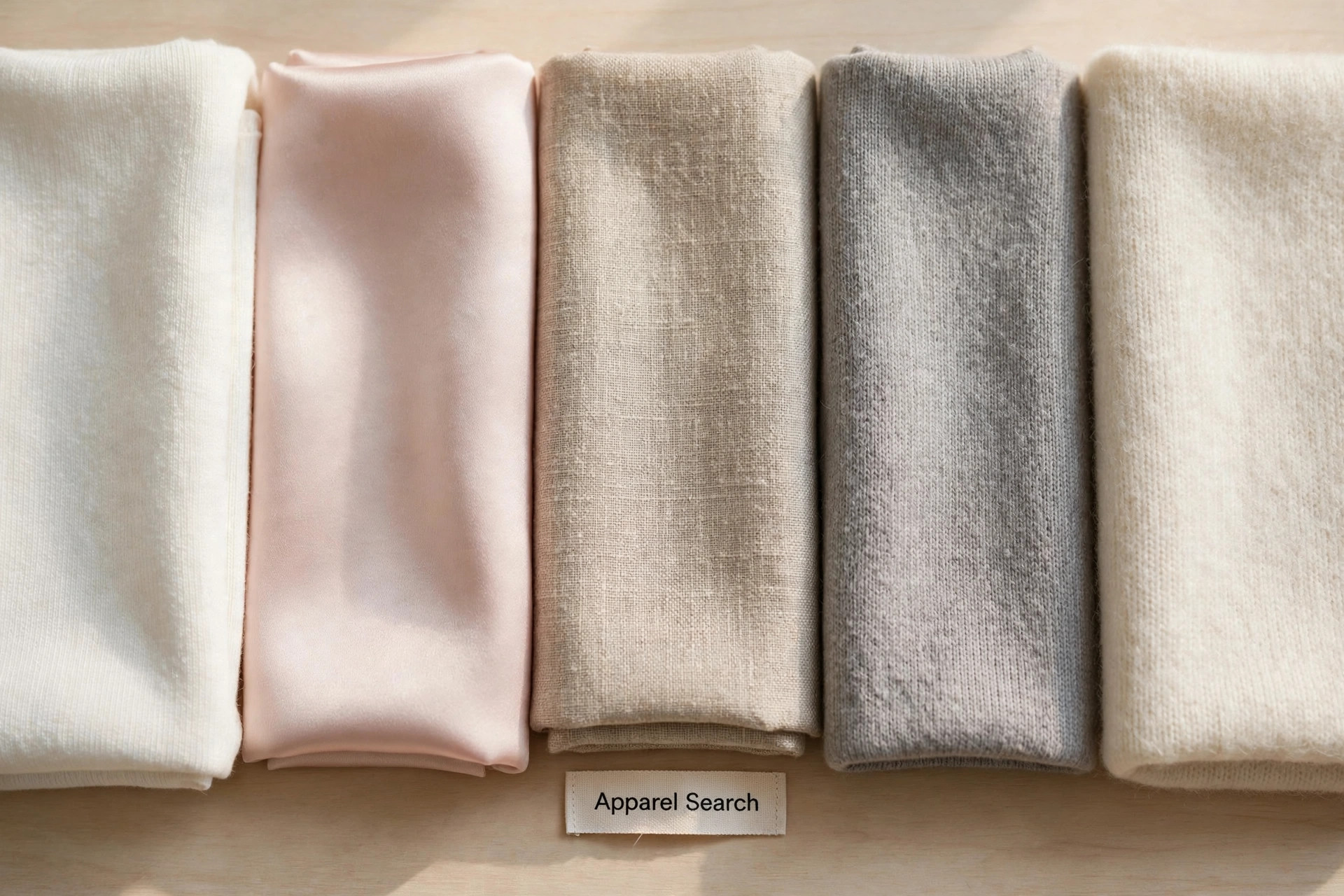
Judge by Hand First
Two tests cost nothing in a shop. Stroke the fabric against the inside of your forearm, where skin is thinnest — prickle and drag register there first. Then scrunch a handful and let go: a fabric that springs back smooth will sit smooth; one that holds creases will hold ridges against the skin too. Fiber content on the label tells you what to expect; your hand confirms it. If you are identifying an unlabeled fabric at home, our burn test guide works through the fiber families by flame, smell and ash.
The Fibers, One at a Time
Cotton
The default starting point. Cotton fiber is soft-edged under a microscope and stays comfortable in knits and fine weaves alike; long-staple cottons feel smoother than short-staple. It absorbs moisture, washes hot when needed, and is the fiber of most sensitive-skin nightwear. The full fiber profile is in our cotton library page. Combed and ring-spun cottons are the smoother grades to look for on labels.
Silk
The smoothest natural fiber — a continuous filament with no short ends to prickle. Silk pillowcases, pajamas and base layers are the classic sensitive-skin luxury, and the smoothness is a physical fact of the fiber rather than a claim. The costs are price and careful washing. See the silk library page for grades and care.
Bamboo and Lyocell
Regenerated cellulose fibers — bamboo viscose and lyocell (sold under names such as Tencel) — are spun into notably smooth, round filaments, and feel silky without the price of silk. They absorb moisture well and are common in sensitive-skin underwear and sleepwear. Our bamboo and lyocell pages cover how each is made; on labels, expect “bamboo viscose” or “lyocell” rather than plain “bamboo”.
Linen
The honest mixed case. Linen is smooth-fibered and gets softer with every wash, and its loose weaves breathe in hot weather — but new linen can feel stiff and boardy, and its slubbed texture is not to everyone’s taste against reactive skin. Many wearers keep linen for outer layers and warm-weather pieces rather than next-to-skin wear. The linen library page, and our linen vs cotton comparison, give the full picture.
Wool — Both Sides, Honestly
Wool divides opinion because “wool” covers a wide range of fiber thicknesses. Coarse fibers bend less, and their ends press against the skin — the familiar prickle. Fine merino fibers bend easily and feel smooth; base-layer makers quote the fiber diameter in microns, with the finest grades sold specifically for next-to-skin wear. Plenty of people with sensitive skin wear fine merino daily; others avoid every grade. Both experiences are real, which is why this guide refuses a verdict: try one garment, in a fine grade, before ruling the family in or out. Background: the wool and merino library pages.
Synthetics
Polyester, nylon and elastane are smooth filaments — a good microfiber knit can feel softer than a coarse natural cloth. Their different cautions: they hold body heat and odor, are colored with disperse dyes, and are often given anti-odor or wicking finishes. For sportswear, their fast drying is a genuine advantage, covered in our moisture-wicking fabrics and performance fabrics guides. For nightwear, most shoppers in this section end up back at cotton, silk or lyocell.
What “Hypoallergenic” Does and Does Not Mean
On clothing, “hypoallergenic” is a marketing word, not a regulated standard with a test behind it. Makers use it to signal that something has been left out — a dye class, a finish, latex, nickel — but the label seldom says what. Read it as a prompt to check the fiber content and construction, which are stated plainly, rather than as a promise about the garment.
Weave and Knit Matter Too
The same fiber can feel different by construction. Fine jersey knits sit smoother than chunky ones; sateen weaves present a smoother face than plain weaves; brushed and flannelette surfaces feel soft but are textured under a hand. When two garments share a fiber label, the smoother construction is usually the one shoppers here choose — and the construction guide shows how that smoothness is kept through the seams.
A Garment Guide, Not Medical Advice
This page covers clothing: fibers, seams, labels and laundry. It describes what garments are made of and how they are put together — nothing here is a claim about what any garment does for a medical condition. Questions about your skin belong to your own doctor or care team, and their guidance outranks anything in a product description — including the ones described here.
Shop Sensitive-Skin Clothing on Amazon
Ready to shop? Product links are kept in one place on the Apparel Search shopping guide:
Shop Clothing on AmazonThis link opens the Apparel Search shopping guide for Amazon, where the product links are kept in one place.
Common Questions
Which fabric do most people try first for sensitive skin?
Cotton — specifically smooth, long-staple cotton in a soft knit or a fine weave. It is inexpensive, easy to wash, and widely sold in the flat-seam, tagless styles this section is about. Silk and lyocell are the usual next trials for nightwear and base layers.
Is wool always a bad choice?
No — wool is the honest both-sides case in this guide. Coarse wool fibers can feel prickly against any skin; fine merino, spun from much thinner fibers, feels smooth to many wearers and is sold in base layers for sensitive skin. The difference is fiber diameter, which is why merino labels quote a micron count. Testing a single garment is the only reliable answer for an individual.
What does “hypoallergenic” on a clothing label actually mean?
Less than it appears to. It is a marketing term rather than a regulated standard for clothing: it usually signals that the maker has avoided common additions — certain dyes, finishes, latex elastic or nickel hardware — but the label rarely says which. Read it as an invitation to read the fiber and construction details, not as a guarantee of anything.
Are synthetic fabrics always the worst option?
Not automatically. A smooth microfiber knit can feel softer against the skin than a coarse natural fabric, and synthetics dry fast, which matters in sportswear. The usual cautions are different: synthetics hold odors, are often dyed with disperse dyes, and feel warmer in bed. Judge the individual fabric by hand, not by the family name.
Back to the Eczema-Friendly Clothing Guide
Fibers, seams, labels and laundry — the full sensitive-skin clothing section.
Search Apparel Search
Please note: Apparel Search is a fashion and clothing guide, not a medical authority. Pages in this section describe clothing features and dressing ideas only. We make no claim that any garment or special product will improve, treat, or help with any medical condition, and descriptions of product features reflect how those products are designed and marketed, not a medical endorsement. Please check with your own doctor or care team about what is right for you.