Apparel Search Consumer Guides
How to Identify Fabric at Home: The Burn Test
What flame, smell and ash reveal about an unlabeled fabric — done safely — plus the hand checks that need no fire at all.
Labels go missing. They are cut out of vintage dresses, worn blank on thrift-store finds, and never existed on the fabric in a sewer's stash. Yet the fiber a fabric is made from decides how it washes, how hot an iron it takes, and whether it will sew like a dream or melt under the presser foot's heat. The professional answer is a laboratory — our textile testing and quality standards guide covers how the industry identifies and tests fabrics properly. The home answer, used by vintage dealers and sewers for generations, is on this page: a careful burn test, backed up by hand checks that need no flame at all.
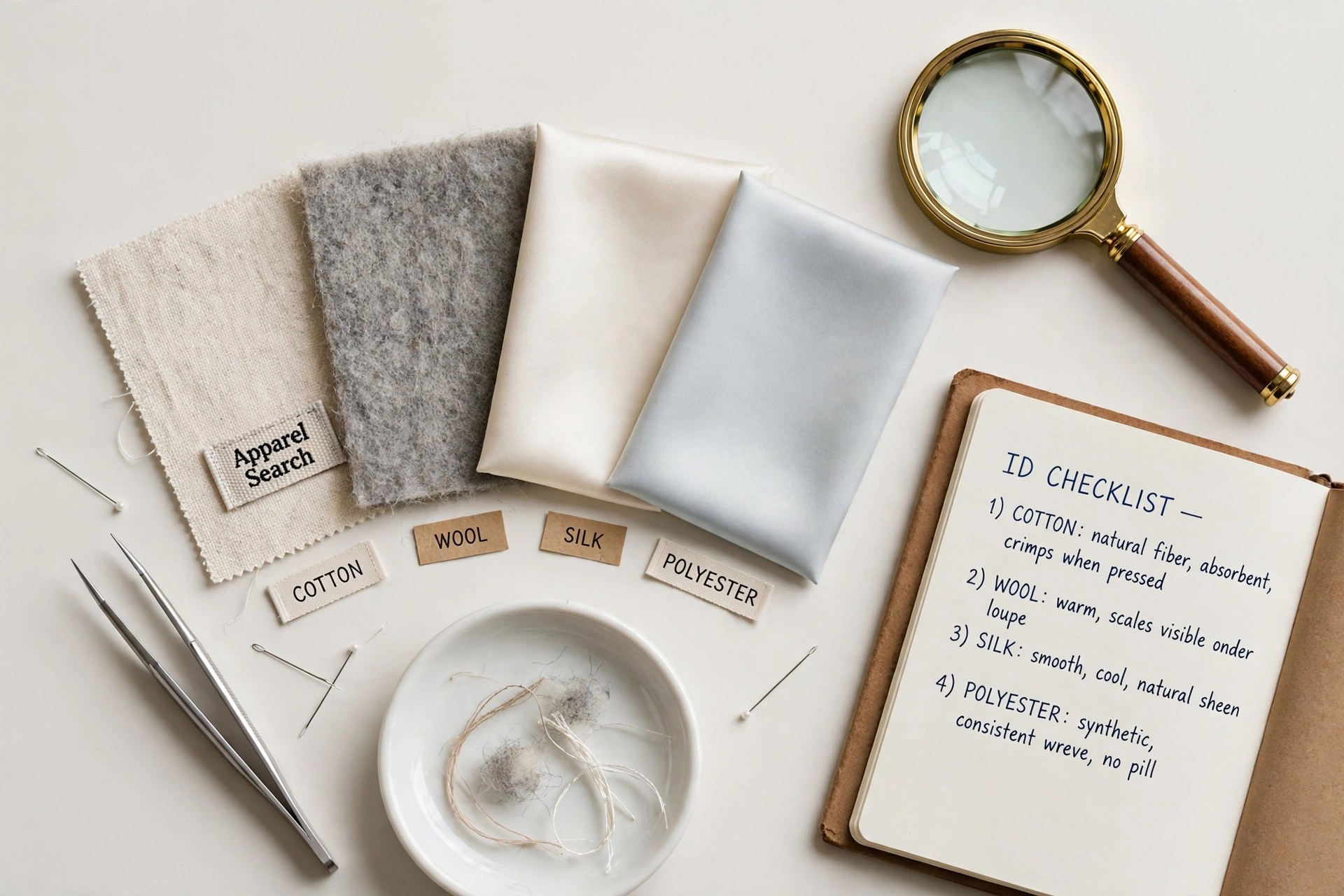
Safety First — Read Before Any Flame
The burn test uses a sample the size of a thumbnail, and the safety rules are part of the method, not a footnote. Work outdoors or in a well-ventilated spot, over a fireproof dish (ceramic or metal) set on a clear, heatproof surface. Hold the sample in tweezers, never your fingers. Snip the sample from a hidden place — an inside seam allowance or hem edge. Keep water within reach, tie back hair and loose sleeves, and never test a garment while it is being worn. Let every sample cool completely in the dish before touching the residue. If any of that is not possible, stop at the hand checks below — they identify more than you might expect.
The Burn Test, Step by Step
- Snip a small sample — a sliver about a thumbnail's width, or a few yarns unpicked from a seam allowance. If you can, take warp and weft yarns separately; some fabrics use different fibers in each direction.
- Grip the sample in tweezers and hold it over the fireproof dish.
- Bring the edge of the sample to the flame slowly and watch what happens before it catches: does it move toward the flame and burn, or shrink and melt away from it? This first reaction divides natural fibers from synthetics more reliably than anything else.
- Let it burn briefly in the flame, noting how fast and how steadily it burns, then remove it and watch whether it keeps burning or puts itself out.
- Note the smell as it smolders — paper, hair, or chemicals are the three families of odor, and they are distinctive once you have met them.
- Let the residue cool completely, then examine it: soft ash you can powder between your fingers, or a hard bead you cannot crush. That difference is the oldest clue in the test.
Reading the Results, Fiber by Fiber
| Fiber | In the flame | Smell | Residue |
|---|---|---|---|
| Cotton | Catches quickly and burns steadily; does not shrink away. | Burning paper or leaves. | Fine, soft gray ash; no bead. |
| Linen | Like cotton but a little slower to catch; burns evenly. | Burning paper, slightly grassier. | Light soft ash; no bead. |
| Wool | Shrinks away from the flame, burns slowly and sputters, usually self-extinguishes when removed. | Strong burnt hair — unmistakable. | Dark, irregular bead that crushes to powder. |
| Silk | Curls away, burns slowly, often self-extinguishes. | Burnt hair, milder than wool. | Dark bead that crushes easily. |
| Rayon (viscose) | Catches very fast and burns quickly, like cotton but brisker. | Burning paper. | Only a wisp of ash; no bead. |
| Polyester | Shrinks and melts away from the flame, burns slowly with dark smoke. | Sweetish, chemical. | Hard dark bead that will not crush. |
| Nylon | Melts and shrinks away; may not sustain a flame at all. | Faintly like celery, or chemical. | Hard grayish bead that will not crush. |
| Acrylic | Melts, then burns with sputtering. | Sharp, acrid, chemical. | Hard, irregular black bead. |
The pattern underneath the table is simple. Cellulose fibers (cotton, linen, rayon) burn like what they are — plant matter — and leave ash. Protein fibers (wool, silk) resist the flame, announce themselves by the hair smell, and leave a crushable bead. Synthetics are plastics: they melt first, burn reluctantly, and leave a bead like a tiny stone that no finger pressure will crush. A sample that does two of these at once is telling you it is a blend — read the blended verdict in the questions below. Fiber definitions for everything in the table live in the fibers library, and the individual entries — cotton, wool, silk, polyester — give the fuller picture of each.
The No-Flame Checks
Fire is the famous test, but hands answer most everyday questions, and they answer them anywhere — including on a thrift-store rack, where burning the merchandise is not an option. Our guide to spotting quality and fakes secondhand builds a full rack check; these are its fabric-identification moves.
- The wrinkle test. Crush a corner in your fist for ten seconds and let go. Cotton and linen keep the creases — linen proudly. Wool and silk spring most of the way back. Synthetics shake out almost smooth. A fabric that creases like linen and recovers like wool is usually a blend of the two families.
- The stretch test. Pull gently along and across the grain. Woven naturals give very little; any fabric that stretches and snaps back smartly has elastane or a knit structure doing the work, whatever its main fiber is.
- The water-drop test. A drop of water on a hidden spot soaks into cotton, linen and rayon at once, spreads slowly on wool and silk, and beads up on most synthetics. One caution: modern water-repellent finishes make naturals bead too, so read a beading result as "finished or synthetic," not proof.
- Hand and warmth. Wool feels warm and springy, silk smooth and oddly warm for its lightness, cotton cool and dry, linen cooler and crisper still. Polyester feels smooth but slightly glassy, and warms up clammy against the skin. Hands learn this vocabulary fast — handle the known fabrics in your own wardrobe first, and the unknowns start to sort themselves.
When the Answer Matters
Three everyday situations are why this page exists. Before sewing: an unlabeled stash fabric identified as wool suiting rather than polyester changes the needle, the pressing temperature and the pattern you choose for it — the Learn to Sew guide and its stitches and seams companion assume you know what is under the needle. Before buying secondhand: the difference between a silk blouse and a polyester one is the difference between a find and a pass, and the thrifting and secondhand guide and how to date vintage clothing both lean on fiber as evidence. Before washing: the fiber sets the care, and our garment care guide is organized by exactly that question. And when the answer has to be certain — a valuable piece, a dispute, a production run — that is the laboratory's job, not the tweezers': see colorfastness testing and the rest of the textile testing family for how the professionals do it.
Common Questions
How accurate is the burn test on fabric blends?
It tells you the dominant story, not the whole one. A cotton-polyester blend burns partly like cotton and partly melts like polyester, and the proportions cannot be read from the ash. Burning a warp yarn and a weft yarn separately helps when the two directions use different fibers, as some fabrics do. For care and sewing decisions the family identification is usually enough; for an exact percentage, only a laboratory analysis — or the original label — will do.
Can I do the burn test without cutting the garment?
You need only a few yarns, not a visible piece. Unpick a few threads from an inside seam allowance, the edge of a hem, or a facing — places where a small snip will never show. Never test a garment while wearing it, and never hold fabric in your fingers to burn it: the sample goes in tweezers, over a fireproof dish, every time.
What does it mean if a fabric both melts and smells like burning paper?
Most likely a blend: a cellulosic fiber such as cotton or rayon supplying the paper smell and the burn, and a synthetic component supplying the melt. Read it as 'mixed fibers' and treat the fabric as the more delicate of the two for washing and ironing — the synthetic's heat limit governs the iron, whatever the cotton content would allow.
Is the burn test safe to do indoors?
It can be, done properly: a tiny sample, tweezers, a fireproof dish on a clear surface, ventilation, water at hand, and nothing flammable nearby. Many people prefer a sheltered spot outdoors, which removes the smoke question entirely. What it must never be is casual — no testing over a sink full of laundry, no samples bigger than a thumbnail, and no leaving a smoldering sample unattended. When in doubt, skip the flame and use the hand checks: they answer more questions than they get credit for.