Colorfastness is a fabric's resistance to changing color or staining other materials when it is washed, exposed to light, rubbed, or worn against perspiring skin. It is the most frequently ordered family of tests in the Textile Testing & Quality Standards Guide, because color failure is the failure customers notice first — and complain about loudest.
Every colorfastness result answers two separate questions. Color change asks whether the fabric's own shade shifted, faded or bled. Staining asks whether dye transferred onto other fibers in contact with it — the white pocket lining, the adjacent garment in the wash, the car seat. A fabric can pass one and fail the other, which is why lab reports grade both, and why a dark, saturated shade that looks rich on the rack can be a fastness problem waiting to happen: more dye on the fiber means more dye available to move.
Results are reported as grades, not raw measurements, and the grading system — the grey scales — is explained below. For the definitions behind the terms, see our glossary entries on color fastness testing and crocking and bleeding; this guide covers how the testing works in practice.
The Four Core Fastness Tests
Fastness to washing (laundering)
The fabric is washed under controlled, accelerated conditions with a multifiber strip — a small cloth woven with bands of different fibers — attached to it. One accelerated laboratory cycle is designed to approximate the effect of repeated home laundering. The best-known method is AATCC 61, colorfastness to laundering: accelerated. After washing, graders score both the specimen's color change and the staining on each fiber band of the multifiber strip, because a dye that leaves cotton may land very differently on nylon or polyester.
Fastness to light
Specimens are exposed in a light cabinet under a controlled light source for a set period, alongside blue wool reference fabrics that fade at known rates. AATCC 16 covers colorfastness to light. Light fastness is the make-or-break property for curtains, swimwear, outdoor apparel and anything displayed in a shop window — and it varies enormously by dye class and fiber, which is why a shade that is perfectly wash-fast can still fade on a hanger near a window.
Fastness to crocking (rubbing)
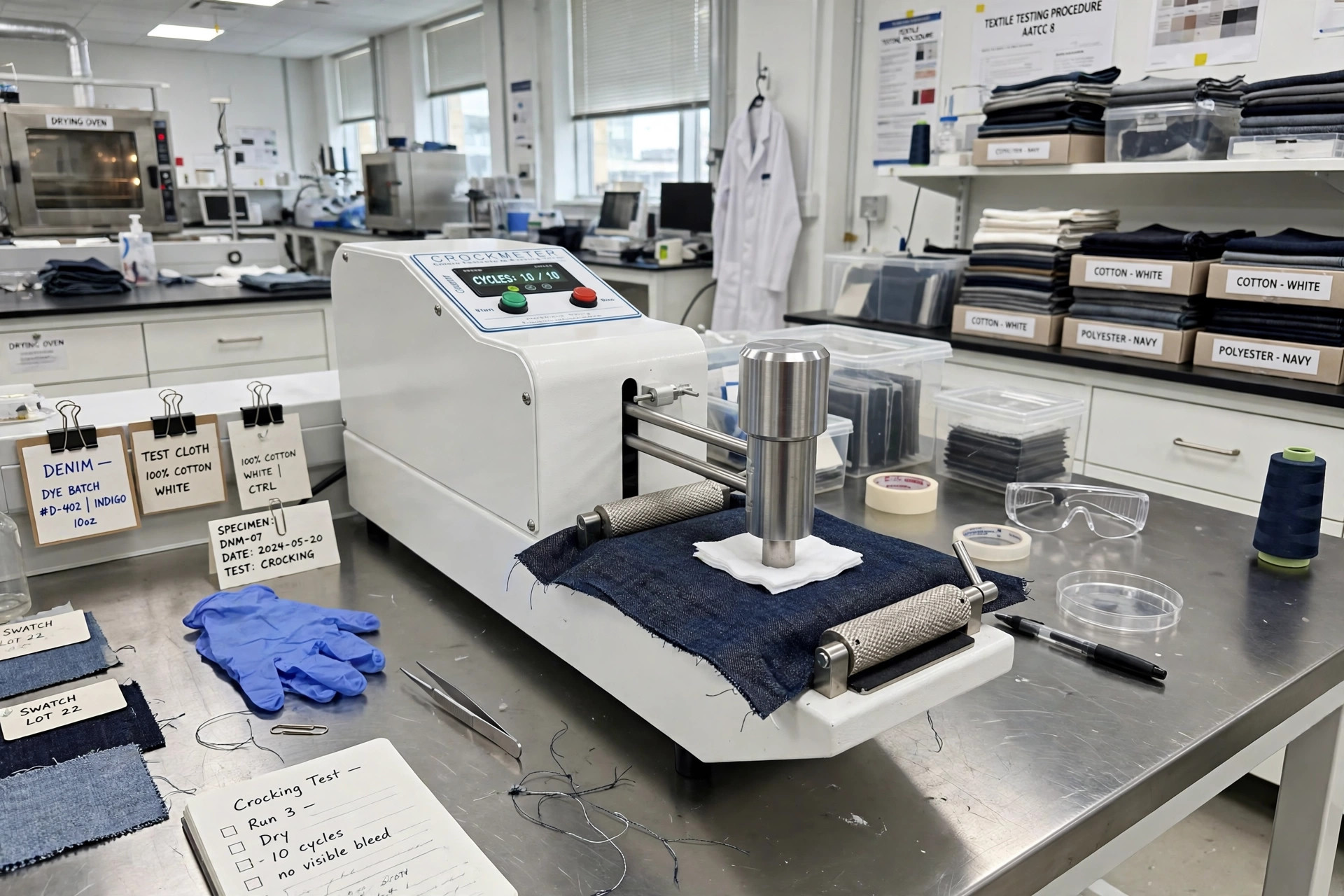
A crockmeter rubs a standard white cloth across the fabric under a set pressure for a set number of rubs — dry, and then again wet. AATCC 8 is the crocking method. The white cloth is then graded for transferred color. Crocking is where deep indigo denim famously "fails" by design: indigo sits on the surface of the yarn and is expected to rub off, which is one reason denim specifications set realistic crocking requirements instead of demanding the impossible.
Fastness to perspiration
Specimens are soaked in a solution formulated to imitate human perspiration, held under pressure, then dried and graded. Body chemistry is mildly acidic or alkaline depending on the person, so methods provide for both. Perspiration fastness matters most for garments worn against the skin in heat — athletic wear, summer shirting, underwear — where shade change appears exactly where the garment works hardest.
How the Grey Scales Work
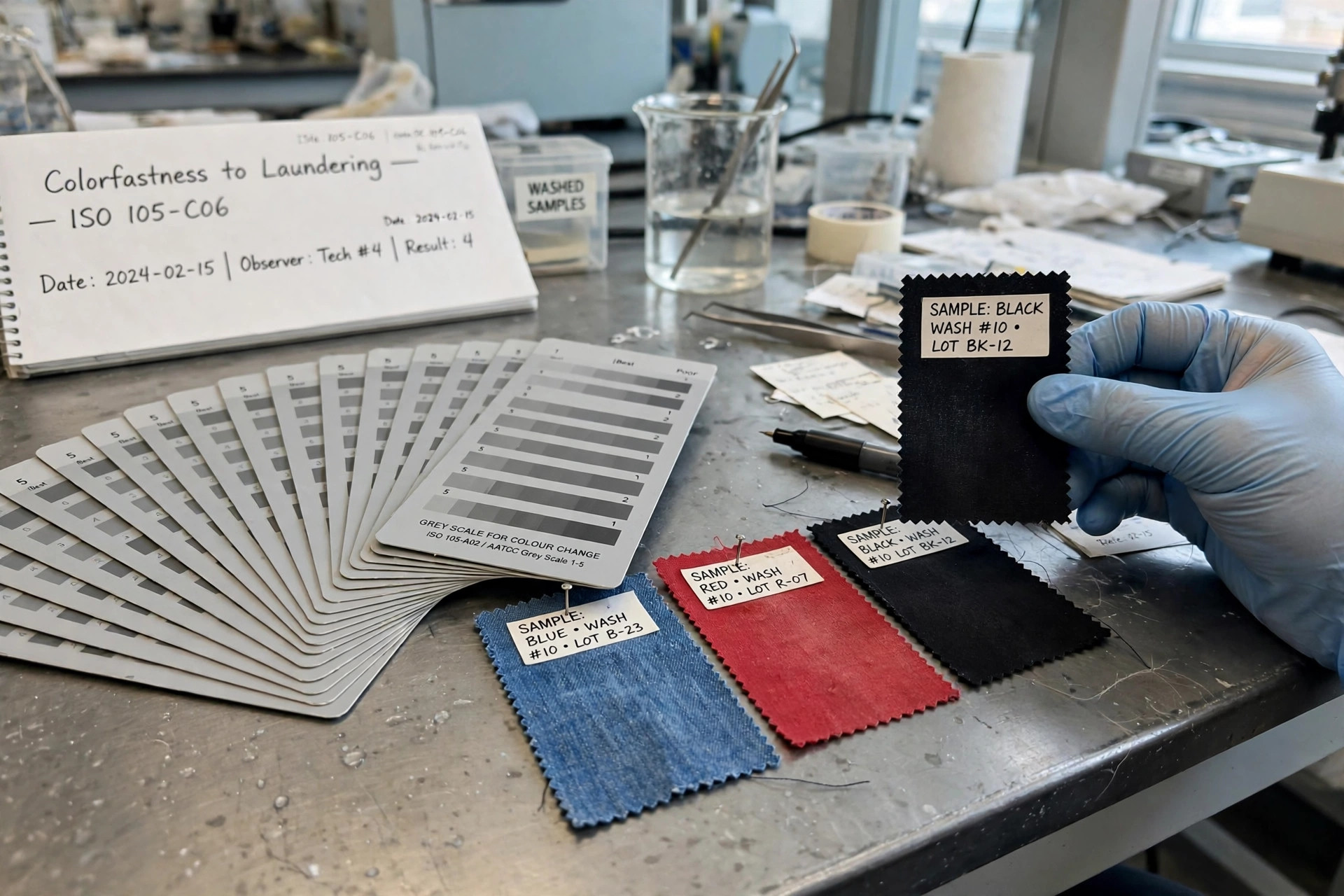
Colorfastness grades come from two grey scales. The grey scale for color change is a set of paired grey chips showing graduated contrast, from no visible difference to a severe difference. The grey scale for staining does the same for white cloth that has picked up color. A trained grader, working in a standard light box, matches the tested specimen against the scale and assigns a grade:
- Grade 5 — no change (or no staining). The best possible result.
- Grade 4 — slight change, acceptable for most apparel requirements.
- Grade 3 — noticeable change; often a borderline or failing result for main body fabric.
- Grade 2 — considerable change.
- Grade 1 — severe change. The worst result.
Half grades (4–5, 3–4) are common and meaningful: many brand requirements are written as a minimum of grade 4 for color change and grade 3–4 or 4 for staining, depending on the test and the product. Because grading is done by eye, reputable labs use trained graders, controlled lighting and, increasingly, instrumental color measurement to back up the visual grade. When a result is borderline, the conditions matter: the wash procedure, the detergent and the number of cycles must match what the requirement assumed — which is why the method and option used belong on every report, as our testing labs guide explains.
Why Colors Fail — and What Fixes Them
Fastness failures usually trace back to dye selection and dyeing quality rather than to the test. Fibers take dye by different chemistry: reactive dyes bond chemically to cotton, disperse dyes dissolve into polyester, acid dyes attach to nylon and wool. A dye class mismatched to the fiber, dye that was never properly washed off after dyeing, or excessive depth of shade all show up as poor washing or crocking grades. The fixes happen at the mill — better dye selection, thorough soaping-off, fixation treatments — or at the design table, where a slightly less saturated shade passes comfortably while the original failed by half a grade.
Color decisions also follow the garment home. The care label the consumer reads is written from these test results: a fabric with marginal wash fastness earns a "wash with like colors" or "wash separately" instruction. Our Garment Care Guide explains that consumer side of the same story.
Common Questions
- What is a good colorfastness grade?
- On the 1–5 grey scales, grade 5 is perfect and grade 4 is a slight change that most apparel brands accept as a minimum for color change. Staining requirements are often set at grade 3–4 or 4 depending on the test. Grade 3 or below on a main fabric usually means a fail against typical brand requirements.
- What is crocking in textile testing?
- Crocking is color transfer by rubbing. A crockmeter rubs a standard white cloth across the fabric, dry and wet, and the cloth is graded for staining. AATCC 8 is the standard crocking method. Surface-held dyes, most famously indigo on denim, crock by nature.
- Why does a lab report grade both color change and staining?
- Because they are different failures. A fabric can hold its own shade while bleeding dye onto other fibers, or fade while staining nothing. Reports grade the specimen's color change and the staining of an attached multifiber strip separately so both problems are visible.
- Can colorfastness be improved after dyeing?
- Sometimes. Thorough washing-off of unfixed dye, fixation treatments and certain after-treatments can raise washing and crocking grades. But the durable fix is usually upstream: the right dye class for the fiber and a depth of shade the fiber can actually hold.
Back to the Textile Testing & Quality Standards Guide
The full guide to fabric and garment testing — every test family, the standards behind them, and how to read a lab report.