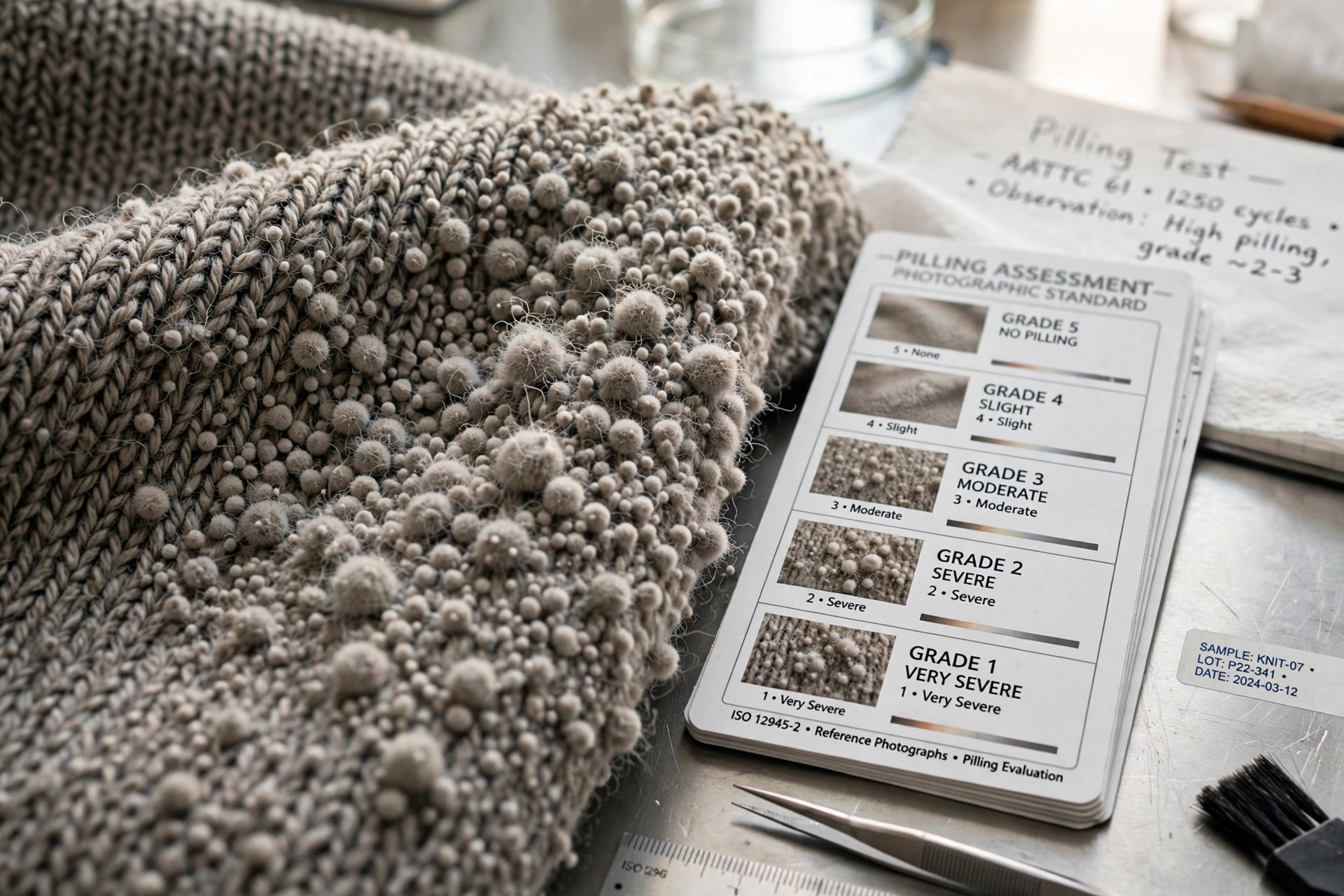
Pilling is the formation of small fiber balls on a fabric surface; abrasion resistance is how long the surface survives rubbing before it breaks down. Together they predict how a garment will look after months of wear, which is why this test family sits at the center of the Textile Testing & Quality Standards Guide. Our glossary entry on pilling defines the term; this guide explains the testing.
Pilling happens in stages: surface fibers loosen and fuzz, the fuzz entangles into pills, and the pills eventually wear away — or don't. Short, weak fibers pill fastest and hold their pills longest when blended with strong fibers that anchor them, which is why a soft spun yarn can look shabby in weeks while a smooth filament fabric looks new for years. Abrasion is the broader wear process: seat, elbow and thigh rub that thins fabric until threads break. Both are tested by rubbing the fabric in a machine far faster than life does, then grading what the surface looks like.
The Martindale Method
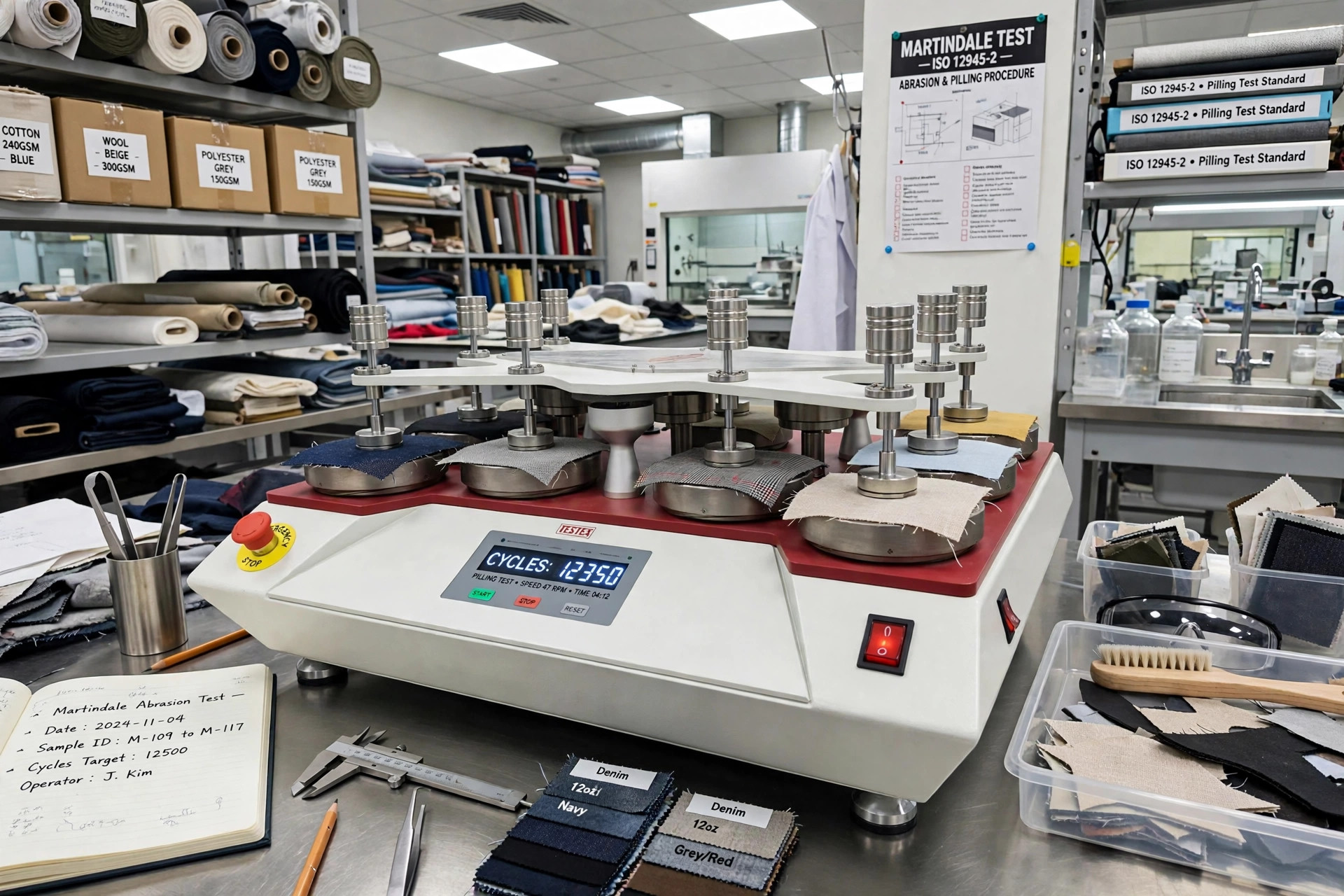
The Martindale machine is the workhorse of wear testing. Circular specimens are mounted in holders and rubbed against a standard abradant fabric in a shifting, multi-directional pattern (a Lissajous figure) under a specified pressure, while a counter tracks the rub cycles. For pilling, ASTM D4970 — the Martindale pilling method — stops at set cycle counts and grades the surface. For abrasion resistance, the test runs until threads break, and the cycle count itself is the result: the higher the cycles to breakdown, the harder-wearing the fabric.
Martindale results are specification language. Upholstery and workwear are bought on minimum cycle counts; apparel buyers more often specify a minimum pilling grade after a stated number of cycles, because appearance — not total breakdown — is what apparel customers judge.
Random Tumble and Other Pilling Methods
The random tumble pilling tester takes a different approach: specimens tumble in a cork-lined chamber with a small amount of cotton lint, tumbling and rubbing against the chamber and each other for a set time. It imitates the random wear of garments in use and is widely used for knits and casual apparel. Other instruments exist for specific fabrics — brush-and-sponge devices for upholstery-type wear, and elastomeric pad methods — but Martindale and random tumble cover most apparel programs.
Whichever instrument is used, the specimen is graded against photographic standards on a five-step scale:
- Grade 5 — no pilling; surface unchanged.
- Grade 4 — slight surface fuzzing or a few partially formed pills.
- Grade 3 — moderate pilling; pills of varied size covering the surface in part. Often the minimum acceptable for apparel.
- Grade 2 — distinct, dense pilling over most of the surface.
- Grade 1 — severe pilling; the surface is covered.
Reading Results and Improving Them
A pilling result is only meaningful with its conditions attached: the method, the number of cycles or minutes, and the grade required in the buyer's specification. A grade of 3–4 after a long Martindale run may be a better fabric than a grade 4 after a short one. Buyers typically require grades around 3–4 minimum for apparel at a stated cycle count, with finer, smoother and more densely constructed fabrics expected to do better.
When a fabric pills too much, the levers are in its construction: longer staple fibers, tighter spinning, singeing or shearing the surface, enzyme or anti-pilling finishes, and avoiding blends where a strong fiber anchors pills made from a weak one. Each fix costs something — softness, hand feel, or money — so testing results become a negotiation about which trade-off the garment can afford. Wear performance is also where performance claims meet the lab: the technical finishes and constructions in our Performance Fabrics Guide are all validated with abrasion and pilling tests like these.
Common Questions
- What does a pilling grade of 3 mean?
- On the five-step photographic scale, grade 5 is no pilling and grade 1 is severe pilling. Grade 3 means moderate pilling — visible pills over part of the surface — and it is often the minimum acceptable grade for apparel at a specified number of test cycles.
- What is the Martindale test used for?
- The Martindale machine rubs fabric specimens in a multi-directional pattern to measure both pilling resistance (ASTM D4970) and abrasion resistance, where the result is the number of rub cycles the fabric survives before threads break.
- Why do some fabrics pill much faster than others?
- Short, weak fibers loosen, fuzz and entangle into pills quickly. Pills persist when strong fibers in the blend anchor them. Tight construction, long-staple fibers, smooth filament yarns and surface finishes all reduce pilling.
- How many Martindale cycles should apparel fabric survive?
- For apparel, buyers usually specify a pilling grade after a stated number of cycles rather than a breakdown count. High cycle-to-breakdown requirements are more typical of upholstery and workwear specifications.
Back to the Textile Testing & Quality Standards Guide
The full guide to fabric and garment testing — every test family, the standards behind them, and how to read a lab report.