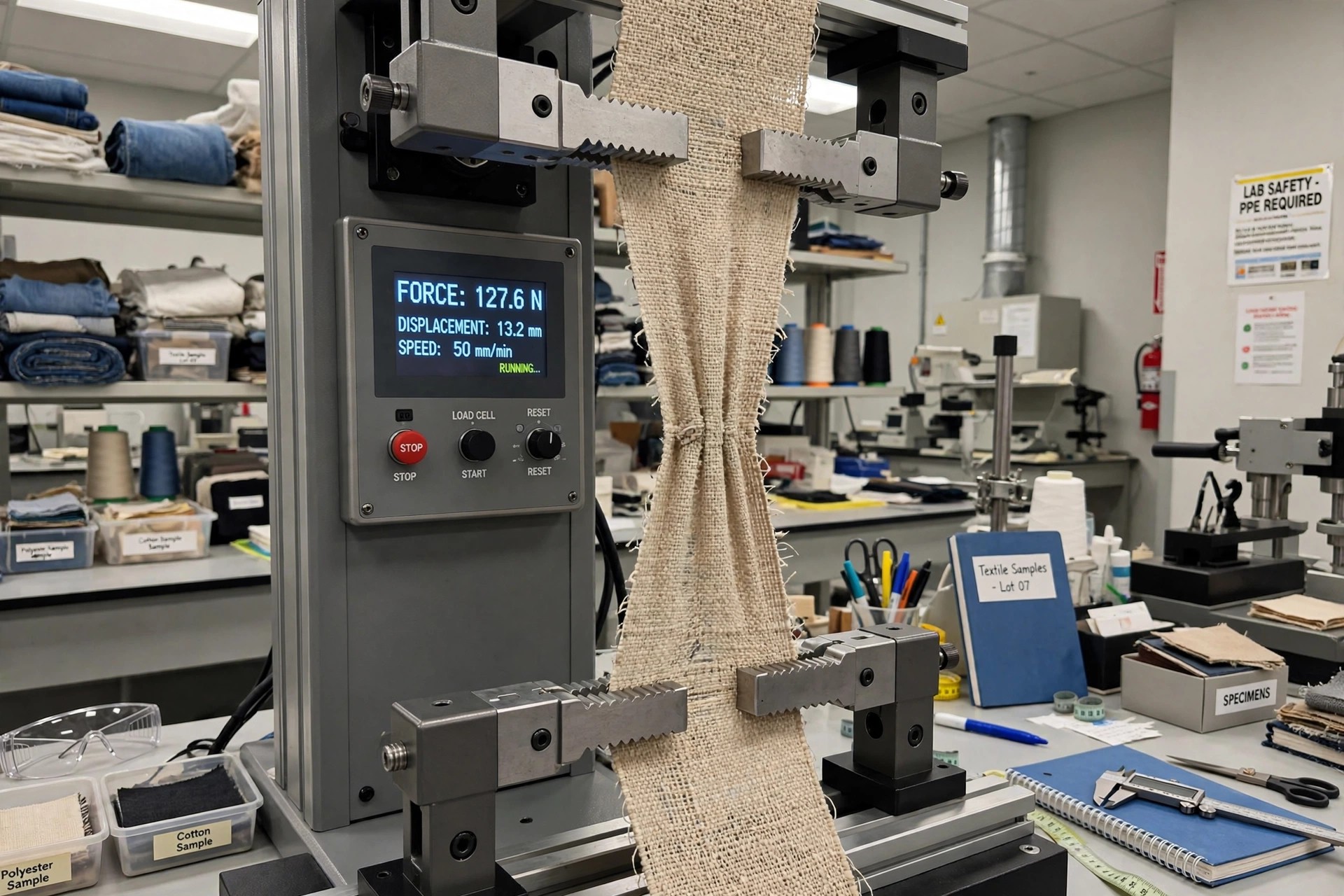
A fabric can be beautiful, colorfast and dimensionally perfect and still fail in the only way that matters at the worst moment: it tears. Strength testing measures the forces a fabric and its seams withstand — pulling, tearing and seam strain — and it anchors the durability side of the Textile Testing & Quality Standards Guide.
Strength is not one property. A fabric resists three different kinds of attack in service: a straight pull (a tight sleeve, a grabbed pocket), a tear that starts from a nick or a stress point, and the slow strain that opens a seam or makes yarns slide apart along it. Each has its own test, its own geometry and its own failure story, and a fabric strong in one can be weak in another. That is why reports list strength as several results, never one number.
Tensile Strength: The Pull Test
Tensile (breaking) strength is the maximum force a fabric strip withstands before it ruptures when pulled in a testing machine. The most widely used apparel method is the grab test, ASTM D5034: a wider specimen is clamped by grips that hold only its center portion, imitating how fabric is stressed in a garment, and pulled at a constant rate until it breaks. The result is a force — reported in pounds or newtons — for the warp direction and the weft direction separately, since the two rarely match.
A companion measurement, elongation, records how far the fabric stretched before breaking. It matters for comfort and fit retention: a fabric can be strong but boardy, or weaker but forgiving. Buyers set minimum breaking-strength values by product type — a shirting, a trouser twill and a sheer blouse fabric live in different worlds, and the specification in the purchase order is what the result is judged against.
Tear Strength: From a Nick to a Rip
Tears almost never start in the middle of intact fabric; they start at a snag, a cut, a worn fold. Tear tests therefore begin with a deliberate slit and measure the force needed to propagate it — commonly with a falling-pendulum (Elmendorf) instrument or a tongue (single-rip) procedure on a tensile machine. Low tear strength relative to tensile strength is a classic warning sign: the fabric feels sturdy in the hand but rips easily once damaged, a combination behind many field failures in lightweight wovens.
Seam Strength and Seam Slippage
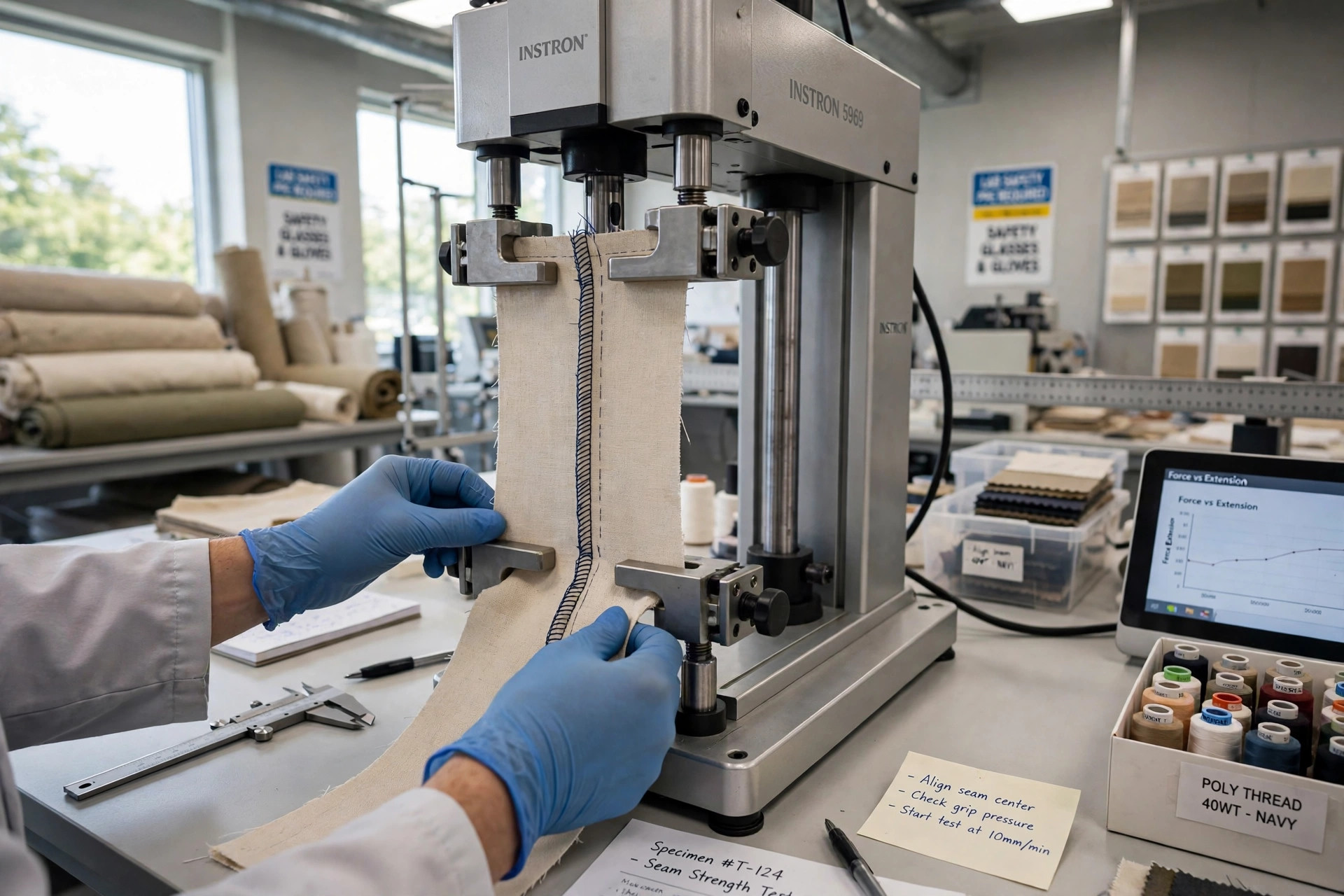
Garments usually fail at seams before the fabric itself gives way, so seams are tested as their own system:
- Seam strength pulls a seamed specimen across the seam until something breaks — thread, fabric at the needle line, or fabric away from the seam. Which one breaks tells the engineer what to fix: stronger thread, different stitch density, or a different seam construction.
- Seam slippage measures how far yarns slide apart alongside the seam under a set load, opening a grin in the fabric without anything breaking. It is the chronic problem of loose, slippery weaves — smooth filament fabrics especially — and is reported as the force at a specified opening, or the opening at a specified force.
Strength results interact with everything else in production. Fabric weight connects here too: ASTM D3776 measures mass per unit area (fabric weight), and a fabric delivered lighter than specified will usually test weaker — one reason weight appears on so many lab reports next to the strength results. When strength fails, the honest fixes are a heavier or tighter fabric, stronger yarns, or a redesign of the stressed area; no finish applied afterward can manufacture strength the yarns do not have. Strength also has a price: the heavier constructions that test strongest cost more per garment, a trade-off laid out in our Garment Costing & Production Economics Guide.
Common Questions
- What is the grab test for fabric?
- The grab test (ASTM D5034) clamps the center portion of a fabric specimen in a tensile machine and pulls it to rupture, recording the breaking force. It imitates the way fabric is gripped and stressed in a real garment better than a full-width strip test.
- What is the difference between tensile strength and tear strength?
- Tensile strength is the force needed to pull intact fabric apart. Tear strength is the force needed to propagate an existing slit or nick. A fabric can have high tensile strength but tear easily once damaged, so both are tested.
- What is seam slippage?
- Seam slippage is the yarns beside a seam sliding apart under load, opening a visible gap without any thread breaking. It is common in loose or slippery weaves and is controlled by fabric construction, seam type and stitch density.
- What units are fabric strength results reported in?
- Breaking and tear forces are reported in pounds-force or newtons, for the warp and weft directions separately. The lab report should always name the method used, because results from different methods are not interchangeable.
Back to the Textile Testing & Quality Standards Guide
The full guide to fabric and garment testing — every test family, the standards behind them, and how to read a lab report.