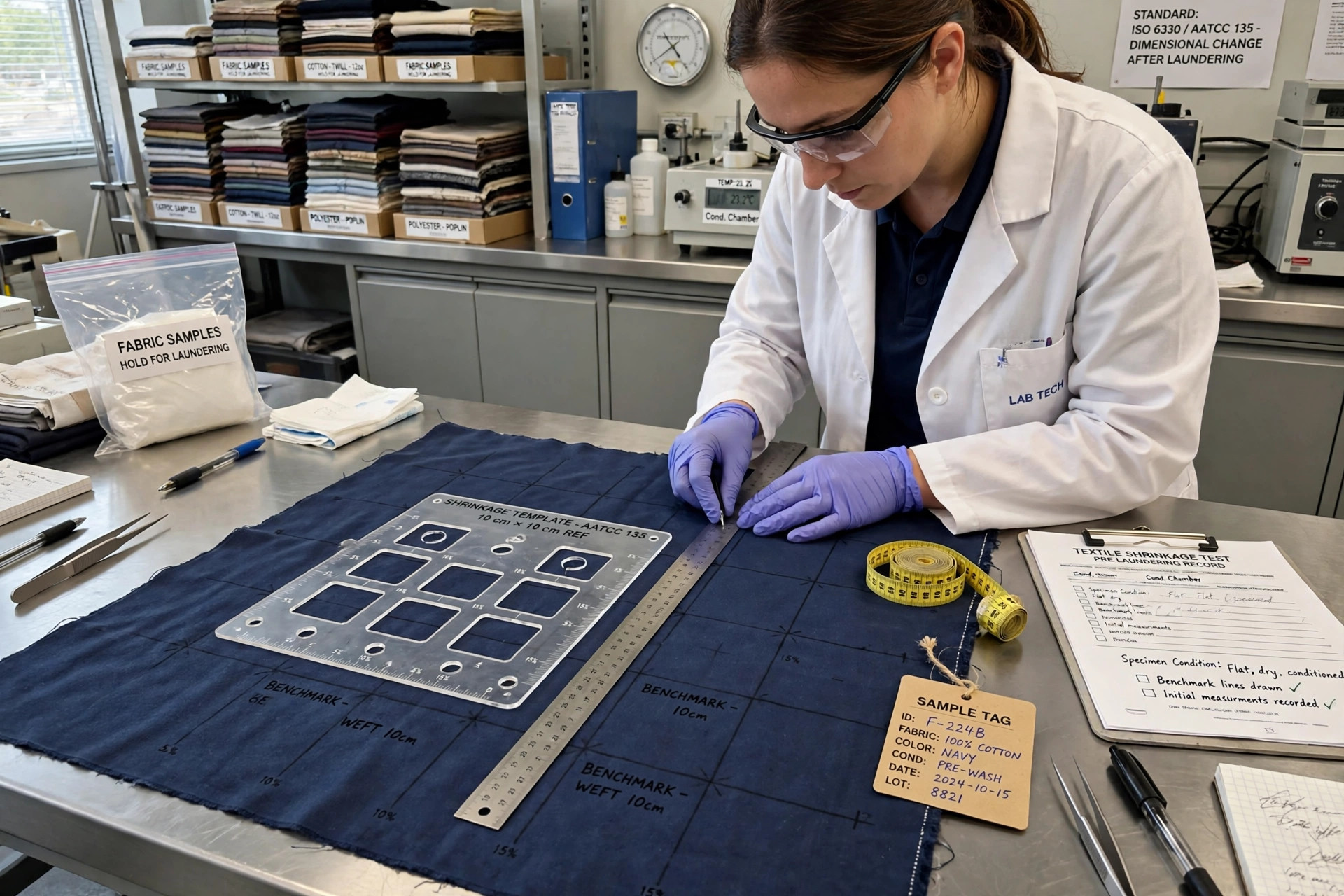
Dimensional stability is a fabric's ability to keep its original size and shape through washing and wearing. Its failure is shrinkage — or its opposites, growth and twisting. Dimensional change testing is a core part of the Textile Testing & Quality Standards Guide, because a garment that fits perfectly in the store and badly after one wash is a return waiting to happen.
Fibers swell when they get wet, yarns relax from the tensions they were woven or knitted under, and finishes wash out. The result: fabric dimensions change in the first launderings, mostly in the first wash, and then settle. Testing exists to measure that change under controlled conditions before production, so patterns can be compensated, fabrics can be pre-shrunk, and the buyer's tolerance can be checked while there is still time to fix the problem.
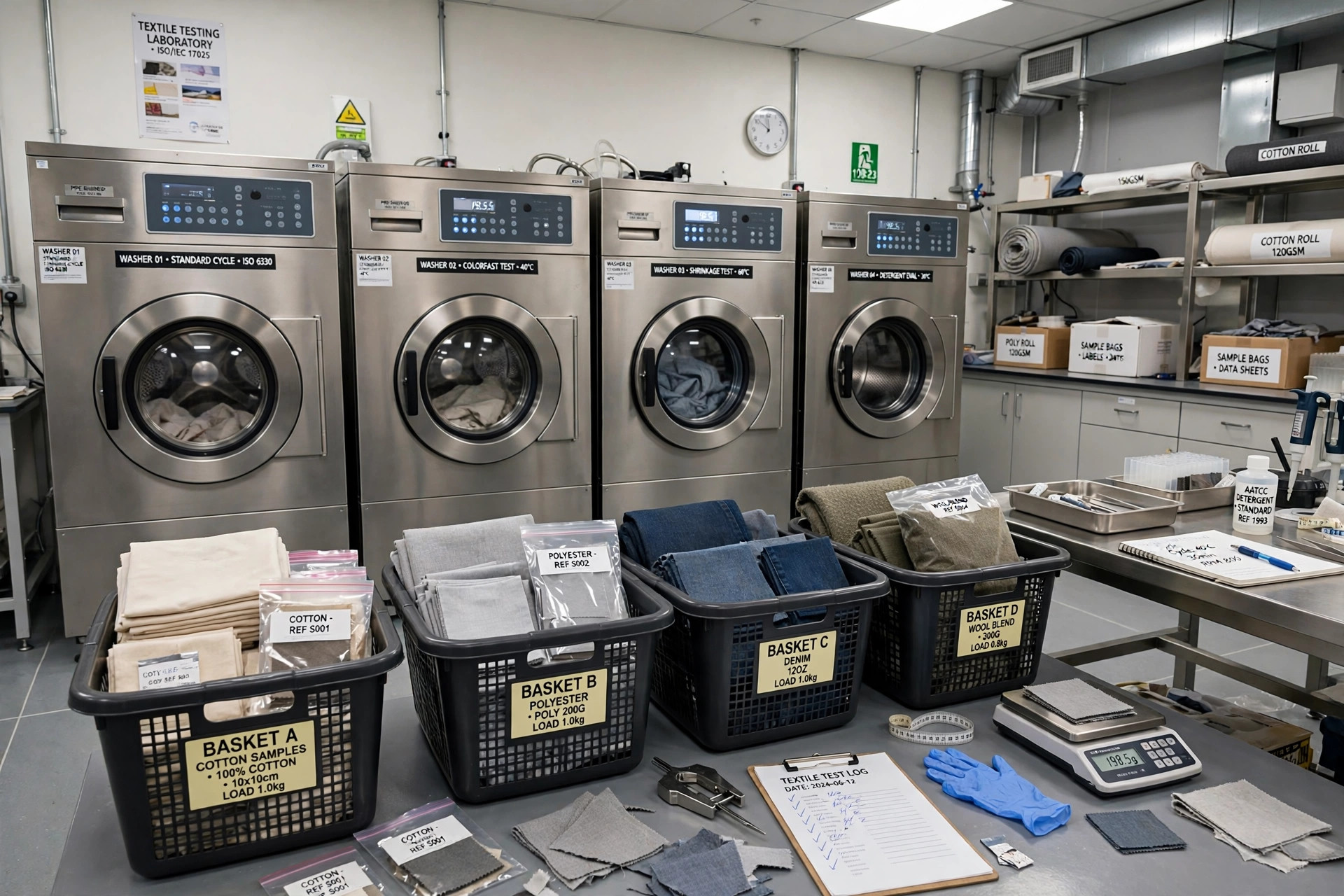
The classic method is AATCC 135, dimensional changes of fabrics after home laundering. Specimens are marked with benchmarks at measured distances, laundered and dried under a specified procedure — machine type, temperature, detergent, and tumble or line dry — then re-measured. Each direction of the fabric is reported separately, as a percentage: negative for shrinkage, positive for growth. Our glossary page on shrinkage covers the basic definition; this guide covers how the measurement and the tolerances actually work.
Warp, Weft and Why Direction Matters
Woven fabrics have two directions with different behaviors. The warp (lengthwise yarns) is held under high tension on the loom and tends to relax and shrink; the weft (crosswise yarns) usually changes less, and sometimes grows. Knits are measured along the wale (length) and course (width) directions instead. A report therefore never gives one shrinkage number — it gives one per direction, and a fabric shrinking 4% in length and 1% in width is a different production problem from one shrinking evenly.
Garment testing works the same way on a finished piece: chest, length and sleeve are measured before and after the specified number of wash cycles, and compared with the buyer's measurements chart. This is where shrinkage meets fit — one reason testing connects directly to the sizing work in our Sizing & Fit Guide.
Spirality, Skew and Torquing
Size is not the only dimension that moves. In knitted fabrics especially, the wales and courses can lose their right-angle relationship after washing, so a T-shirt's side seam creeps toward the front and the garment hangs twisted. This is spirality (also called torquing or skew in garments), caused mainly by unbalanced yarn twist released in laundering. It is measured as a percentage of displacement after washing, and it is a defect no amount of careful pressing can fix — the cure is yarn and fabric engineering at the mill, which is why buyers test for it at fabric stage rather than discovering it in finished goods.
Related appearance measures often travel with dimensional testing: smoothness appearance after laundering (how wrinkled the fabric looks against photographic standards) and the retention of creases or pleats. All of them answer the same consumer question — what will this look like after I wash it?
Tolerances: What Buyers Typically Allow
Standard methods define how to measure; the tolerance — the maximum change allowed — is set by the buyer in the product specification, based on fiber, construction and end use. Typical industry practice looks like this:
- Woven apparel fabrics are commonly specified around ±3% in each direction; stable, pre-shrunk wovens can be held tighter.
- Knitted fabrics and garments commonly allow more — often around ±5% — because loop structures move more in laundering.
- Garments are typically judged point-of-measure by point-of-measure rather than by a single percentage, with the most visible measurements (length, chest) held closest.
These are typical ranges, not universal rules: a premium shirting program may demand less, a relaxed jersey may allow more, and the specification in the purchase order is always the governing document. When a fabric fails, the remedies are preshrinking treatments such as sanforizing for wovens, compaction and heat-setting for knits and synthetics, or adjusting the pattern to build the expected shrinkage into the garment — each with a cost the buyer and mill negotiate.
Shrinkage results also write the care label: the wash temperature and drying method on the label come from the conditions the garment survived in testing. The consumer view of the same subject is in our Garment Care Guide.
Common Questions
- How is fabric shrinkage measured?
- Specimens are marked with benchmarks at known distances, laundered and dried under a specified procedure (AATCC 135 for home laundering), then re-measured. The change is reported as a percentage for each direction — negative numbers mean shrinkage, positive numbers mean growth.
- How much shrinkage is acceptable in clothing fabric?
- It depends on the buyer's specification. Typical practice allows about ±3% for woven apparel fabrics and around ±5% for knits, but premium programs specify tighter limits and the purchase order specification always governs.
- What causes a T-shirt to twist after washing?
- Spirality — the knit's loops relaxing unevenly because of unbalanced yarn twist. The side seam rotates toward the front and the garment hangs skewed. It originates in yarn and fabric construction, so it must be tested and controlled at fabric stage.
- Can shrinkage be fixed before garments are made?
- Yes. Wovens can be preshrunk (sanforizing), knits can be compacted, and synthetics can be heat-set. Alternatively, pattern makers can add the expected shrinkage into the pattern. All three approaches are cheaper than discovering the problem in finished garments.
Back to the Textile Testing & Quality Standards Guide
The full guide to fabric and garment testing — every test family, the standards behind them, and how to read a lab report.