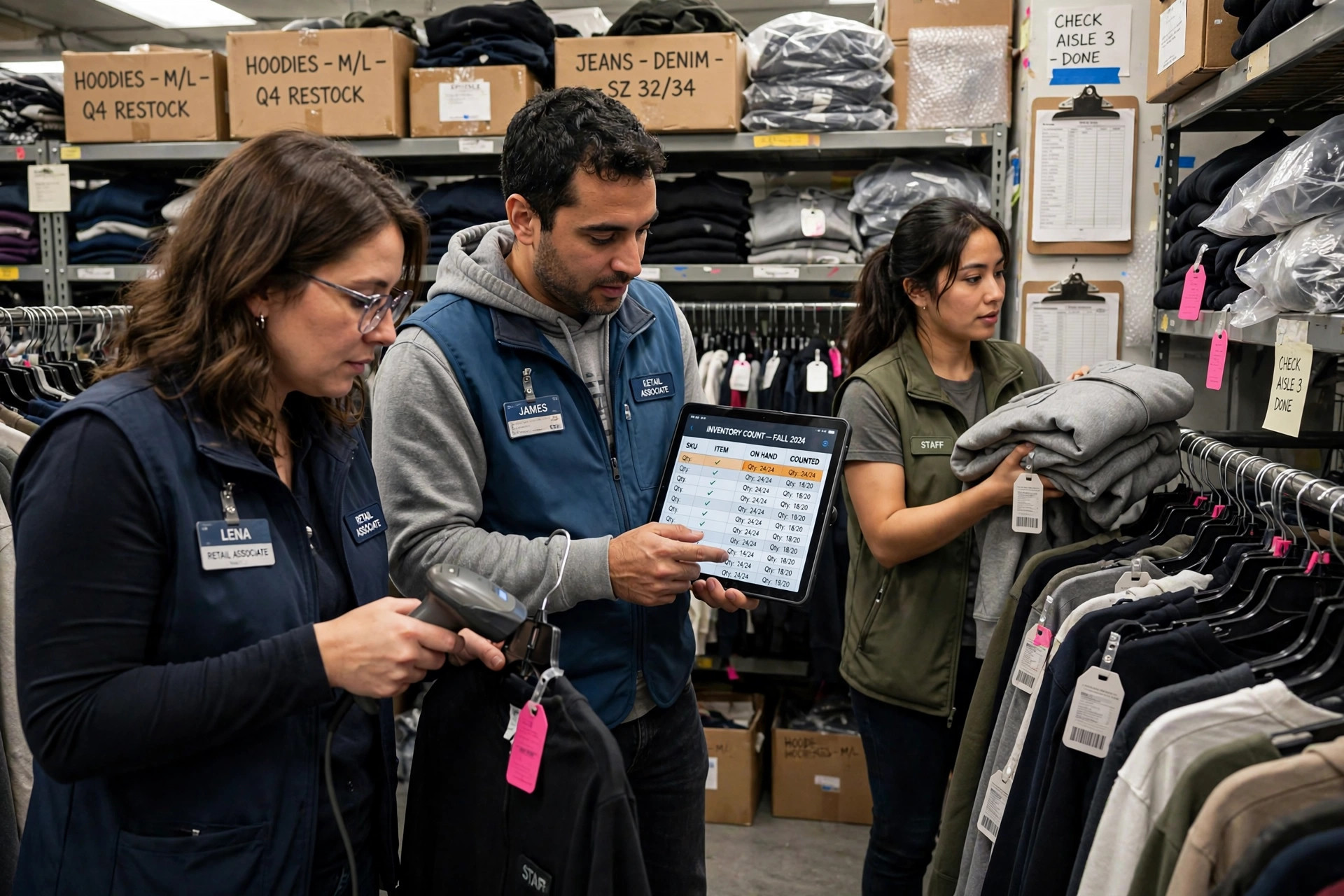
Retail shrinkage is the loss of inventory between the quantity a retailer's records say should be on hand and the quantity a physical count actually finds, where the difference cannot be explained by recorded sales. It is the gap between book inventory and reality, and it matters far beyond the missing goods themselves: inaccurate stock records corrupt every other retail number, from turnover to the availability promises made by BOPIS.
The Shrinkage Formula — and the Convention Used Here
Formula (convention used on this page): shrinkage % = (book inventory − physical inventory) ÷ net sales × 100, with the inventory difference valued at retail and all figures taken over the same accounting period.
Worked example: at stocktake, a store's book inventory is $520,000 at retail but the physical count is $505,000, a shortage of $15,000. Net sales for the period were $1,000,000. Shrinkage = $15,000 ÷ $1,000,000 × 100 = 1.5% of sales.
Conventions vary, and stating them matters. Some companies value the inventory difference at cost rather than retail, which produces a smaller shortage figure against the same sales; others express shrinkage as a percentage of inventory rather than of sales. Comparisons between stores or years are only valid on one consistent basis, and any benchmark quoted from an industry survey should be read with its own basis in mind. As general context, industry surveys commonly put total retail shrinkage at roughly 1–2% of sales, varying by sector and year — apparel sits within that broad range, and the figure is best treated as an approximate order of magnitude rather than a precise constant.
The Causes of Shrinkage
Shrinkage has five main sources, and honest loss-prevention work starts by separating them, because each responds to a different remedy. Shoplifting by customers, including organized groups that steal for resale, is the cause the public imagines first. Employee theft — goods taken, cash-register fraud, or sweethearting, where an associate under-rings merchandise for accomplices — is consistently reported in industry surveys as a comparably large share.
Administrative and paperwork errors — mis-scanned items, wrong prices or sizes keyed at the till, receiving mistakes, returns processed incorrectly, and stock written off but never recorded — create phantom inventory that only a count exposes. Vendor fraud covers deliveries invoiced at higher quantities than shipped, or cartons short-counted at receiving. Damage that is discarded without being recorded — soiled, torn, or customer-damaged garments thrown away informally — completes the list.
Prevention That Actually Works
Prevention is layered. For external theft: attentive service on the floor — genuinely the most effective deterrent in apparel — sensible placement of high-risk items, fitting-room count discipline, electronic tags on vulnerable lines, and clear sightlines supported by the store's planogram. For internal loss: separation of duties at receiving and refunds, exception reports from the till that flag unusual void and refund patterns, bag checks applied consistently, and a culture where raising a concern is safe.
For the paperwork share, prevention is process hygiene: counting deliveries against invoices at the door, scanning discipline at the till, recorded damage write-offs, and frequent cycle counts of high-value categories instead of one annual count, so errors surface while their cause can still be found. Shrinkage will never reach zero in an open selling environment; the goal is a measured, understood rate low enough that stock records can be trusted for buying and promising.
Common Questions
- How is shrinkage percentage calculated?
- On the convention used in this guide, subtract physical inventory from book inventory, both at retail, and divide the shortage by net sales for the same period, multiplied by 100. A 15,000-dollar shortage on 1,000,000 dollars of sales is 1.5 percent shrinkage.
- What are the main causes of retail shrinkage?
- Shoplifting, employee theft, administrative and paperwork errors, vendor fraud such as short deliveries, and unrecorded damage. Industry surveys generally find the theft and error categories are all significant, so prevention has to address each one.
- How much shrinkage is normal for a clothing store?
- Industry surveys commonly put total retail shrinkage at roughly 1 to 2 percent of sales, treated as an approximate range rather than a precise figure. A store should mainly compare its own rate over time, measured on a consistent basis.
- Why does shrinkage matter beyond the missing stock?
- Because buying, allocation, and online pickup promises all run on inventory records. Shrinkage makes those records wrong, causing stock-outs of items the system shows as available and over-ordering of items it shows as missing.
Retail Math & Fashion Business Guides
This page is part of the Apparel Search retail math and fashion business series. Browse the full series below, or start from the apparel industry tools hub.