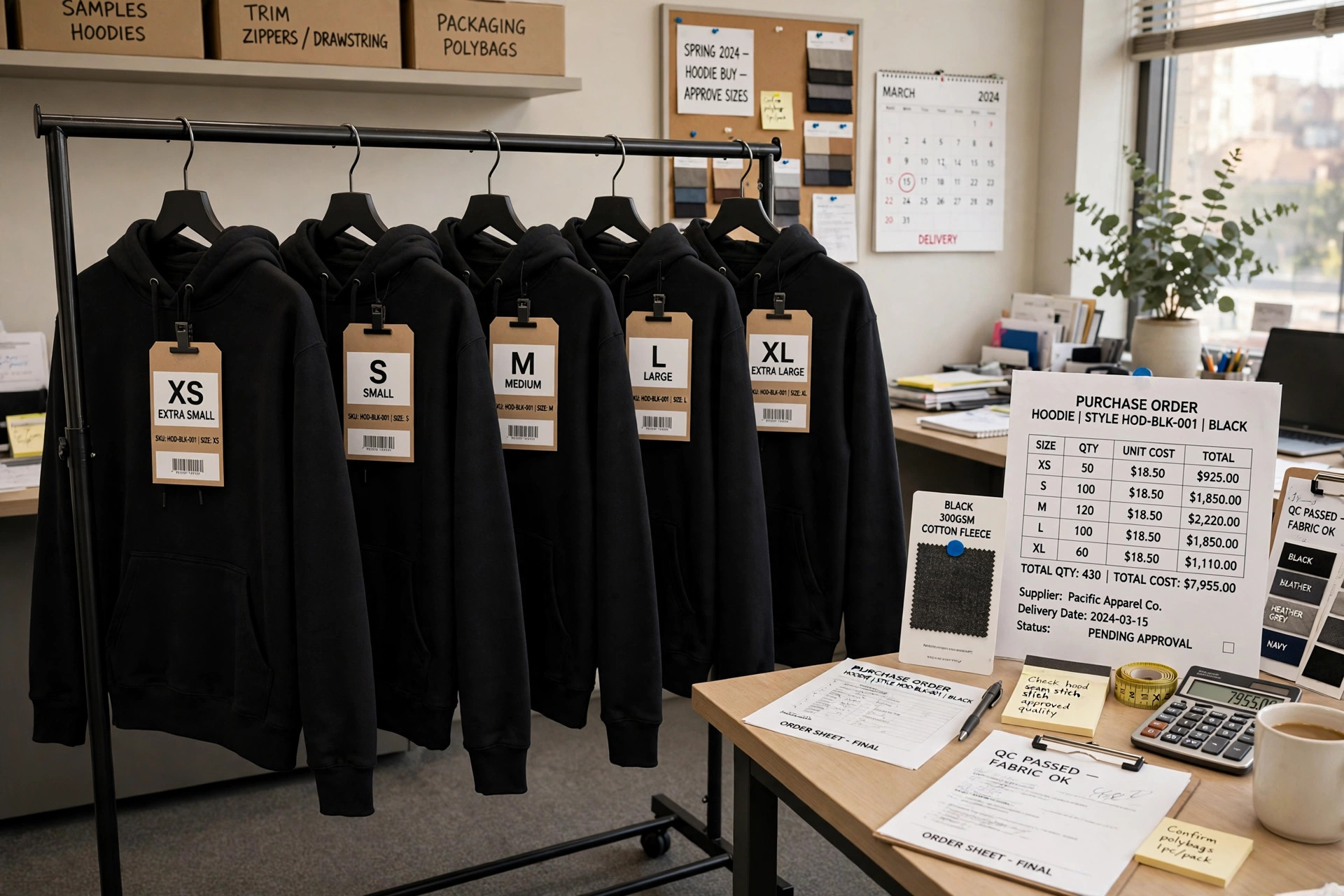
A size run is the full range of sizes offered for a style, and the quantities bought in each size — its size ratio — decide how those units are distributed across the run. Getting the ratio right is one of the least visible and most profitable skills in apparel buying: the right style in the wrong sizes sells through in the middle sizes, strands the extremes, and ends the season as markdowns on the sizes nobody wanted while customers for the sold-out sizes went elsewhere.
Ratio Packs and How the Math Works
Vendors often sell apparel in ratio packs (also called pre-packs): cartons packed to a fixed size ratio chosen by the brand. A typical women's core ratio across S–M–L–XL might be 1:2:2:1 — for every unit of small, two of medium, two of large, and one of extra-large. Retailers who buy open stock instead choose their own ratio style by style, which gives control but adds picking cost and minimums per size.
Worked example: a buyer orders 120 units in a 1:2:2:1 ratio. The ratio has 1 + 2 + 2 + 1 = 6 parts, so each part is 120 ÷ 6 = 20 units: S = 20, M = 40, L = 40, XL = 20.
The Apparel Search size curve splitter does this arithmetic for any order quantity and curve, including curves built from a store's own sales history.
Setting Ratios from Sales History
Sound ratios come from size-level sales history for the same category, in the same store or a genuinely similar one. Buyers look at the share of units sold in each size over recent seasons, adjust for stock-outs — a size that sold out early was under-bought, so its recorded sales understate its demand — and allow for known shifts, such as a growing plus-size business or a new store whose customers differ from the chain average.
Size curves differ sharply by category. Core sizes dominate in most women's and men's apparel, footwear curves peak in the middle sizes with long tails, and children's sizes track age groups rather than body proportions.
Broken Size Runs and What They Cost
A size run is described as broken when one or more sizes have sold out while others remain, so the style can no longer be offered as a complete range. Broken runs are inevitable late in a season, but early breakage is expensive twice over: the sold-out sizes represent lost full-price sales, and the remaining sizes become harder to sell, because customers who cannot find their size rarely substitute another one in the same style — and on a fixture, a run of only extra-small and extra-large looks like picked-over clearance even at full price.
Managers fight early breakage with transfers between stores, prompt replenishment of core sizes where the vendor allows it, and honest reporting: a style at high sell-through overall may simply have broken, not succeeded. For the next buy, broken-run data is gold — it names the exact sizes to deepen. Buyers planning quantities for a reorder can test the new ratio against the season's budget in the open-to-buy planner before committing, rather than discovering in week ten that the money went to sizes still hanging in week twenty.
Common Questions
- What is a ratio pack?
- A ratio pack, or pre-pack, is a carton packed by the vendor to a fixed size ratio, such as 1:2:2:1 across small to extra-large. Buying pre-packs is simpler and sometimes cheaper, but the retailer gives up control of the exact size mix.
- How should a store set its size ratios?
- From its own size-level sales history for the category, adjusted for stock-outs that understated demand in sizes that sold out early. Ratios copied from other stores or categories rarely match a store's actual customers.
- What is a broken size run?
- A size run where some sizes have sold out while others remain, so the style is no longer available as a complete range. Early breakage costs lost sales in the missing sizes and makes the remaining sizes harder to sell.
- Do size ratios differ by category?
- Yes. Apparel, footwear, and children's categories all peak in different sizes, and the curve also varies by store and customer base. That is why ratios should be reviewed by category each season rather than set once for the whole store.
Retail Math & Fashion Business Guides
This page is part of the Apparel Search retail math and fashion business series. Browse the full series below, or start from the apparel industry tools hub.