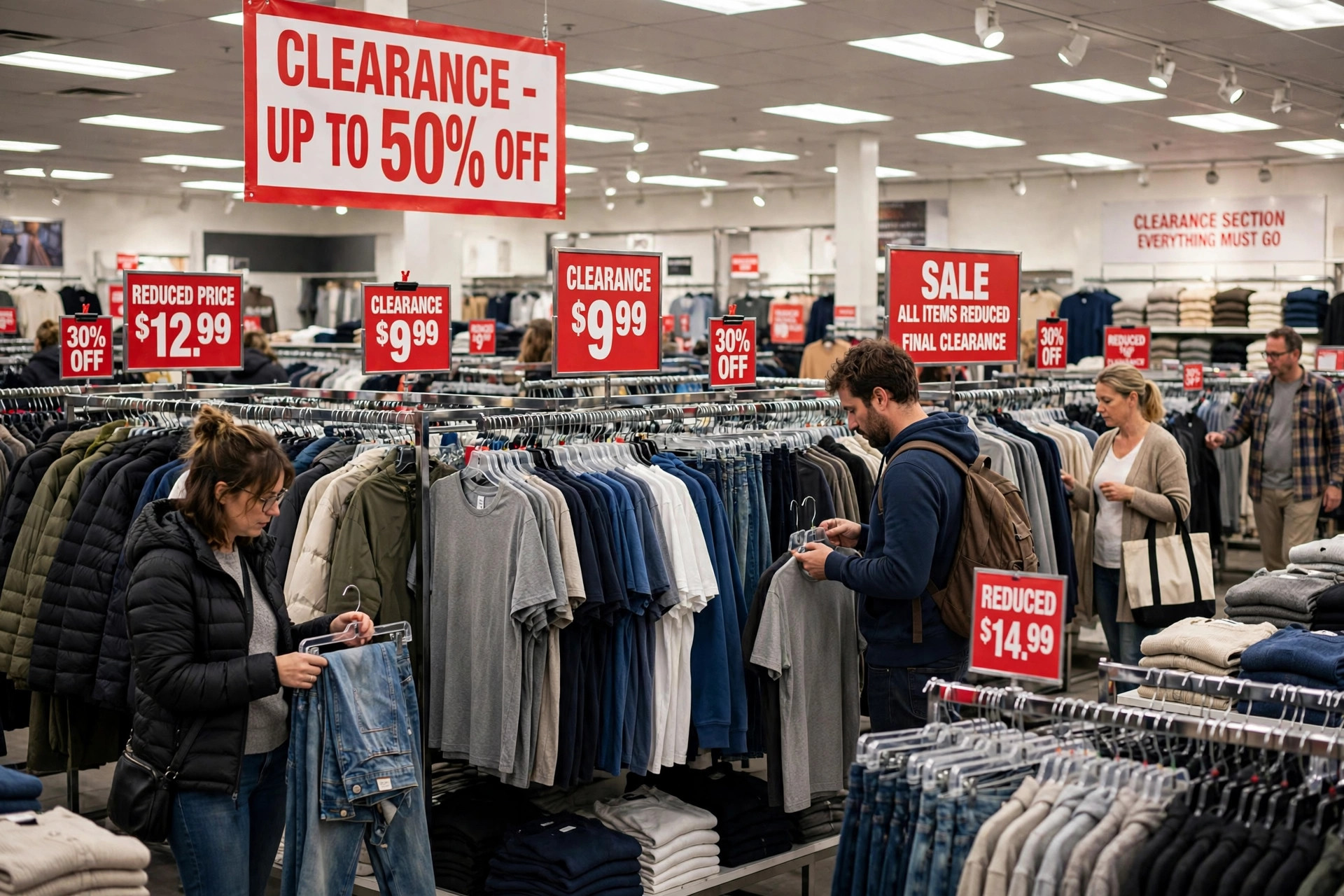
A markdown is a reduction in the retail price of merchandise, taken because the goods have not sold — or are not expected to sell — at their original price. Markdowns are a normal, budgeted part of apparel retail, not an admission of failure: seasons end, weather disappoints, and trends move. What separates profitable merchants from struggling ones is whether markdowns are planned in amount and timing, or taken late and in panic after the stock has already lost most of its recoverable value.
The Markdown Percentage Formula
Formula: markdown % = (original price − reduced price) ÷ original price × 100
Worked example: a jacket originally priced at $80 is reduced to $60. The reduction is $20, so markdown % = $20 ÷ $80 × 100 = 25% off. At department level the same logic applies to totals: if a category takes $50,000 of markdowns on goods with an original retail value of $400,000, the markdown rate for the period is 12.5% of original retail.
Note what the percentage is measured against: the original retail price, not the reduced price. Taking 25% off $80 gives $60, but restoring $60 to $80 would require a 33% increase — a common source of confusion in store conversations.
Planned Versus Unplanned Markdowns
Planned markdowns are built into the season's budget before it begins. Every merchant knows that some share of a seasonal buy will not sell at full price, so the buying plan reserves a markdown allowance — an expected percentage of sales — and prices and open-to-buy are set with that reality included.
Unplanned markdowns are the extra reductions forced by events: a style that misses, a warm winter that strands coats, a competitor's aggressive promotion, or damaged and soiled goods reduced to sell. They are the ones that damage margin, because they come on top of the allowance the plan already absorbed. Tracking the two separately is what makes a post-season review useful — a department can hit its total markdown budget while hiding a buying mistake inside it, or exceed budget for reasons, such as weather, that say little about the buyer's judgment. Either way, the figures feed the next season's plan and the sell-through targets used to judge new buys.
Markdown Cadence, Timing, and Margin
Timing is where markdown money is made or lost. The classic apparel cadence takes a moderate first reduction while the season still has selling weeks left — deep enough to change the customer's calculation, early enough that full assortments of sizes remain to sell. Waiting until the season is over forces far deeper cuts: a coat reduced 25% in January has a chance; the same coat at 60% off in March may still not cover its cost once handling is counted.
Retailers therefore schedule markdown cadence in advance — for example a first reduction at a set week for styles below a sell-through threshold, a second deeper step a few weeks later, and a final clearance point — and they apply it by style rather than by emotion. The effect on margin is direct: every markdown dollar comes out of gross margin unless it generates enough extra full-price selling elsewhere to compensate. That trade-off is why markdown planning sits inside the broader merchandising numbers rather than at the store's discretion alone; the Apparel Search merchandising metrics tool shows how markdown rate, margin, and turnover interact across a season.
Common Questions
- How do you calculate markdown percentage?
- Subtract the reduced price from the original price, divide the difference by the original price, and multiply by 100. A reduction from 80 dollars to 60 dollars is a 20 dollar reduction, which is 25 percent of the original price.
- Are markdowns always a sign of a bad buy?
- No. A planned share of markdowns is budgeted into every apparel season for clearance and promotions. The warning sign is unplanned markdowns above the allowance, which usually point to buying, pricing, or timing mistakes.
- When is the best time to take a first markdown?
- While the season still has selling time left and size ranges are reasonably intact. An earlier, moderate reduction usually recovers more than a deeper cut taken after the season, when demand for the category has largely passed.
- Do markdowns affect GMROI?
- Yes, directly. Markdowns reduce gross margin dollars, which is the numerator of GMROI, and slow clearance also raises average inventory, the denominator. Planned, timely markdowns protect GMROI better than late, deep ones.
Retail Math & Fashion Business Guides
This page is part of the Apparel Search retail math and fashion business series. Browse the full series below, or start from the apparel industry tools hub.