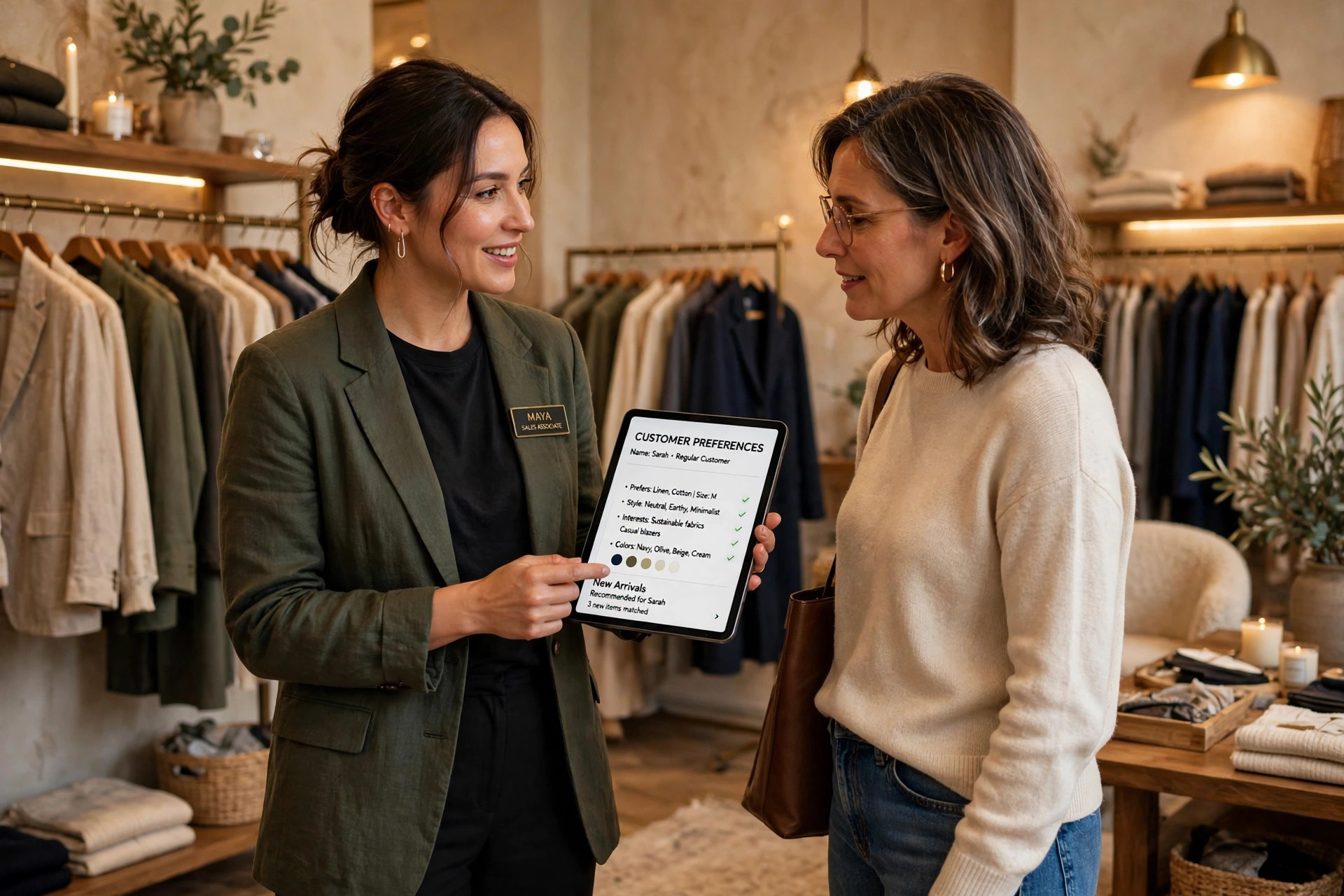
Clienteling is the practice of building and using individual customer knowledge in store selling: an associate who knows a client's sizes, preferred brands and colors, past purchases, and important dates can contact that client with genuinely relevant suggestions and serve them personally when they visit. Long practiced informally by good boutique staff with a notebook — the traditional client book — it is now supported by apps that put a customer's history in the associate's hand.
How Clienteling Works in Practice
The routine has three parts. First, capture: with the customer's agreement, the store records contact details, sizes, fit preferences, brand and color likes, and purchase history against a customer profile. Second, outreach: when new stock arrives that matches a client's profile — their size in a brand they collect, a restock of something they missed — the associate sends a personal message or call offering to put items aside. Third, the appointment and the visit: the client arrives to a rail already pulled in their sizes, with alternatives ready, rather than starting from a cold browse.
Done well, the contact feels like a service because it is specific: this jacket, in your size, in the color you bought last year, held until Saturday. Done badly — generic blasts wearing a first name — it is immediately recognized as marketing in disguise and ignored. The difference is the quality of the recorded preferences and the associate's judgment about when a message is truly warranted, a judgment the endless aisle supports by letting the associate source a client's size from the whole chain when the store has sold out.
Tools of the Trade
The classic tool is the client book, and its modern replacement is a clienteling app linked to the point-of-sale and customer database. Typical features include customer profiles with sizes and preferences, purchase history across stores and online, wish lists, task reminders for follow-ups and anniversaries, lookbooks the associate can send, and outreach through the customer's preferred channel with replies coming back to the associate rather than a call center.
Two governance points matter. Privacy and consent: customer data is collected for personal service, messages should follow the contact permissions the customer gave, and records must be handled under the retailer's data policies — a client list is company data, not the associate's personal property when they change employers. And measurement: clienteling is judged on repeat purchase rate, visit frequency, and average transaction among known clients, not on message volume, which only encourages spam.
How Clienteling Differs from Service and Marketing
General customer service is reactive and available to everyone: helping whoever is in the store, handling problems, answering questions. Marketing is one-to-many communication designed centrally — campaigns, emails, and advertising sent to segments. Clienteling sits between them: it is proactive like marketing but individual like service, carried out by a named associate who has a real relationship with that customer and is accountable for its quality.
That middle position is why it fits apparel particularly well. It pairs naturally with services such as BOPIS, where a known client's pickup can be ready with a suggested addition in their size, and with disciplined selling-floor presentation under a planogram, so the rail pulled for an appointment actually reflects the client's recorded taste. The retailers who sustain it treat it as a craft of the sales team, supported by tools — not as a software feature switched on and left alone.
Common Questions
- What is clienteling in retail?
- It is the practice of recording individual customer knowledge such as sizes, preferences, and purchase history, and using it for personal outreach and service, for example alerting a client when a matching new arrival can be held in their size.
- How is clienteling different from marketing?
- Marketing communicates one message to many customers from a central team. Clienteling is one-to-one communication from a named associate based on what is known about that specific customer, and it continues as personal service when the customer visits.
- What information goes into a client profile?
- Typically contact details and preferred channel, sizes and fit notes, favorite brands, colors and categories, purchase history, wish list items, and relevant dates. It should be collected with the customer's agreement and used only for the service they expect.
- What tools do associates use for clienteling?
- Modern clienteling apps connect customer profiles, purchase history, and outreach messaging to the point of sale. They replace the traditional paper client book while keeping the same purpose: helping the associate remember and act on customer preferences.
Retail Math & Fashion Business Guides
This page is part of the Apparel Search retail math and fashion business series. Browse the full series below, or start from the apparel industry tools hub.