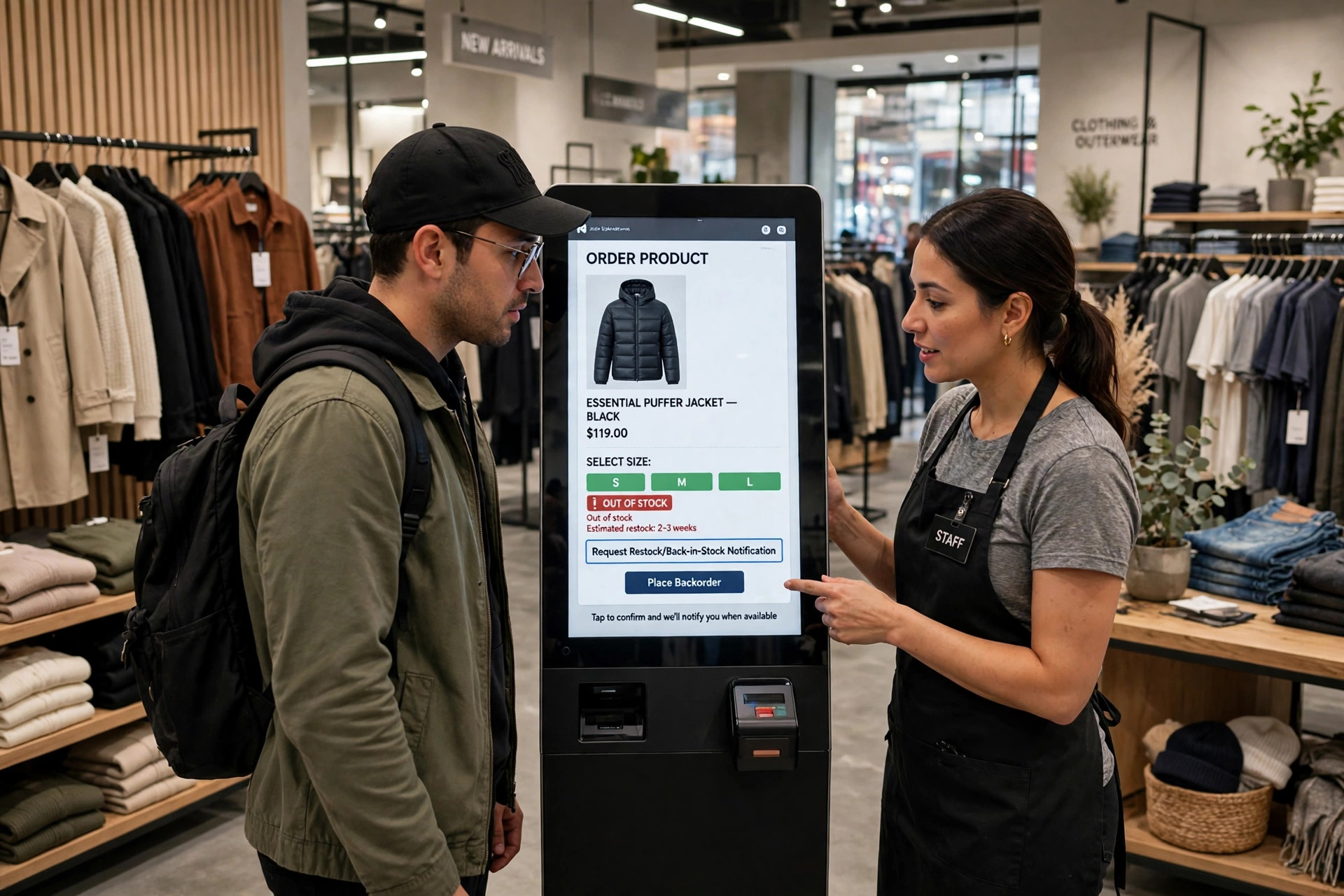
The endless aisle is the practice of letting a customer in a physical store order an item that is not in stock in that store — a sold-out size, an extra color, or a style the location does not carry — and have it shipped to their home or to the store for pickup. The store's effective assortment becomes the whole chain's and the warehouse's inventory, not just what fits on its own fixtures, which is why the concept is a foundation of omnichannel apparel retail rather than a novelty.
How the Endless Aisle Works
In practice, an associate or the customer uses a tablet, kiosk, or the store's own point-of-sale system to check live inventory across warehouses and other stores. If the wanted size or color exists anywhere in the network, it is ordered on the spot, paid for with the rest of the customer's purchases where possible, and shipped — often free as a service gesture — to the customer's home, or routed to the store for collection in the manner of BOPIS. The customer gets a confirmation and tracking, exactly as with an online order.
The crucial moment is the stock-out conversation. Without an endless aisle, a broken size run ends in an apology and a lost sale, and possibly a lost customer who assumes the chain never has their size. With one, staff are trained to check the network before saying no — a habit that has to be built into service routines and measured, because the technology sitting unused saves nothing.
Benefits for Retailers and Customers
For customers the benefit is simple: the trip was not wasted, and their size exists somewhere in the business even if their local store cannot stock every variant. For retailers, the benefits compound. Sales that would have been lost are captured. Stores can carry shallower depth in slow sizes and fringe colors without abandoning those customers, which improves inventory turnover and reduces end-of-season markdowns on odd sizes. And every endless-aisle order is data: repeated requests for an unstocked size or style are direct evidence for the next season's allocation and buying decisions.
There is also an assortment effect. Small stores gain access to the chain's full range, including online-only lines, so location size stops dictating what a customer can buy.
Requirements and Its Place in Omnichannel
An endless aisle stands or falls on inventory accuracy. The system must show stock the business actually has, in near real time; promising a size that the warehouse cannot find converts a saved sale into a cancelled order and a worse customer experience than the original stock-out. It also needs clean product data — sizes, colors, and images consistent between store and online systems — plus shipping terms, returns handling for ship-to-home store orders, and staff incentives that credit the store or associate for the sale so teams promote rather than avoid it.
Within an omnichannel strategy, the endless aisle is the in-store counterpart of services customers already know from the other direction: buy online and pick up in store, reserve online, and return online orders at a store counter. Together they treat inventory as one pool serving every channel. Retailers usually start with a simple version — associate-ordered shipping from the distribution center — and extend it to store-to-store fulfillment as their inventory systems mature. The technology is the smaller part of the project; accurate stock, trained staff, and fair sales credit are the larger parts.
Common Questions
- What is the endless aisle in retail?
- It is the ability for a customer in a physical store to order an out-of-stock size, color, or style from the wider chain or warehouse inventory and have it shipped home or to the store, instead of losing the sale.
- How is the endless aisle different from BOPIS?
- BOPIS starts online: the customer orders on the website and collects in store. The endless aisle starts in the store, when the item is not on that store's shelves, and the order is usually shipped to the customer.
- What does a store need to run an endless aisle?
- Accurate, near real-time inventory across locations, consistent product data, an ordering device or point-of-sale function, clear shipping and returns terms, and staff training and sales credit so associates actually use it.
- Does the endless aisle help with broken size runs?
- Yes. When a size has sold out locally, staff can check the network and ship that size to the customer. Repeated endless aisle requests for the same size also show buyers where the size ratio needs deepening.
Retail Math & Fashion Business Guides
This page is part of the Apparel Search retail math and fashion business series. Browse the full series below, or start from the apparel industry tools hub.