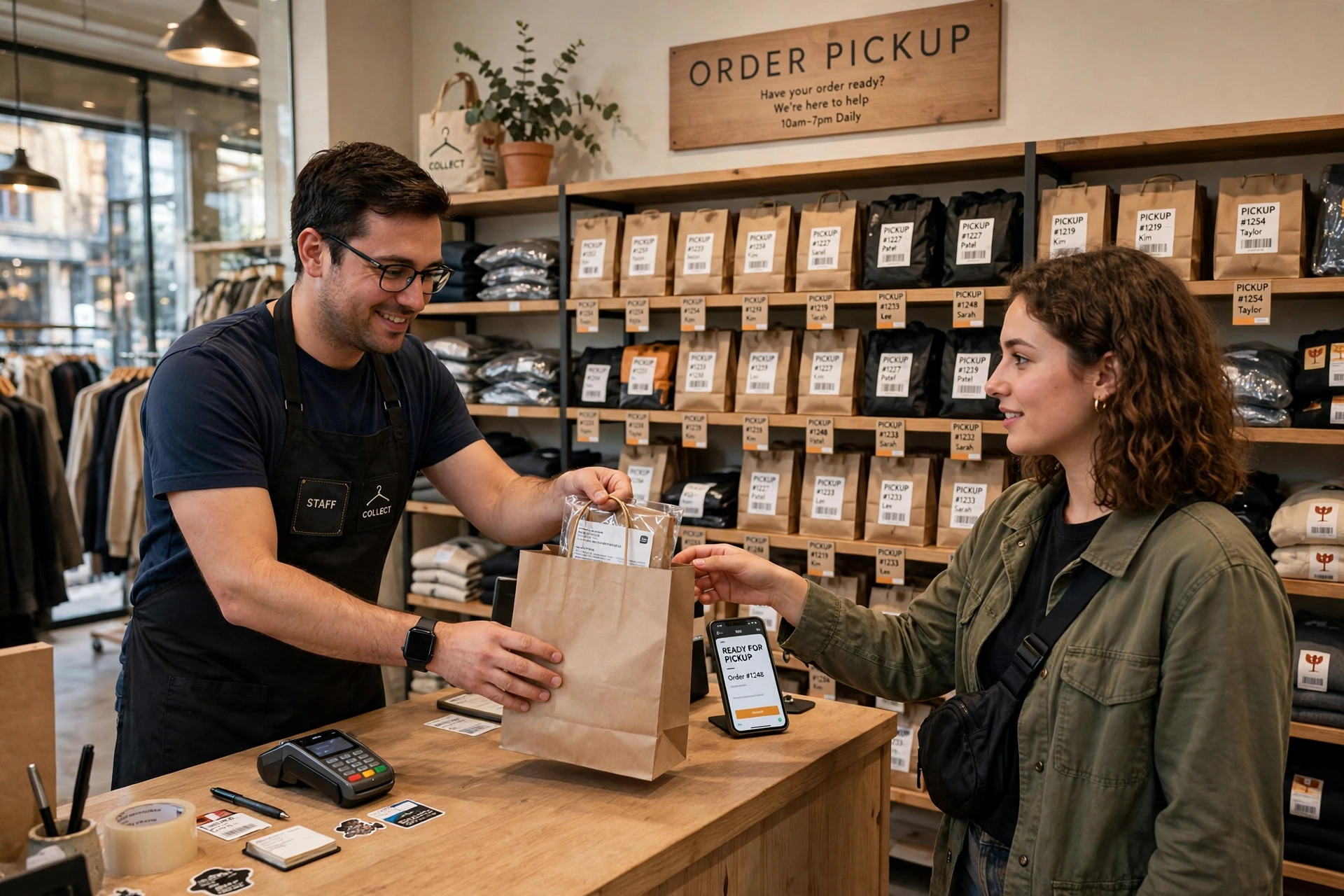
BOPIS — buy online, pick up in store — lets a customer order and pay on a retailer's website or app and collect the goods at a physical store, typically the same day. For apparel it has become a standard service rather than a differentiator: customers get the certainty of reserving their size without delivery fees or wait, and retailers get a store visit from a customer who has already decided to buy.
How BOPIS Works, Step by Step
The customer shops online, sees which nearby stores show the item in stock, pays, and receives a confirmation with an estimated pickup time. Behind the scenes the order drops into the store's task queue; an associate picks the item from the sales floor or stockroom, checks size and condition, bags it with the order details, and stages it in a designated pickup area. The customer is notified, arrives with identification or an order code, and collects the package — ideally in minutes at a clearly signed counter or service desk.
Variants sit around the core service. Curbside pickup brings the order out to the customer's car. Reserve online, pay in store holds the item without prepayment, at more risk to the retailer. Ship-to-store lets a customer collect an item the store never stocked, which overlaps with the endless aisle run in reverse. All of them depend on the same foundation: the stock the website promises must actually be in the store.
Operational Requirements
BOPIS is an operations program wearing a website feature's clothes. It needs inventory records accurate enough to promise from — the subject covered below — picking workflows that fit around serving floor customers, a secure and organized staging area sized to peak volume, and clear rules for how long orders are held and what happens to uncollected ones. Staffing has to match the promise: a one-hour pickup pledge made in a store with one associate at lunch is a complaint being scheduled.
Communication is the other half of the operation. Customers need a realistic ready time, a prompt notification, and honest messaging when an item cannot be found, with an easy alternative offered — shipment, another store, or a refund — before they travel.
Why Apparel Retailers Offer It — and Where It Fails
Apparel has specific reasons to like BOPIS. Fit uncertainty makes customers value reserving a size and trying on at pickup, with an easy exchange on the spot. Pickup visits generate additional purchases at a meaningful rate, because a customer already in the store, already in a buying frame of mind, often adds an item. And BOPIS turns store stock into a local fulfillment asset, competing with pure online delivery speeds without a courier network — while every cancelled or mis-picked order avoided protects the kind of margin discussed in the markdown and GMROI guides.
The common failure points are equally specific. Inventory inaccuracy is the largest: apparel counts drift through mis-scanned returns, fitting-room strays, theft recorded in shrinkage, and sizes rung up wrong, so the website promises what the shelf does not have. Slow picking at peak times, pickup queues behind regular checkout customers, and orders staged in untidy, insecure areas complete the usual list. Retailers that run BOPIS well treat inventory accuracy as a daily discipline, audit pickup times honestly, and design the collection point as part of the store experience rather than an afterthought by the door.
Common Questions
- What does BOPIS stand for?
- Buy online, pick up in store. The customer orders and pays through the website or app and collects the purchase at a chosen store, usually the same day, avoiding delivery charges and shipping waits.
- Why is inventory accuracy so important for BOPIS?
- The website promises items based on store stock records. If those records are wrong because of scanning errors, misplaced stock, or shrinkage, the customer travels for an item that is not there, which damages trust more than not offering the service.
- How long do stores hold BOPIS orders?
- Hold periods vary by retailer, commonly a few days. The order confirmation states the deadline; uncollected orders are returned to stock and refunded. Clear communication of the hold window reduces wasted trips and staging congestion.
- Does BOPIS increase store sales?
- Retailers commonly report that pickup customers often buy additional items during the visit, and apparel customers may try on and exchange at collection. The effect is strongest when the pickup point is convenient and staff suggest relevant additions naturally.
Retail Math & Fashion Business Guides
This page is part of the Apparel Search retail math and fashion business series. Browse the full series below, or start from the apparel industry tools hub.